


















Lesson 34 of 44 · Religion and Meaning
Chapter Review: Religion and Meaning
A recap of the arguments about God, the problem of evil and theories of meaning, with a comparison table and a nine-question chapter quiz.
This chapter covered some of the oldest arguments in philosophy. Here is the whole picture in one place, followed by a quiz that mixes the three lessons.
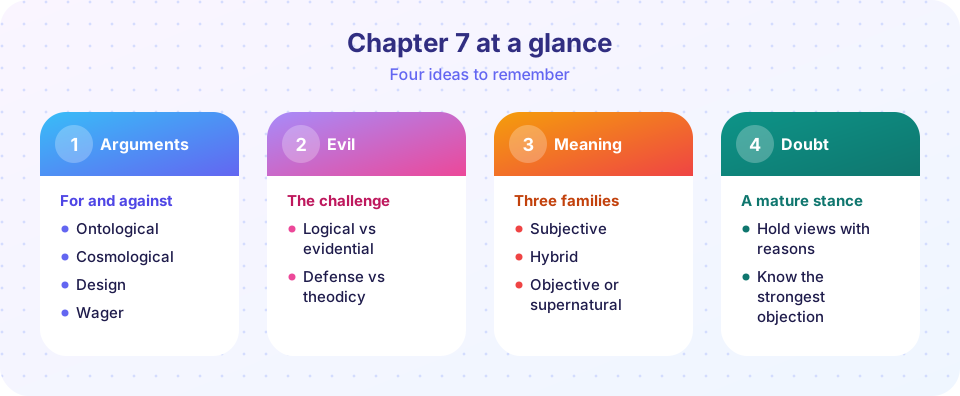
Recap table
| Argument or view | Core idea | Classic reply |
|---|---|---|
| Ontological (Anselm) | God's concept implies God's existence | Gaunilo's island; Kant: existence is not a predicate |
| Cosmological (Aquinas, Leibniz, kalam) | The universe needs a cause or explanation | Why not a brute fact? Why call the cause God? |
| Design (Paley, fine-tuning) | Order points to a designer | Hume, Darwin, anthropic selection, multiverse |
| Pascal's wager | Belief has the best expected payoff | Many gods; belief is not a choice |
| Logical problem of evil (Mackie) | God, goodness and evil are inconsistent | Plantinga's free will defense |
| Evidential problem (Rowe) | Pointless evil makes God unlikely | Skeptical theism; theodicies |
| Subjectivism | Meaning is what you care about | The grass-counter objection |
| Hybrid (Wolf) | Fitting fulfillment | Who decides what is worthwhile? |
| Absurdism (Camus) | Revolt against a silent universe | Is happiness in revolt enough? |
How to use these arguments
- Write each argument as numbered premises and a conclusion. If you cannot, you do not yet understand it.
- Test validity first, then each premise. The kalam argument is valid, and the debate is about soundness.
- Name the cost. Skeptical theism undermines moral knowledge; soul-making struggles with animal pain; subjectivism counts obsessions as meaningful.
- Hold views with reasons, and know the best objection to your own. That is the mark of a mature stance, whatever the conclusion.
Try writing a two-sentence summary of each lesson: one sentence for the argument, one for its strongest reply. If you can do that without notes, you are ready for the next chapter.
Try it
Press Run (or Ctrl + Enter) to see the console output here.
No output.
Chapter quiz
Quick check · 9 questions
of 9 answered You scored / 9 · perfect!
-
1. Anselm defined God as
This definition is the starting point of the ontological argument. -
2. Which reply used a perfect island as a parody?
Gaunilo argued the same form of reasoning would prove an absurd conclusion. -
3. What is Paley's design argument based on?
A watch implies a watchmaker; living things imply a designer. -
4. What makes an argument sound?
Validity concerns form; soundness adds true premises. -
5. Which premise in Mackie's argument do theists usually deny?
The bridge premise is the natural target. -
6. What did Rowe's fawn example illustrate?
He used it to argue that some evil seems gratuitous. -
7. Which theory of meaning requires both being engaged and the object being worthwhile?
Fitting fulfillment needs subjective attraction meeting objective attractiveness. -
8. In Camus's view, how should we respond to the absurd?
He rejects both escape and the leap. -
9. What does 'steel-manning' help you do?
It is a habit of fair and useful argument.
Summary
- Arguments about God come in four families, each with classic replies; evaluate validity then soundness.
- The logical problem of evil is widely thought answered by the free will defense; the evidential problem remains debated.
- Theories of meaning vary on how much depends on you; Wolf's hybrid and Camus's revolt are two influential views.
- Mature thinking means knowing the best objection to your own view.
Track your progress
Create a free account to tick off lessons and pick up where you left off on any device.
of Introduction to Philosophy lessons completed