


















Lesson 25 of 44 · Free Will and Personal Identity
Chapter overview: Free Will and Personal Identity
A map of two big questions about being a person: could you have done otherwise, and what makes you the same person over time? Includes a chapter slideshow.
Two ordinary assumptions run through your daily life. You assume that you choose what you do, so that you can be praised or blamed for it. And you assume that the person who woke up this morning is the same person who went to sleep last night, and the same one who sat in a classroom years ago. Both assumptions turn out to be much harder to defend than they look. This chapter takes each one seriously.
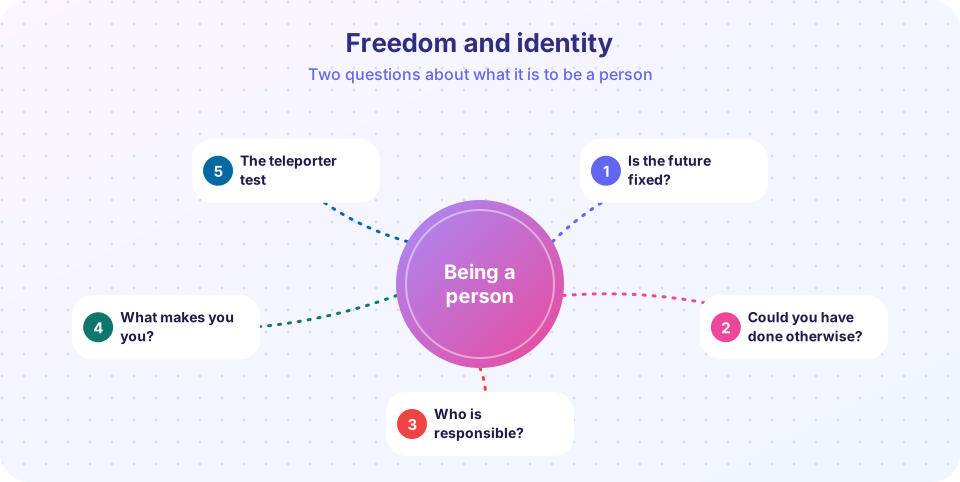
What you will learn
- What the free will problem is and which four answers philosophers give.
- Why the question matters for blame, praise and punishment.
- What the problem of personal identity is, and how thought experiments test theories of it.
- How the two topics connect: you can only be responsible for what you did.
Key terms
- Determinism: the thesis that the state of the world at one time, together with the laws of nature, fixes everything that happens later.
Free will: the capacity to choose and act in a way that makes you responsible; what exactly that requires is disputed.
Moral responsibility: being a fitting target for praise or blame.
Personal identity: what makes a person at one time the same person as someone at another time.
Overview slides
Two big questions
The problem of free will
Lesson 2
Four answers
Responsibility
Lesson 3
Identity over time
Lesson 4
Why these two topics belong together
Imagine a crime. To punish someone, we need two things to be true. First, they chose it in a sense that makes blame fair (free will and responsibility). Second, the person in the dock is the same person who did it (personal identity). If either fails, the practice of punishment, and of promising, thanking and apologizing, loses its foundation. Philosophers call the whole set of these practices moral responsibility, and they ask what must be true of us for it to be justified.
When you read about these problems, keep a simple question in view: "What would have to be different about the facts for ordinary praise and blame to be unfair?" Different theories give different answers, and the differences are where the arguments live.
What each lesson covers
| Lesson | Question | Key names |
|---|---|---|
| Free will and determinism | Are our choices fixed by the past? | Laplace, van Inwagen, Libet |
| Compatibilism and responsibility | Can we be free and responsible if determinism is true? | Hume, Frankfurt, P. F. Strawson, Dennett |
| Personal identity | What makes you the same person over time? | Locke, Reid, Parfit, Hume |
| Chapter review | Putting the views side by side | all of the above |
Try it
Press Run (or Ctrl + Enter) to see the console output here.
No output.
Check your understanding
Quick check · 4 questions
of 4 answered You scored / 4 · perfect!
-
1. What does determinism claim?
Determinism is a thesis about laws and states of the world, not about thinking. -
2. Why do free will and personal identity belong in one chapter?
To hold someone responsible they must have acted freely and be the same person as the agent. -
3. Which term names fair praise or blame?
Moral responsibility is the status that makes praise and blame fitting. -
4. What is personal identity about?
It is a metaphysical question about persistence over time.
Summary
- Free will and personal identity underlie our practices of responsibility.
- The free will debate has four main positions: compatibilism, hard determinism, libertarianism and luck skepticism.
- Personal identity theories (body, soul, memory, bundle) are tested with thought experiments.
- The next lessons treat each in turn.
Track your progress
Create a free account to tick off lessons and pick up where you left off on any device.
of Introduction to Philosophy lessons completed