


















Lesson 28 of 44 · Free Will and Personal Identity
Personal Identity: What Makes You the Same Person?
Body, soul, memory and bundle theories of the self, tested with the Ship of Theseus, Reid's brave officer and Parfit's teletransporter.
Almost every cell in your body has been replaced since you were a small child. Your tastes, beliefs and memories have changed too. Yet you say, without hesitation, "I was a child once". What exactly makes the child and the adult one person? The problem of personal identity asks what it takes for a person at one time to be the same person as someone at another time. It sounds like a puzzle for the seminar room, but it decides real questions: whether you survive a dramatic brain injury, whether a person with advanced dementia is "the same person", and whether it would be you who steps out of a teleporter.
What you will learn
- The difference between numerical identity and qualitative similarity.
- Four theories: body, soul, psychological continuity (Locke, Parfit) and bundle.
- Reid's objection to Locke and how Parfit's version answers it.
- What the teleporter and fission cases suggest about "what matters".
Key terms
- Numerical identity: being one and the same thing (not two things that are alike).
Qualitative identity: being exactly similar (two coins from one mint).
Psychological continuity: a chain of overlapping memories, intentions, beliefs and character traits.
Psychological connectedness: the direct links between two times, such as remembering an experience.
Fission: one person splitting into two, each with the original's psychology.
Warm-up: the Ship of Theseus
Plutarch told of a ship preserved by the Athenians; as planks rotted they were replaced, until none of the original wood remained. Is it the same ship? Thomas Hobbes added a twist: suppose someone collects the discarded planks and rebuilds the ship. Now which is the original? The puzzle shows that identity over time can depend on matter, on form and function, or on continuous history, and these can come apart. Persons, too, change their parts.
Four theories
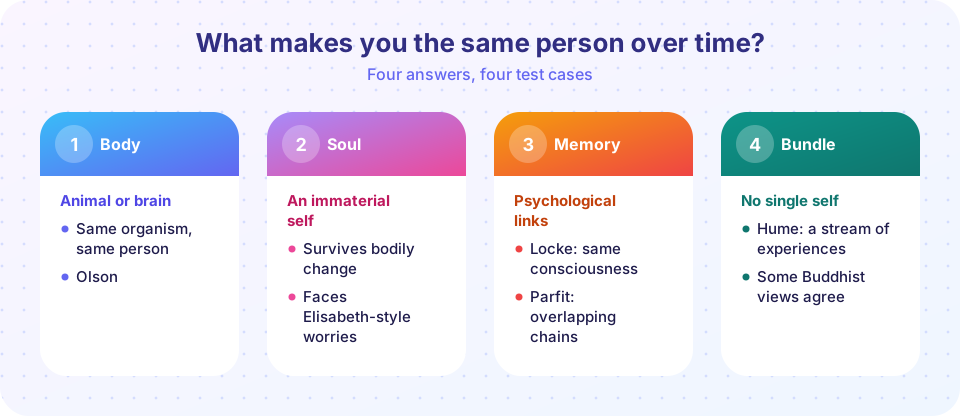
1. Body or animal. You are the same person as long as you are the same living organism, or perhaps the same brain. Eric Olson's animalism says that we are human animals. This explains why we are the same through childhood and old age, and why we existed as fetuses. But it has odd results in brain-transplant cases: if your brain is moved into another body, most people feel that you go with the brain.
2. Soul. You are an immaterial thing that persists whatever happens to the body. This fits many religious views and seems to give a clean answer. But we cannot observe souls; we could not tell by looking whether two bodies have the same soul; and it inherits the interaction problems from the dualism lesson.
3. Psychological continuity. John Locke (An Essay Concerning Human Understanding, 1690) argued that a person is a thinking being that can consider itself the same across time, and identity extends as far as consciousness, in particular memory, extends. His example imagines a prince's consciousness entering the body of a cobbler: the resulting person is the prince, he thought, though the body is that of the cobbler. This explains why memory matters, and fits brain-transplant cases.
4. Bundle theory. David Hume (A Treatise of Human Nature, 1739) looked inward and found no single self, only a stream of perceptions and feelings: "a bundle or collection of different perceptions". The sense of a single self is a fiction produced by memory and association. Some Buddhist traditions teach a related "no-self" doctrine, though the details differ.
Reid's brave officer
Thomas Reid objected to Locke that memory cannot be the whole story, because identity is transitive: if A is B and B is C, then A is C. A boy is flogged for stealing apples. Later, as an officer, he remembers the flogging. Later still, as a general, he remembers taking a standard in battle, but no longer remembers the flogging. By Locke's test, the general is the officer, and the officer is the boy, yet the general is not the boy, because he cannot remember it. This contradicts transitivity.
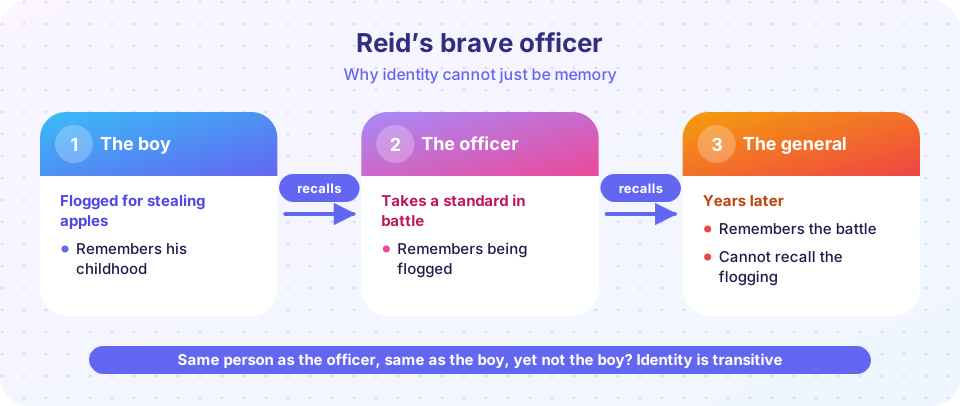
Joseph Butler raised a related problem: memory presupposes identity (you can only truly remember your own experiences), so using memory to define identity is circular.
Parfit and the chain
Derek Parfit (Reasons and Persons, 1984) developed a refined version. Distinguish connectedness (direct links between two times, such as a memory) from continuity (overlapping chains of strong connectedness). The general is continuous with the boy through the officer, even if not directly connected. This answers Reid's transitivity worry. To avoid circularity, Parfit proposed "quasi-memory", a memory-like state with the right causal origin, whether or not the rememberer is the original experiencer.
The teleporter and fission
Parfit's most provocative thought experiments challenge what we care about. In the teletransporter, a machine scans you, destroys your body, and sends the information to Mars, where a replica is built, with your memories and character. Have you traveled or died? If psychological continuity is what counts, you have survived. But suppose the machine fails to destroy the original: now there are two beings with equal claim. This is fission: both are continuous with you, but they are not identical to each other, so they cannot both be you. Parfit's startling conclusion was that identity is not what matters: what matters is psychological continuity and connectedness, which can hold in degrees and can branch.
Critics reply that a copy, however perfect, is another person, so the teleporter is a death machine. Others say that the intuitions in such science-fiction cases are not reliable guides, since our concepts evolved for cases without copying.
Common misconceptions. (1) "Identity theories are about who you feel you are." They concern persistence, not self-esteem. (2) "Parfit says you do not exist." He says the self is not an extra deep fact beyond the physical and psychological facts. (3) "Philosophers have settled it." There is no consensus; the positions on this page all have defenders.
Try it
Press Run (or Ctrl + Enter) to see the result here.
Program input · what you'd type while the program runs
Type the answers before you press Run, one per line. Each time the program reads a line (with input()), it gets the next line from this box.
Check your understanding
Quick check · 5 questions
of 5 answered You scored / 5 · perfect!
-
1. What is the difference between numerical and qualitative identity?
Two identical coins are qualitatively identical but numerically two. -
2. What was Reid's objection to Locke's memory theory?
The general remembers the officer, the officer remembers the boy, but the general does not remember the boy. -
3. How does Parfit answer the transitivity worry?
The general is continuous with the boy through the officer. -
4. What does Hume's bundle theory claim?
Hume claimed that introspection reveals only particular perceptions. -
5. What is Parfit's controversial conclusion from the teleporter and fission cases?
Fission shows identity cannot always be preserved, yet we might still care about what continues.
Summary
- Personal identity asks what makes a person at one time the same as a person at another.
- Four families of answer: body, soul, psychological continuity, bundle.
- Reid's brave officer shows direct memory is not transitive; Parfit's chains of overlapping links fix this.
- Teleporter and fission cases suggest that what matters may not be strict identity.
- There is no consensus; each view has counterexamples.
Track your progress
Create a free account to tick off lessons and pick up where you left off on any device.
of Introduction to Philosophy lessons completed