


















Lesson 35 of 44 · Political and Social Philosophy
Chapter overview: Political and Social Philosophy
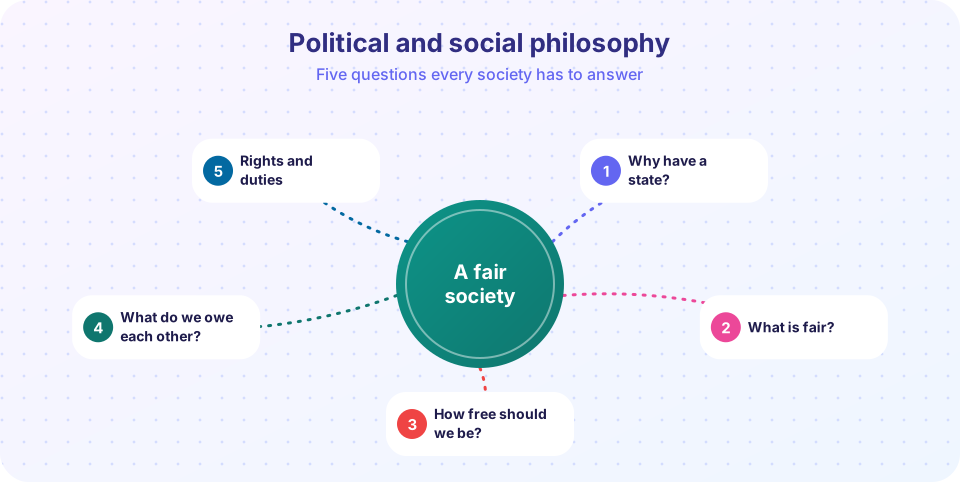
A map of the big questions about the state, justice, liberty and rights: why we obey, what is fair, and how free we should be.
Every society makes rules, collects taxes, punishes some acts and protects others. Political philosophy asks whether and why those arrangements are justified. Why should anyone obey the state? What would a fair distribution of money, jobs and opportunities look like? How much should the law interfere with how you live? These are questions about reasons, and they are different from the questions of political science (how institutions actually work) and of party politics (who should win).
What you will learn
- The central questions of political philosophy and how they differ from party politics.
- The social contract tradition, theories of justice, and the debate about liberty and rights.
- How to compare theories fairly, by their principles and their costs.
Key terms
- Legitimacy: the right of a state to rule, and the moral duty (if any) to obey it.
Social contract: an imagined agreement that is supposed to justify political authority.
Distributive justice: what counts as a fair distribution of goods in a society.
Liberty: freedom, whether from interference or to achieve your aims.
Rights: claims that others (including the state) have duties to respect.
Chapter slides
Why have a state?
Lesson 2
What is fair?
Lesson 3
How free should we be?
Lesson 4
Comparing theories
A fair way to study political ideas
Political ideas arouse strong feelings, so a few ground rules help.
- Describe before you judge. Be able to state each theory in a way its supporters would accept.
- Separate values from facts. Disagreements about justice often hide disagreements about facts (for example, what taxes do to incentives). Philosophy sorts out the value part; social science helps with the facts.
- Look at the whole tradition. The thinkers in this chapter come from very different times, and none of them has the last word. Their arguments are tools for your own thinking.
This is not a lesson in what to vote for. Philosophers who share the same basic principles often disagree about policies, and philosophers with very different principles sometimes agree.
What each lesson covers
| Lesson | Question | Key names |
|---|---|---|
| The social contract | Why should anyone obey the state? | Hobbes, Locke, Rousseau |
| Justice and fairness | What is a fair distribution? | Rawls, Nozick, Sen |
| Liberty and rights | How much freedom, and what rights? | Berlin, Mill |
| Chapter review | Putting the theories side by side | all of the above |
Try it
Press Run (or Ctrl + Enter) to see the console output here.
No output.
Check your understanding
Quick check · 4 questions
of 4 answered You scored / 4 · perfect!
-
1. What is political legitimacy?
Legitimacy is about justified authority, not popularity. -
2. How does political philosophy differ from party politics?
Philosophers evaluate arguments for principles. -
3. What is distributive justice about?
It concerns who gets what, and why. -
4. Why separate values from facts in political arguments?
Sorting the two makes debate clearer.
Summary
- Political philosophy asks what justifies the state, what is fair, and how free we should be.
- Main tools: the social contract, theories of justice, concepts of liberty and rights.
- Study theories by their principles and their costs, without telling you how to vote.
Next: The social contract
Track your progress
Create a free account to tick off lessons and pick up where you left off on any device.
of Introduction to Philosophy lessons completed