


















Lesson 18 of 44 · Knowledge and Skepticism
Skepticism: Descartes, Dreams and the Brain in a Vat
Follow Descartes' method of doubt from the senses to the evil demon to the cogito, meet the brain-in-a-vat argument, and weigh the best replies to skepticism.
Suppose you wanted to build knowledge on a foundation that could not crack. One sensible plan is to test every belief by trying to doubt it, and to keep only what survives. In 1641 the French philosopher René Descartes did exactly this in his Meditations on First Philosophy. His method of systematic doubt produced the most famous sentence in philosophy ("I think, therefore I am"), and a series of arguments that skeptics have used ever since.
This lesson follows Descartes' stairs of doubt, shows how modern versions (the brain in a vat, the simulation) update them, and compares the best replies. The goal is not to make you doubt everything, but to see exactly what kind of argument is being made and what it takes to answer it.
What you will learn
- The ancient background to skepticism.
- Each step of Descartes' doubt and the cogito.
- The brain-in-a-vat argument and the closure form of the skeptical argument.
- Replies: Moore, Putnam, contextualism, Hume's moderation and inference to the best explanation.
Key terms
- Method of doubt: treating any belief that can be doubted as if it were false, to find what is certain.
- Cogito: Descartes' "I think, therefore I am".
- Skeptical hypothesis: a scenario (dream, demon, vat) that fits all your evidence but makes your beliefs false.
- Closure: if you know p and you know that p implies q, then you are in a position to know q.
- Foundationalism: the view that knowledge rests on basic, secure beliefs.
Ancient skeptics
Skepticism did not start with Descartes. The Greek thinker Pyrrho of Elis (about 360 to 270 BCE) is the namesake of Pyrrhonian skepticism: for any argument, one can find an equally strong opposing argument, so the wise response is to suspend judgment, which, Pyrrhonians claimed, brings peace of mind. Their writings survive mainly through the physician Sextus Empiricus (around 200 CE). A rival school, the Academic skeptics, argued that certainty is unattainable but that we can follow what seems probable. Chapter 2 mentioned a Chinese cousin: Zhuangzi's story of dreaming he was a butterfly and then wondering whether he is a butterfly dreaming that it is Zhuangzi.
Descartes' doubt
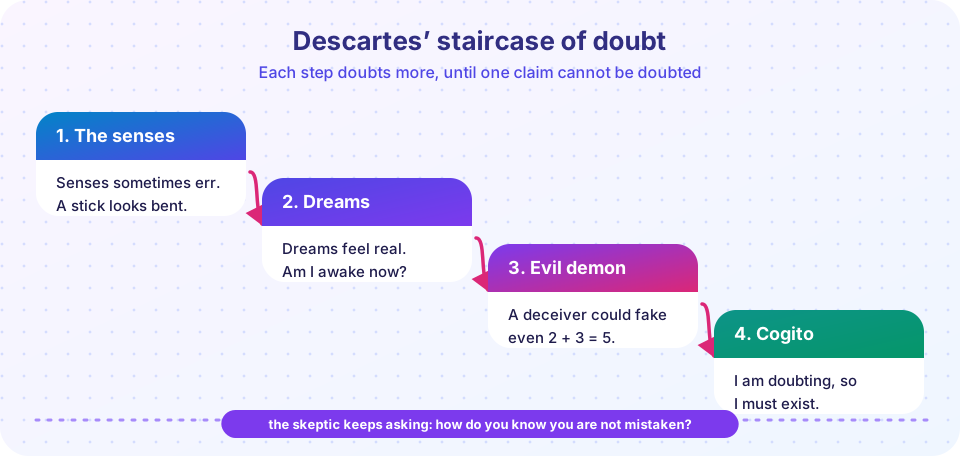
Descartes (1596 to 1650) wanted knowledge that could withstand any doubt, so he decided to reject anything doubtful. He proceeded in stages.
- The senses sometimes deceive. A tower looks round from far away and square up close; a straight stick looks bent in water. If the senses have fooled us, should we trust them? But Descartes admitted that some perceptions, such as that I am sitting here by the fire, seem too obvious to doubt.
- The dream argument. He recalled dreams that felt as real as waking life. There are no certain marks that distinguish them, so perhaps I am dreaming now. Yet even in dreams, 2 + 3 still make 5 and a square still has four sides, so mathematics survives.
- The evil demon. He then imagined a powerful deceiver who arranges all my experiences and even makes me err when I add 2 and 3. If such a being is possible, even mathematics is in doubt.
- The cogito. But even a demon cannot deceive me unless I exist. "I think, therefore I am" (cogito, ergo sum) was, Descartes said, the first certainty: whenever I am thinking, I exist.
From this fixed point he tried to rebuild knowledge: he argued that God exists, is not a deceiver and so guarantees that what I perceive "clearly and distinctly" is true. Critics from his own time, such as Antoine Arnauld, pointed to the Cartesian circle: he seems to use clear and distinct perception to prove God, then God to guarantee clear and distinct perception. Whether this is fair is still debated. Many readers think the lasting value of the Meditations lies in the doubt, not the rebuilding.
Modern versions
The brain in a vat
In 1981 Hilary Putnam described a version of the demon story for the scientific age: suppose your brain has been removed and placed in a vat of nutrients, with wires connecting it to a computer that supplies exactly the experiences you would normally have. From the inside, nothing would seem different. The films The Matrix (1999) and Philip K. Dick's novels popularized similar scenarios, and the philosopher Nick Bostrom (2003) argued that if advanced civilizations run many simulations, we might be in one. These are all skeptical hypotheses: possibilities that fit all our evidence but would make most of our beliefs false.
The closure argument
Contemporary epistemologists sharpen the skeptic's argument into something like:
- If I know that I have hands, then I know that I am not a brain in a vat (since I know that having hands implies I am not one).
- I do not know that I am not a brain in a vat (nothing in my experience could tell).
- Therefore, I do not know that I have hands.
This is a valid argument (modus tollens, from chapter 3). Notice what you must do to resist it: deny premise 1, deny premise 2, or accept the conclusion. Each option has defenders.
Replies to skepticism
- Moore's common-sense reply. G. E. Moore (1939) held up his hands and said "here is one hand", arguing that he is more certain of that than of any philosophical premise that implies it is false. If the skeptic's premises contradict something so certain, he said, the premises are the thing to reject. Critics reply that this begs the question against the skeptic.
- Semantic externalism. Putnam argued that a brain in a vat could not even think "I am a brain in a vat" meaningfully, because its words would not refer to real vats. If so, the hypothesis defeats itself. Whether the argument works is controversial.
- Contextualism. In ordinary talk, "know" requires only that you rule out relevant alternatives. In a philosophy seminar the standards rise and the vat becomes relevant. So "I know I have hands" is true in everyday contexts and false when the skeptic raises the stakes (Keith DeRose, David Lewis).
- Best explanation. The hypothesis that there is a real world is simpler and explains our experiences better than a vat story that needs extra machinery. This is abduction (lesson 3 of chapter 3). The skeptic can answer that this assumes the very reliability of reasoning in question.
- Denying closure. Fred Dretske and Robert Nozick suggested you can know you have hands without knowing you are not a brain in a vat. Most philosophers find this odd: it seems to say that "I have hands, but I don't know I'm not handless" is fine.
- Mitigated skepticism and pragmatism. Hume agreed that reason cannot refute radical skepticism but said nature (habit, practical life) does not let us stay skeptical for long. Wittgenstein's last notes, On Certainty (published 1969), suggested that some "hinge" beliefs, like the existence of the external world, are not themselves doubted or justified but are the framework that makes doubting and justifying possible.
Whichever reply you favor, state it in standard form and check which premise it denies. That makes it easier to compare replies and see what each costs.
Common misconceptions
"Descartes believed he was a brain in a vat or dreaming." He used doubt as a method, to find certainty, and did not claim to believe the doubts.
"The cogito proves that I have a body." The cogito establishes only that a thinker exists. Descartes needed further arguments for bodies, and critics doubt that he succeeded.
"Skepticism means being cynical." Philosophical skepticism is about the limits of knowledge, not an attitude of contempt.
"If you cannot disprove the vat hypothesis, you should believe it." Being unable to rule out a possibility is not evidence for it.
Try it
Press Run (or Ctrl + Enter) to see the result here.
Program input · what you'd type while the program runs
Type the answers before you press Run, one per line. Each time the program reads a line (with input()), it gets the next line from this box.
Check your understanding
Quick check · 6 questions
of 6 answered You scored / 6 · perfect!
-
1. What was the purpose of Descartes' method of doubt?
He used doubt as a tool to find certainty, not as a final position. -
2. The cogito is
Cogito, ergo sum: even if deceived, I must exist as a thinker. -
3. Which is a skeptical hypothesis?
A skeptical hypothesis fits all my evidence while making most of my beliefs false. -
4. Moore's reply to skepticism
Moore argued that it is more reasonable to reject the skeptic's premises than to doubt something as obvious as his own hand. -
5. Contextualism claims that
On this view, the skeptic raises the standards, which makes 'I know' false in that context but not in ordinary life. -
6. Why does the Bayesian demonstration show that evidence cannot tell the real world from the vat?
If both hypotheses predict the same experiences, observing them favors neither.
Summary
- Ancient skeptics (Pyrrho, Sextus Empiricus, the Academics) urged suspension of judgment.
- Descartes doubted the senses, then dreams, then imagined an evil demon, and found certainty in the cogito.
- Modern versions: the brain in a vat and the closure argument.
- Replies: Moore's common sense, Putnam's semantic argument, contextualism, best explanation, denying closure, and Hume's or Wittgenstein's moderation.
- Skeptical arguments are valuable because they force us to say exactly why we trust our evidence.
Next: Chapter 4 Review
Track your progress
Create a free account to tick off lessons and pick up where you left off on any device.
of Introduction to Philosophy lessons completed