


















Lesson 11 of 44 · Logic and Argument
Arguments, Validity and Soundness
Learn what makes an argument valid or sound, how to test validity with counterexamples and truth tables, and the key forms: modus ponens, modus tollens and invalid look-alikes.
In the last lesson you learned that an argument offers premises in support of a conclusion. Now comes the central question of logic: when do the premises really support the conclusion? Two different ideas answer it. Validity asks whether the conclusion follows. Soundness asks whether, besides following, the premises are true.
These two words are used in a strict sense in logic, and mixing them up is the most common mistake in an introductory course. Everyday speakers say "that's a valid point" to mean "reasonable". In logic, only arguments are valid or invalid; sentences are true or false.
What you will learn
- The precise definition of validity, and why truth is a different matter.
- How soundness combines validity with true premises.
- How to test validity with a counterexample or a truth table.
- Four common argument forms, two valid and two invalid.
Key terms
- Valid: it is impossible for all the premises to be true and the conclusion false.
- Sound: valid, and all the premises are in fact true.
- Argument form: the pattern of an argument when its content is replaced by letters.
- Counterexample: a case with the same form, true premises and a false conclusion.
- Conditional: an "if... then" statement; the "if" part is the antecedent and the "then" part the consequent.
Validity: the conclusion must follow
An argument is valid when it is impossible for all the premises to be true while the conclusion is false. Validity concerns only the link between premises and conclusion. It does not care whether anyone believes the premises.
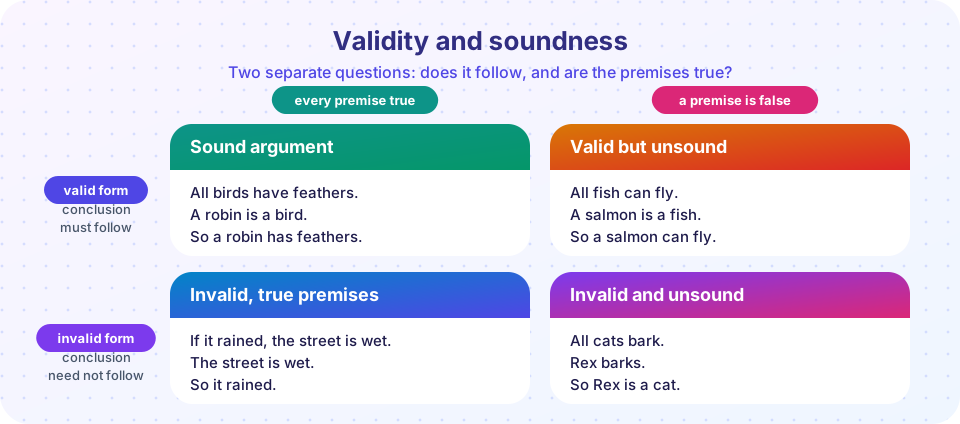
Look at the two top cards of the grid above. In "All fish can fly; a salmon is a fish; so a salmon can fly" the first premise is false, yet the argument is valid: if the premises were true, the conclusion would have to be. A valid argument can have false premises, and even a false conclusion, as here. What a valid argument cannot have is all true premises and a false conclusion.
Conversely, an invalid argument can have true premises and a true conclusion. "Paris is in France; Berlin is in Germany; so water boils at 100 degrees Celsius at sea level" contains only truths, but the premises give no reason for the conclusion.
Soundness: valid plus true
An argument is sound if it is valid and all its premises are true. A sound argument guarantees a true conclusion. That is the gold standard of deductive reasoning, and why philosophical arguments spend so much effort defending their premises.
A useful checklist for evaluating an argument:
- Write it in standard form.
- Ask: if the premises were true, would the conclusion have to be true? (Validity.)
- If not valid, look for a counterexample.
- If valid, ask: are the premises actually true? (Soundness.)
- Reject or doubt the argument at the weakest premise.
Testing validity
The counterexample method
To show an argument form is invalid, build another argument with the same form, obviously true premises and an obviously false conclusion. For example:
If it is a dog, then it is an animal.
It is an animal.
So it is a dog.
The form is "If P then Q; Q; therefore P". Take P = "it is a dog" and Q = "it is an animal". Pick a cat: both premises are true and the conclusion is false. So the form is invalid.
Truth tables
For arguments built from "and", "or", "not" and "if... then", you can check every possible combination of true and false for the letters. If there is a row where every premise is true and the conclusion is false, the argument is invalid. The Python demonstration below does this for you.
Four forms you should know
| Form | Pattern | Valid? |
|---|---|---|
| Modus ponens ("affirming the antecedent") | If P then Q. P. So Q. | Valid |
| Modus tollens ("denying the consequent") | If P then Q. Not Q. So not P. | Valid |
| Affirming the consequent | If P then Q. Q. So P. | Invalid |
| Denying the antecedent | If P then Q. Not P. So not Q. | Invalid |
Two more valid forms: hypothetical syllogism (If P then Q. If Q then R. So if P then R) and disjunctive syllogism (Either P or Q. Not P. So Q).
Why is affirming the consequent so tempting? Because "if it rained, the street is wet" sounds like "the street is wet only if it rained". But the original conditional never says rain is the only way the street gets wet: a street cleaner, a burst pipe or a hose will do.
Categorical syllogisms
Aristotle's syllogisms talk about kinds of things. The standard example (nicknamed Barbara in the medieval mnemonic):
All M are P.
All S are M.
So all S are P.
with M = humans, P = mortal and S = Greeks. This is valid. Compare it with the invalid "All M are P; All S are P; so all S are M": All dogs are mammals, all cats are mammals, so all cats are dogs.
Strong and weak: a glance ahead
Some arguments make the conclusion probable rather than certain. We call them strong or weak instead of valid or invalid. Lesson 3 covers this. For now, remember that validity is all-or-nothing: an argument is either valid or it is not.
Common misconceptions
"A valid argument has true premises." No. Validity is about form. Only soundness requires true premises.
"If the conclusion is true, the argument is valid." No. An argument can have a true conclusion for bad reasons, as in the Paris and Berlin example.
"An argument with false premises is worthless." It is unsound, so it does not establish its conclusion. But it can still be a useful test: if you accept the conditional "if the premises were true then the conclusion", you learn what you would need to deny.
"'Valid point' means the same in logic." In logic, validity belongs to arguments, not to points or claims.
Try it
Press Run (or Ctrl + Enter) to see the result here.
Program input · what you'd type while the program runs
Type the answers before you press Run, one per line. Each time the program reads a line (with input()), it gets the next line from this box.
Check your understanding
Quick check · 5 questions
of 5 answered You scored / 5 · perfect!
-
1. An argument is valid when
Validity is about the guarantee linking premises to conclusion, not about whether they are true. -
2. Which description fits a sound argument?
Soundness = validity + true premises, which guarantees a true conclusion. -
3. 'If it is a dog, it is an animal. It is an animal. So it is a dog.' This is
A cat is a counterexample: both premises are true and the conclusion is false. -
4. 'If P then Q. Not Q. So not P.' is called
If P guarantees Q and Q is absent, P cannot be the case. -
5. Can a valid argument have a false conclusion?
Validity rules out true premises with a false conclusion. With a false premise, a valid argument may have a false conclusion.
Summary
- Valid means the premises cannot all be true while the conclusion is false; it concerns form only.
- Sound means valid with all premises true; a sound argument has a true conclusion.
- Test validity with a counterexample or truth table.
- Modus ponens and modus tollens are valid; affirming the consequent and denying the antecedent are invalid.
- Evaluate arguments in order: standard form, validity, then truth of the premises.
Next: Deduction and Induction
Track your progress
Create a free account to tick off lessons and pick up where you left off on any device.
of Introduction to Philosophy lessons completed