


















Lesson 24 of 44 · Mind and Reality
Chapter Review: Mind and Reality
A one-page recap of dualism, behaviorism, identity theory, functionalism and the hard problem, with a comparison table and a ten-question chapter quiz.
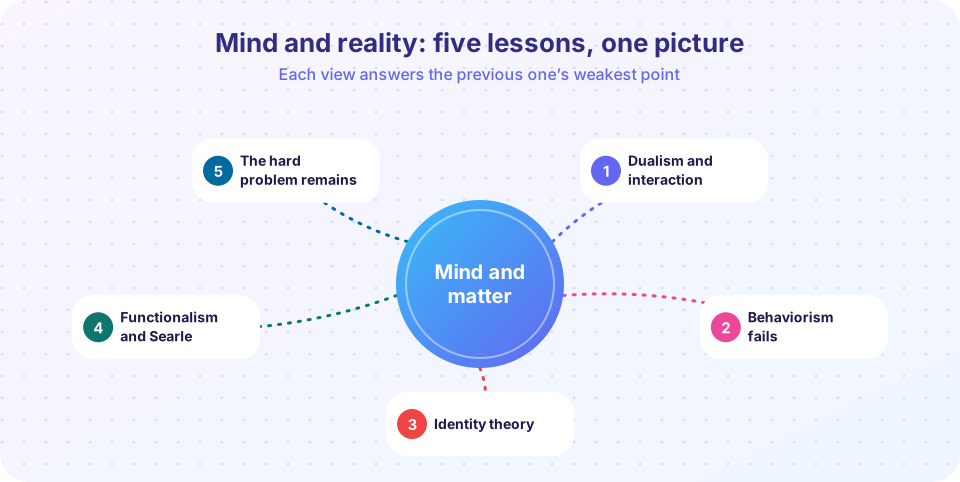
You have now met the main positions on the mind-body problem, and each one was a response to a flaw in an earlier view. This review puts them side by side, shows how they relate, and tests whether you can use them, not just recall them.
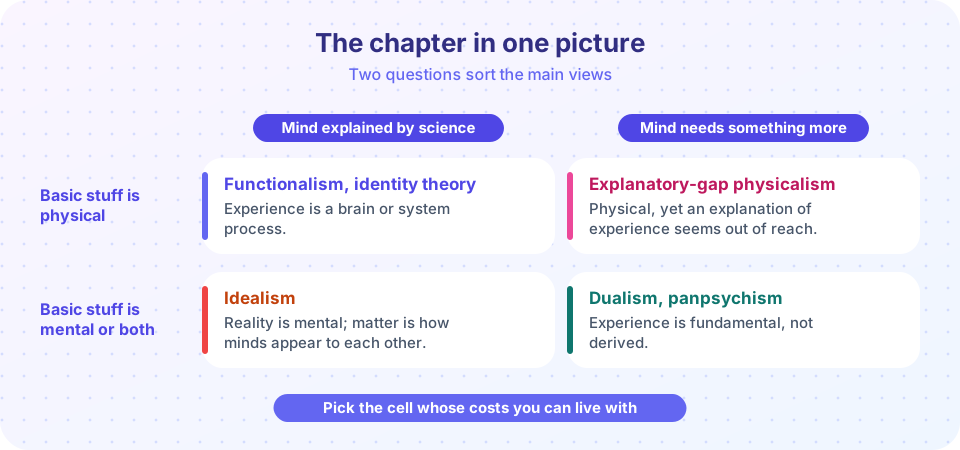
The chapter in one grid
Two questions sort the major positions: what is the basic stuff of the world, and can science fully explain the mind?
Recap table
| View | Core claim | Chief support | Chief problem |
|---|---|---|---|
| Substance dualism | Mind and body are different substances | Descartes' doubt argument; apparent privacy of experience | Interaction (Elisabeth); causal closure |
| Property dualism | One substance, irreducibly mental properties | Mary; zombies | Why do those properties go with brains? |
| Epiphenomenalism | Experience causes nothing | Fits physical closure | Seems to make experience pointless |
| Behaviorism | Mind is behavior or disposition | Avoids the ghost (Ryle) | Super-spartans; circular definitions |
| Identity theory | Mental types are brain types | Science discovers identities | Multiple realizability |
| Functionalism | Mind is causal role | Explains realizability; supports AI | Chinese Room; qualia |
| Eliminativism | Folk psychology may be replaced | Compare phlogiston | Seems to deny what we know best |
| Idealism | Reality is mental | Berkeley's argument about ideas | Explaining the stable, shared physical world |
| Illusionism | Phenomenal feel is a misrepresentation | Dissolves the hard problem | Seems to explain away the data |
When you meet a new theory, fill in this table row for it: claim, support, problem. It is the fastest way to understand and compare positions.
Skills to take with you
- Locate the exact joint. Descartes' argument turns on Leibniz's Law; Mary's argument turns on whether knowing facts and knowing what it is like are the same thing.
- Distinguish conceivable from possible. The zombie argument depends on that step.
- Ask what the view costs. Every position here has a price. Calling a view "obvious" usually means you have not found it yet.
- Separate empirical from philosophical questions. Which brain regions correlate with consciousness is empirical; whether correlation could ever explain experience is philosophical.
Try it
Chapter quiz
Quick check · 10 questions
of 10 answered You scored / 10 · perfect!
-
1. Which argument relies on Leibniz's Law?
Descartes argues that the mind has a property (being indubitable) the body lacks, so they are not identical. -
2. What did Princess Elisabeth of Bohemia ask Descartes?
Her question started the interaction problem for substance dualism. -
3. Epiphenomenalism says that
Mental events are by-products with no causal power. -
4. What did Jackson's Mary argument target?
If Mary learns something new, there are non-physical facts about experience, said the original argument. -
5. Why does multiple realizability trouble identity theory?
If pain were one human brain state, creatures with different brains could not feel pain. -
6. What is functionalism's central claim?
That is how it allows many realizations. -
7. What is the point of Searle's Chinese Room?
Searle follows rules with no grasp of meaning; he draws a conclusion about syntax and semantics. -
8. Which is an 'easy problem' in Chalmers' sense?
Easy problems concern mechanisms; the hard problem concerns why experience exists. -
9. What is the explanatory gap?
Levine's term for how a physical story seems not to entail what the experience is like. -
10. Which theory says the puzzle of experience arises from the brain's self-model?
Illusionists (Dennett, Frankish) aim to explain why we think we have inexplicable experience.
Summary
- Each position responds to a problem in an earlier one: dualism to physicalism's silence on feeling, behaviorism to dualism's ghost, identity theory to behaviorism's gaps, functionalism to multiple realizability.
- The hard problem is the live frontier; theories differ on whether it is real.
- Evaluate positions by claim, support and cost.
Track your progress
Create a free account to tick off lessons and pick up where you left off on any device.
of Introduction to Philosophy lessons completed