


















Lesson 6 of 44 · What Is Philosophy
The Branches of Philosophy
Tour the six main branches of philosophy with sample questions, landmark thinkers and the methods each branch uses, plus the many 'philosophy of' fields.
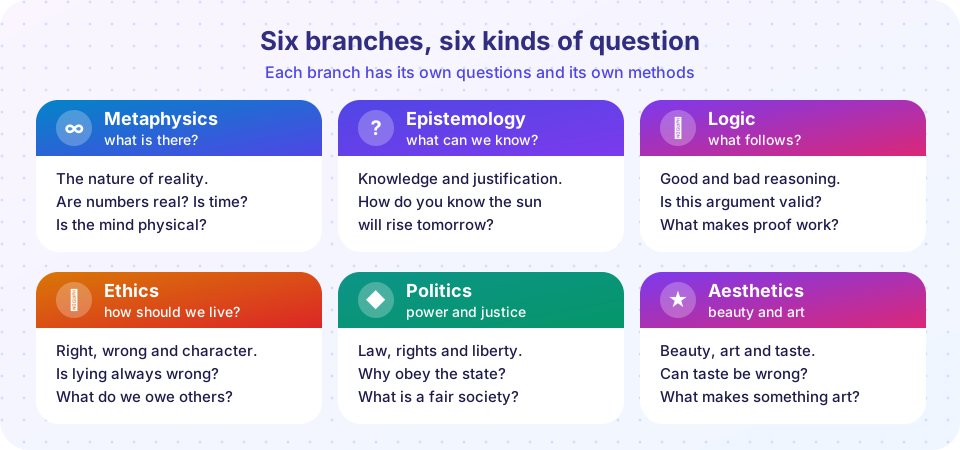
Philosophy is a large country with regions. Each region has its own questions, its own vocabulary and its own classic books, but the regions share borders, and a puzzle in one often turns up in another. Knowing the layout helps you find your way around, and it explains why a book in "ethics" can contain an argument about "metaphysics".
The six branches in this lesson are traditional rather than official. Different universities draw the lines differently, and some thinkers refuse to be filed under any heading. Treat the map as a guide, not as law.
What you will learn
- The central question of each of the six branches.
- A landmark thinker or text for each branch.
- Which methods philosophers use to answer such questions.
- How "philosophy of X" fields fit in.
Key terms
- Metaphysics: the study of what exists and what its basic nature is.
- Epistemology: the study of knowledge, belief and justification.
- Ethics: the study of right and wrong, good and bad, and how to live.
- Aesthetics: the study of beauty, art and taste.
- Political philosophy: the study of power, law, rights and justice.
Metaphysics: what is there?
Metaphysics asks about the most general features of reality. Does time flow, or is it just another dimension? Are there abstract things like numbers, or only physical objects? Is the mind a physical thing? What is it for one event to cause another? Aristotle's Metaphysics (fourth century BCE) is the founding text of the name. Modern examples include the debate about whether the universe is fundamentally made of matter, as materialists say, or whether mind is basic too. You will explore mind and reality in chapter 5.
Epistemology: what can we know?
Epistemology (from episteme, "knowledge") asks what knowledge is, how we get it and whether we have any. Is knowing just believing something true, or does it need more? Can we know anything beyond our own experience? Plato asked what separates knowledge from lucky guessing; Descartes tried to find a foundation that could not be doubted; David Hume asked why past experience should justify our expectations about the future. Chapter 4 is devoted to this branch.
Logic: what follows from what?
Logic studies the difference between good and bad reasoning. It does not ask whether a conclusion is true; it asks whether it follows from the premises. Aristotle's syllogisms (fourth century BCE) began the formal study, and the German mathematician Gottlob Frege's Begriffsschrift (1879) started modern symbolic logic. Logic also underlies mathematics and computer science, so it is the branch with the closest ties to other subjects. Chapter 3 teaches you its core tools.
Ethics: how should we live?
Ethics (sometimes called moral philosophy) is usually divided into three parts:
- Metaethics asks what moral claims are. Are they facts, feelings, commands?
- Normative ethics asks which acts are right and why. Rival theories include consequentialism (outcomes matter most), deontology (duties and rights matter) and virtue ethics (character matters).
- Applied ethics takes up concrete problems: animals, medicine, war, technology.
Aristotle's Nicomachean Ethics, Kant's Groundwork of the Metaphysics of Morals (1785) and John Stuart Mill's Utilitarianism (1861) are landmarks. This site has a full Ethics track if you want more.
Political philosophy: how should we live together?
Why should anyone obey a government? What is a fair distribution of wealth and opportunity? What rights should every person have? Plato's Republic, Thomas Hobbes's Leviathan (1651), John Locke's Second Treatise (1689), and John Rawls's A Theory of Justice (1971) are classic stops. Chapter 8 covers this branch.
Aesthetics: what is beauty?
Aesthetics asks about beauty, art and the experience of both. Can taste be wrong, or does "beautiful" only report a feeling? What makes something a work of art? Is a forgery worth less if it looks identical? Kant's Critique of Judgment (1790) argued that judgments of beauty claim universal agreement though they cannot be proved. Questions about film, music and games all belong here.
Fields that apply philosophy to other subjects
Besides the six branches, there are many "philosophy of" fields:
| Field | A sample question |
|---|---|
| Philosophy of mind | Could a machine be conscious? |
| Philosophy of language | How do words refer to things? |
| Philosophy of science | What separates science from pseudoscience? |
| Philosophy of mathematics | Are mathematical truths discovered or invented? |
| Philosophy of law | Must an immoral law still be obeyed? |
| Philosophy of religion | Can the existence of God be argued for or against? |
How philosophers answer these questions
No lab is required, but there is plenty of method:
- Conceptual analysis: breaking a concept into necessary parts (is knowledge justified true belief?).
- Argument: building and testing chains of reasons, as you practiced in chapter 1.
- Thought experiments: imagined cases to test principles.
- Use of empirical results: psychology, physics and neuroscience often constrain the options.
- Dialogue: discussion with opponents, from Socrates to modern journals.
Common misconceptions
"Each branch is separate." Questions cross borders. Whether free will exists is both metaphysical and ethical, since moral responsibility depends on it.
"Ethics is just personal opinion." Whether moral claims can be true is a live question in metaethics, and even those who say no usually argue about which views are better supported.
"Logic tells you what to believe." Logic tells you what follows from what you already accept, not whether the starting premises are true.
Try it
Press Run (or Ctrl + Enter) to see the result here.
Program input · what you'd type while the program runs
Type the answers before you press Run, one per line. Each time the program reads a line (with input()), it gets the next line from this box.
Check your understanding
Quick check · 5 questions
of 5 answered You scored / 5 · perfect!
-
1. Which branch asks 'what is the difference between knowing and merely believing?'
Epistemology studies knowledge, belief and justification. -
2. Normative ethics mainly asks
Metaethics asks what moral claims are; normative ethics asks which acts are right and why; applied ethics studies concrete problems. -
3. Who started modern symbolic logic with the Begriffsschrift of 1879?
Frege's Begriffsschrift (1879) introduced the quantifier notation that underlies modern logic. -
4. A question about whether a law must be obeyed even if it is unjust belongs most directly to
It concerns legitimate authority and the relation of law to justice, which are central topics of political and legal philosophy. -
5. Which of these is a method philosophers use?
Philosophers use argument, conceptual analysis, thought experiments and sometimes empirical results, but not usually laboratory apparatus.
Summary
- The six traditional branches are metaphysics, epistemology, logic, ethics, political philosophy and aesthetics.
- Ethics divides into metaethics, normative ethics and applied ethics.
- "Philosophy of X" fields apply the same methods to a specific subject.
- Methods include analysis, argument, thought experiments, empirical input and dialogue.
- The branches overlap, and good problems cross their borders.
Track your progress
Create a free account to tick off lessons and pick up where you left off on any device.
of Introduction to Philosophy lessons completed