


















Lesson 44 of 44 · Projects and Practice
Further Study: Where to Go After Introduction to Philosophy
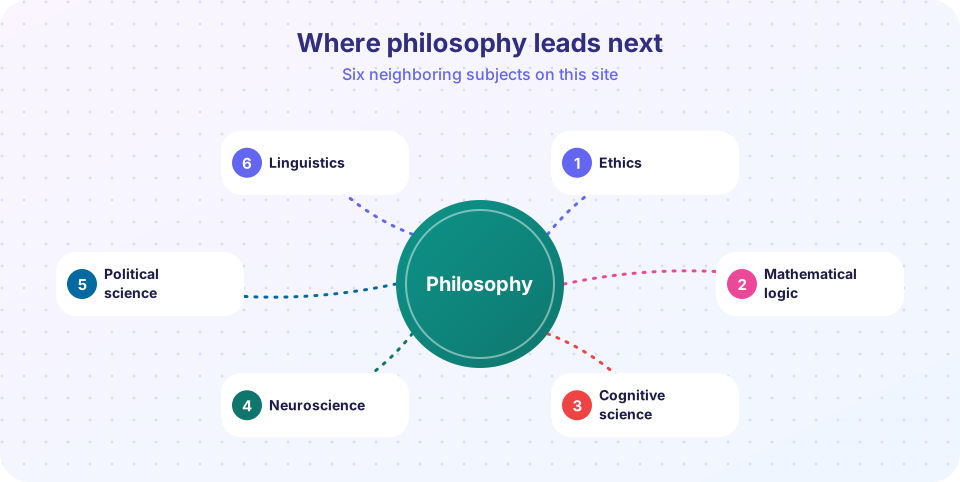
Where to go after an introduction to philosophy: ethics, logic, cognitive science, neuroscience, political science and linguistics, plus how to read primary texts.
You have finished an introductory course. Philosophy rewards going deeper, and it rewards connecting with other fields: nearly every science and social science began as a branch of philosophy and still returns to it for its foundations. This final page suggests next steps, how to read original texts, and how to keep practicing.
What you will learn
- Which subjects continue each thread of the course.
- How to read a primary text without being overwhelmed.
- How to keep a philosophical habit going with small regular practice.
Key terms
Primary source: the original text of a thinker (for example, Descartes's Meditations).
Secondary source: a commentary or textbook about primary sources.
Close reading: reading slowly, paragraph by paragraph, and summarizing each in your own words.
Threads to follow
| If you enjoyed... | Try next | What you will find |
|---|---|---|
| Arguments and validity | Mathematical Logic | Formal systems, proofs and the limits of what can be proved |
| Right and wrong | Ethics | Moral theories, applied problems and how to reason about them |
| Mind and consciousness | Cognitive Science and Neuroscience | What empirical research says about perception, memory, attention and the brain |
| Language and meaning | Linguistics | How language works, from sounds to meaning, and what it reveals about thought |
| The state, justice and liberty | Political Science | Institutions, voting, power, and the empirical side of political questions |
| Why people believe and behave as they do | Introduction to Psychology | Methods and findings about thought, emotion and behavior |
How to read a primary text
Original philosophical texts can be hard because they were written for specific audiences in specific times. These habits help:
- Pick a short, famous work. Descartes's Meditations (first two meditations), Hume's Enquiry, Mill's On Liberty, Nagel's bat paper, Parfit's early chapters. Short works are manageable and reward rereading.
- Read with a pencil. Mark the conclusion, then the reasons. Write one sentence per paragraph.
- Ask what the author is arguing against. Many arguments make sense only against a rival view.
- Reconstruct the main argument using the method from the argument mapping project.
- Then read a commentary. A good encyclopedia entry or textbook chapter will help you check your reading.
Do not worry if the first reading is confusing. The point is to wrestle with the argument. Most students need two readings, and professionals reread classics for years.
A practice routine
- Once a week, pick a claim you hear in the news or in conversation and write it in standard form.
- Once a month, run a thought experiment from the lab with a friend and compare the principles you reach.
- Once a term, take a position you disagree with and write its strongest defense in 300 words.
Philosophy is a skill like any other: it improves with regular, small, deliberate practice.
Try it
Press Run (or Ctrl + Enter) to see the console output here.
No output.
Check your understanding
Quick check · 3 questions
of 3 answered You scored / 3 · perfect!
-
1. What is a primary source?
Commentaries and textbooks are secondary sources. -
2. Which habit helps with a hard primary text?
Close reading and summarizing reveal the structure. -
3. Which subject continues the thread of arguments and validity in a formal way?
Mathematical logic studies formal systems and proof.
Summary
- Each strand of the course continues in a neighboring subject.
- Read primary texts with a pencil, asking what the author argues against.
- Small, regular practice builds the skill of philosophical thinking.
Return to the course page and revisit any lesson. Good philosophy is mostly rereading.
Track your progress
Create a free account to tick off lessons and pick up where you left off on any device.
of Introduction to Philosophy lessons completed