


















Lesson 23 of 44 · Mind and Reality
Consciousness and the Hard Problem
Nagel's bat, Chalmers' hard problem, zombies, and the main theories of consciousness. Learn what is settled, what is disputed and why the question is difficult.
Put your hand under a warm tap. A lot happens: nerve endings fire, signals reach the brain, you pull the hand away or leave it there. All of that can be described from the outside. But you also feel the warmth. That inner side, the feel, is what philosophers mean by consciousness, and it is surprisingly hard to fit into a scientific picture. This lesson explains why, in plain terms, and gives a fair map of the best-known theories.
What you will learn
- What "consciousness" means in philosophy, and how it differs from being awake or self-aware.
- Nagel's bat argument, Chalmers' easy/hard distinction and the explanatory gap.
- The zombie thought experiment, and what it is (and is not) trying to show.
- A short guide to four theories: global workspace, higher-order, integrated information, and illusionism, plus panpsychism.
Key terms
- Phenomenal consciousness: the experiential side, "what it is like" to have a state.
Hard problem: why and how physical processes give rise to experience at all.
Explanatory gap: Joseph Levine's term for the apparent lack of any link between a physical explanation and the felt quality it is supposed to explain.
Philosophical zombie: a being physically identical to you but with no experience.
Illusionism: the view that the feeling of having inexplicable experience is itself a kind of misrepresentation.
What it is like to be a bat
In 1974 Thomas Nagel published "What Is It Like to Be a Bat?". Bats navigate by echolocation, which is a sense we lack. We can study their brains and behavior in every detail, but Nagel argued that we would still not know what the experience is like for the bat. A creature has conscious experience, he said, if and only if there is something it is like to be that creature. The point was not about bats; it was that objective, third-person science seems built to leave out the first-person viewpoint.
The easy and the hard problems
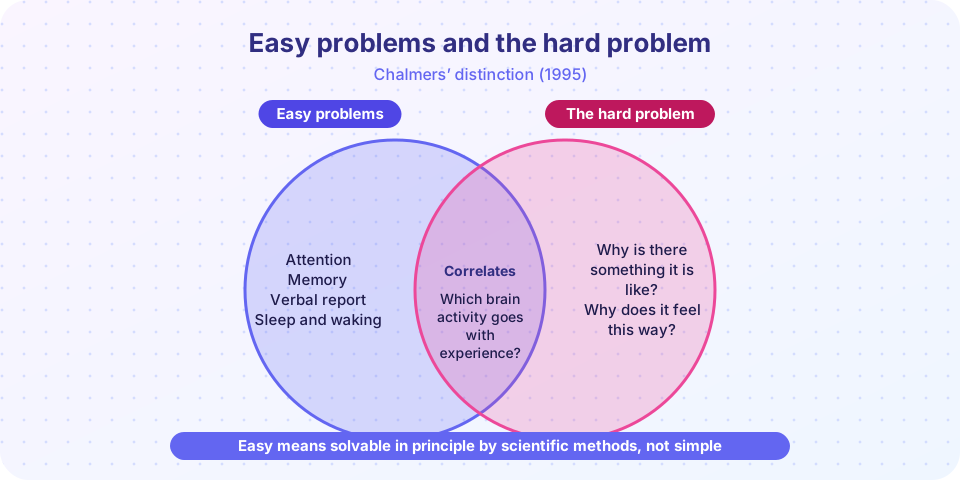
David Chalmers (1995) divided the study of consciousness into two groups. The easy problems are about functions: how the brain focuses attention, integrates information, controls behavior, reports on its states, and distinguishes sleep from waking. "Easy" does not mean simple; it means that we know what kind of explanation would solve them: find the mechanism. The hard problem asks something else: why should any of those mechanisms be accompanied by experience? Even after a complete explanation of the functions, it seems an extra question remains.
Notice the structure. Chalmers does not say experience is unscientific. He says explaining it needs something that the standard "find the mechanism" method does not give.
Neural correlates
Science makes real progress on a neighboring question: which brain activity goes with conscious experience? Francis Crick and Christof Koch popularized the search for the neural correlates of consciousness. Experiments contrast conscious and unconscious processing, for example, in patients with blindsight (damage to the visual cortex): they deny seeing in part of their visual field, yet can point to objects there above chance. Correlates are valuable data, but a correlate is not an explanation, which is precisely the gap.
Zombies and the conceivability argument
A philosophical zombie behaves like you, speaks like you, even says "I am conscious", and is molecule-for-molecule identical, but has no experience. Chalmers argues: zombies seem conceivable; if conceivable, then possible; if possible, then consciousness is something over and above the physical. Each step is contested. Critics say the first step is mistaken (we cannot truly conceive a full physical duplicate without experience, any more than we can truly conceive water without H2O). Others say that conceivability is a poor guide to possibility. Daniel Dennett considers the zombie idea incoherent. The zombie is a tool for locating where you stand, not a claim that zombies exist.
Four theories in brief
Treat the following as a map of live research programs, not a vote.
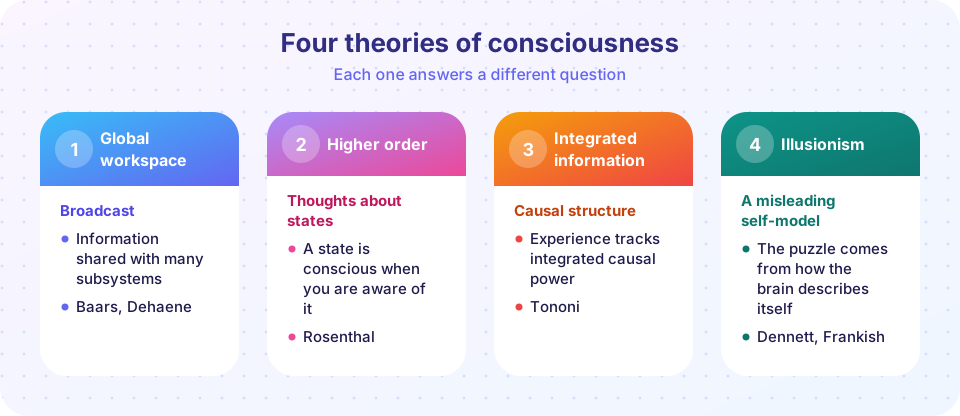
- Global workspace theory (Bernard Baars; later Stanislas Dehaene). Consciousness is information broadcast widely to many specialized brain processes, like a speaker addressing a crowded hall. It is a functional theory that fits the "easy" side well and says the hard problem dissolves once the function is explained.
- Higher-order theories (David Rosenthal and others). A state is conscious when the mind has a thought about it. A pain you do not notice is not conscious pain.
- Integrated information theory (Giulio Tononi). Consciousness corresponds to the amount of integrated causal structure in a system, so the physical makeup matters, not just the program. It takes experience as a starting point. Some researchers criticize it for implying that very simple systems could be conscious.
- Illusionism (Keith Frankish, in the spirit of Dennett). There is no extra "phenomenal" property; the impression that there is, is what the brain's self-model produces. The task is to explain why we think we have inexplicable experiences.
Panpsychism (Philip Goff, Galen Strawson) offers a different route: if experience cannot be derived from non-experiential matter, perhaps some form of experience is a basic feature of matter. Critics raise the combination problem: how do tiny experiences add up into one rich human experience?
Common misconceptions. (1) "Consciousness is just being awake." Sleeping people have dreams, and anaesthetized patients differ from sleeping ones; wakefulness and experience come apart. (2) "The hard problem means science cannot study consciousness." Researchers study it every day; the dispute is over what such studies explain. (3) "If we do not understand it, it must be spiritual." A gap in explanation is not evidence for any particular answer.
Try it
Press Run (or Ctrl + Enter) to see the console output here.
No output.
Check your understanding
Quick check · 5 questions
of 5 answered You scored / 5 · perfect!
-
1. What was Nagel's main point in the bat paper?
He argued that knowing all the physical facts about bat brains would not tell us what it is like to be a bat. -
2. Which is one of Chalmers' 'easy problems'?
Easy problems concern functions and mechanisms, even when they are scientifically demanding. -
3. What does the zombie argument try to show?
If a zombie is possible, then physical facts alone do not guarantee experience. Each step is disputed. -
4. Which theory says consciousness is information broadcast widely across the brain?
That is Baars' and Dehaene's global workspace idea. -
5. What is the combination problem?
It is the main challenge for panpsychism.
Summary
- Phenomenal consciousness is what it is like to have an experience.
- Nagel and Chalmers argue that functional, third-person explanation may leave experience unexplained (the hard problem).
- Neural correlates are real data, but a correlate is not an explanation.
- Theories compete: global workspace, higher-order, integrated information, illusionism, panpsychism, each with a price.
- Zombies are a thinking tool, and every step of the argument is contested.
Track your progress
Create a free account to tick off lessons and pick up where you left off on any device.
of Introduction to Philosophy lessons completed