


















Lesson 22 of 44 · Mind and Reality
Physicalism and Functionalism: Is the Mind What the Brain Does?
Behaviorism, identity theory and functionalism compared, with the Chinese Room and multiple realizability. See what each view gets right and where it struggles.
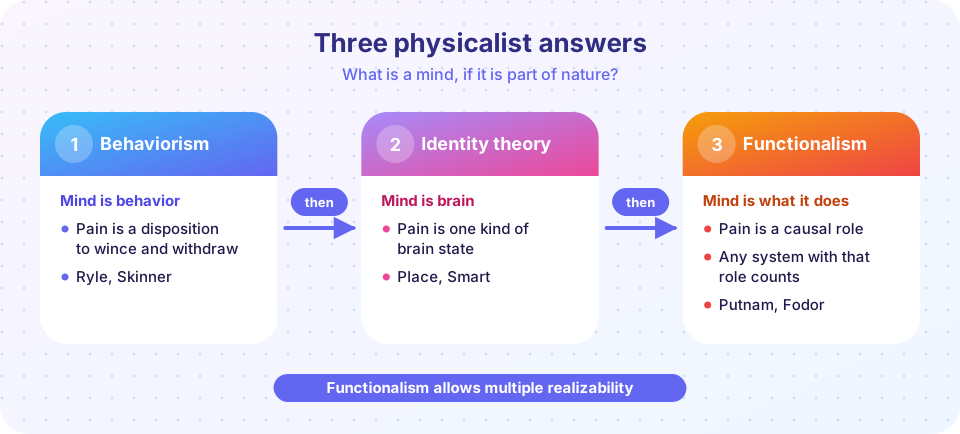
Most scientists who study the brain assume that the mind is a natural phenomenon, something that arises from physical processes and obeys the same laws as everything else. That assumption is called physicalism (or materialism). But "the mind is physical" can be filled in in very different ways. Is a mind the same as a brain? Is it a pattern of behavior? Or is it something like software, which could run on many kinds of hardware? This lesson follows the three main answers in the order philosophers discovered their problems.
What you will learn
- The three main physicalist theories: behaviorism, identity theory, functionalism.
- Why Putnam's "multiple realizability" pushed philosophers from identity theory to functionalism.
- How Searle's Chinese Room challenges the idea that running the right program is enough for understanding.
- Where eliminative materialism fits.
Key terms
- Physicalism: everything that exists is physical, or is fixed by the physical facts.
Type identity theory: each type of mental state is identical to a type of brain state.
Functionalism: a mental state is defined by its causal role: what it is caused by, what it causes, and how it connects to other mental states.
Multiple realizability: the same mental state can be physically realized in different ways.
Qualia: the felt qualities of experience (the redness of red, the sting of pain).
Round 1: behaviorism
Early in the 20th century, psychologists such as John B. Watson and B. F. Skinner argued that scientific psychology should study behavior, not hidden inner states. Philosophers turned this into a thesis about meaning. Gilbert Ryle's The Concept of Mind (1949) argued that Descartes had made a category mistake: he treated "mind" as a ghostly thing behind the body, like a ghost in the machine. For Ryle, to say someone is in pain or is clever is to say how they behave, or would behave, in various circumstances.
Behaviorism is neat, but it fails in two ways. First, a person can be in pain and show nothing: the stoic, or the person who is paralyzed. Hilary Putnam's thought experiment of "super-spartans" (people trained never to show pain) makes the point. Second, behavior depends on combinations of mental states: you reach for an umbrella only if you want to stay dry and believe it is raining. You cannot define a belief without mentioning a desire, and the desire without the belief, so the definitions go in a circle.
Round 2: identity theory
In the 1950s, U. T. Place and J. J. C. Smart proposed something bolder: mental states are brain states, identical to them in the way that lightning is identical to an electrical discharge. This is a discovery by science, not a definition. The stock example is "pain is C-fibre firing"; it is a deliberately simple placeholder, not a claim about the real neuroscience of pain, which is far more complicated.
Identity theory respects the evidence that damage to the brain changes the mind, and it avoids Descartes' interaction problem (there is only one kind of stuff). Its weak point is multiple realizability, pointed out by Putnam in the 1960s. Octopuses, dogs and humans all seem able to be in pain, yet their nervous systems are very different. If pain were identical to one specific human brain state, only humans could feel it. And what about a possible alien, or an artificial system? It seems too narrow to tie a mental state to one physical implementation.
Round 3: functionalism
Functionalism takes the lesson. What makes something a pain is not what it is made of but what it does: it is typically caused by tissue damage, it causes distress and a desire to make it stop, it leads to wincing and avoidance, and it interacts with other beliefs and desires. Any system that has that causal organization is in pain, whether it is built of neurons, silicon or something else.
A common analogy is a mousetrap or a clock: many different physical devices count as a clock because they perform the function of keeping time. Another is software: the same program can run on very different machines. Functionalism explains why the mind can be studied at its own level (psychology, cognitive science) without knowing every neuron, and it fits the project of artificial intelligence.
Objections to functionalism
- The Chinese Room. In 1980, John Searle imagined himself locked in a room with a rulebook (in English) for manipulating Chinese symbols. People slip in questions in Chinese; he follows the rules and sends out appropriate replies. To outsiders, the room understands Chinese. But Searle understands nothing; he is just shuffling shapes. His conclusion: running a program (syntax) is not enough for understanding (semantics). Replies are numerous. The "systems reply" says the whole room, not the man, understands. Searle's response is that he could memorize the rulebook and still understand nothing.
- Absent and inverted qualia. Perhaps a system could have all the right functional organization yet have no experience at all (absent qualia), or experience red where you experience green (inverted spectrum), with no behavioral difference. Ned Block's "China brain" (1978) imagines the entire population of China, each person acting as a neuron, wired by radios. Does the nation feel pain?
- The hard problem (see the next lesson): even if function explains behavior and report, it may leave out the felt side.
Round 4: eliminative materialism
Paul and Patricia Churchland argued something more radical: our everyday vocabulary of "beliefs", "desires" and "pains" (folk psychology) may be a bad theory, as phlogiston was a bad theory of fire. Mature neuroscience might replace it rather than reduce it. Critics say this misses the obvious fact that we know we have experiences; defenders say that confidence can be mistaken.
Common misconceptions. (1) "Physicalism means the mind is not real." No: physicalists say minds are real and physical (except eliminativists, who say some of our concepts of mind are mistaken). (2) "Functionalism says the mind is a computer." Functionalism says the mind is defined by causal roles; computation is one way of describing roles, not the only one. (3) "The Chinese Room proves machines cannot think." It is an argument, with serious replies, not a proof.
Try it
Press Run (or Ctrl + Enter) to see the console output here.
No output.
Check your understanding
Quick check · 5 questions
of 5 answered You scored / 5 · perfect!
-
1. Why did many philosophers move from identity theory to functionalism?
If pain is tied to one human brain state, octopuses and aliens could not feel pain. Functionalism ties it to a causal role instead. -
2. What did Ryle mean by a 'category mistake' in Descartes?
Ryle said 'mind' names abilities and dispositions, not an extra object inside the machine. -
3. What is Searle's conclusion from the Chinese Room?
Searle can produce correct replies without understanding Chinese, so symbol manipulation alone seems insufficient. -
4. Which sentence best describes functionalism?
That is the defining idea; it allows the same mental state in different materials. -
5. What do eliminative materialists suggest?
The Churchlands compared folk psychology to discarded theories such as phlogiston.
Summary
- Physicalism says minds are part of the natural world; theories differ on how.
- Behaviorism (Ryle) fails because mental states do not map one-to-one onto behavior.
- Identity theory (Place, Smart) fails the multiple-realizability test (Putnam).
- Functionalism defines mind by causal role; it faces the Chinese Room and questions about qualia.
- Eliminativism says parts of folk psychology may be abandoned.
Track your progress
Create a free account to tick off lessons and pick up where you left off on any device.
of Introduction to Philosophy lessons completed