


















Lesson 33 of 44 · Religion and Meaning
The Meaning of Life
Subjectivism, objectivism, supernaturalism, nihilism and Camus's absurd, with Susan Wolf's fitting-fulfillment view and the case of Sisyphus.
"What is the meaning of life?" is often asked as a joke, but philosophers take it seriously and, usefully, they break it into smaller questions. Does life as a whole have a meaning or purpose? Or do individual lives have meaning, and what makes one meaningful? These are different questions with different answers, and mixing them up is the most common mistake in everyday conversation about the topic. This lesson separates them, introduces the main theories, and tests each against the same example: Sisyphus.
What you will learn
- The difference between "the meaning of life" and "meaning in life".
- Subjective, objective, hybrid and supernatural theories of meaning.
- Nihilism and Camus's response to the absurd.
- Susan Wolf's view, and why philosophers distinguish meaning from happiness and from morality.
Key terms
- Meaning in life: what makes an individual life significant or worthwhile.
Subjectivism: meaning depends on your attitudes: what you care about and are drawn to.
Objectivism: some things are worthwhile independently of what anyone thinks.
Nihilism: nothing has real value or meaning.
The absurd (Camus): the clash between our wish for meaning and a universe that does not answer.
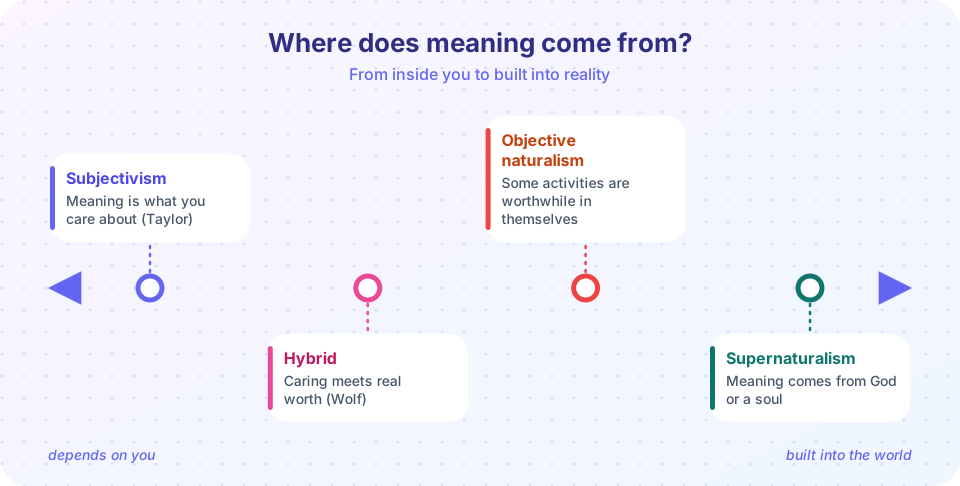
Four families of theory
Subjectivism. A life is meaningful if it is full of things you care about. Richard Taylor (1970) used the example of Sisyphus: imagine the gods implanted in him a strong desire to roll stones. Then his rolling would be meaningful for him. The attraction of the view is that it respects individuals; the worry is that it counts any obsession, even counting blades of grass, as meaningful.
Objectivism (naturalism). Meaning requires engaging with things of real worth, such as knowledge, creativity, justice, love, and the cultivation of one's abilities. These are worthwhile whether or not you care about them. Critics ask who decides what has real worth, and whether this view is too narrow for people whose projects are ordinary.
Hybrid views. Susan Wolf (Meaning in Life and Why It Matters, 2010) argues that meaning arises "when subjective attraction meets objective attractiveness": you must be engaged by, and love, something that is actually worthwhile. Neither element is enough alone. A gripped person pursuing a worthless project, and a person who finds a worthy cause boring, both miss out.
Supernaturalism. Meaning comes from God or an immortal soul: either life has a purpose assigned by God, or without eternity nothing could matter. Critics say that purposes assigned by someone else do not obviously give meaning, and that a finite life can matter without being eternal. Defenders say that only an ultimate purpose can make the difference between a story that matters and one that does not.
What psychologists add
Empirical work is separate from the philosophical question but relevant. Psychologists studying "sense of meaning" often describe three ingredients: coherence (your life makes sense), purpose (you have goals and direction) and significance (your life matters). Viktor Frankl, in Man's Search for Meaning (1946), drew on his experience of Nazi camps to argue that people can find meaning in work, in love, and in the stance they take toward unavoidable suffering. Such findings describe what feels meaningful; philosophers still ask what makes a life meaningful.
Nihilism and the absurd
Nihilists say nothing matters. Friedrich Nietzsche warned in the 19th century that, as religious belief declined, Europe faced a crisis of values; his own answer was that we must create values. Leo Tolstoy, in A Confession (1882), described a personal crisis in which every goal seemed pointless in the face of death, until he found faith.
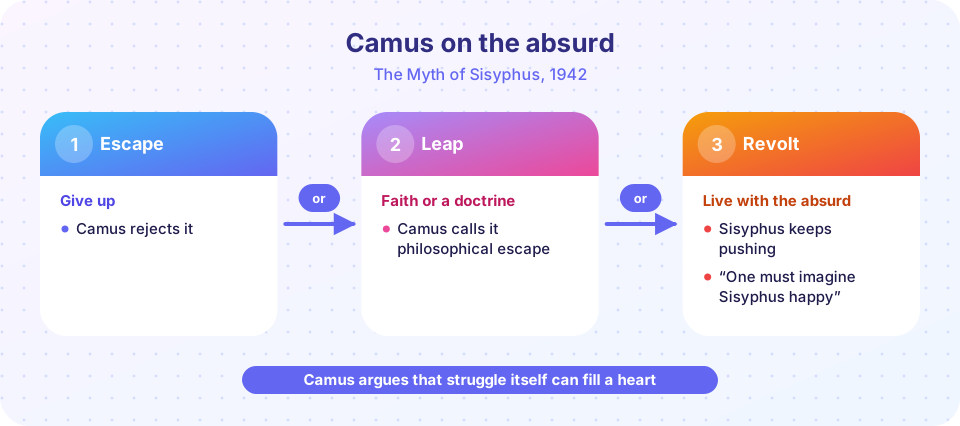
Albert Camus (The Myth of Sisyphus, 1942) called the clash between our hunger for meaning and the silence of the world the absurd. He considered three responses: escape (giving up), a "leap" into a doctrine that promises meaning, and revolt: living fully while admitting the absurd. His image of Sisyphus, condemned to push a rock up a hill forever, ends with the line that "one must imagine Sisyphus happy".
Thomas Nagel (1971, "The Absurd") offered a gentler view: our lives seem absurd because we can take them seriously and also step back and see that the seriousness cannot be justified from outside. His advice: since the doubt cannot be answered, meet it with irony rather than despair.
Sisyphus under four theories
| Version of Sisyphus | Subjectivist | Objectivist | Wolf's hybrid |
|---|---|---|---|
| Forced to push, hates it | Not meaningful | Not meaningful | Not meaningful |
| Implanted desire to push (Taylor) | Meaningful | Not meaningful | Not meaningful (rock-pushing is not worthwhile) |
| Pushes a rock and writes poetry he loves | Meaningful | Meaningful | Meaningful |
Common misconceptions. (1) "Meaning is the same as happiness." A meaningful life can include hardship, and a pleasant life can feel empty. (2) "Without God, life must be meaningless." Naturalists and many religious thinkers disagree on this, and the question is about the arguments, not about anyone's character. (3) "If the universe is indifferent, nothing matters to anyone." Things can matter to us and for good reasons even if the universe does not care.
Try it
Press Run (or Ctrl + Enter) to see the console output here.
No output.
Check your understanding
Quick check · 5 questions
of 5 answered You scored / 5 · perfect!
-
1. What is the difference between 'the meaning of life' and 'meaning in life'?
Separating them avoids confusion in the debate. -
2. How does Susan Wolf describe meaning?
You must be engaged by something that is actually worthwhile. -
3. What is Camus's recommended response to the absurd?
He rejected escape and the leap, and spoke of imagining Sisyphus happy. -
4. What problem does subjectivism face?
The grass-counter example illustrates the worry. -
5. Which is NOT one of the three psychological components of a sense of meaning mentioned in the lesson?
The three are coherence, purpose and significance.
Summary
- Distinguish the meaning of life from meaning in a life.
- Four families: subjectivism, objectivism, hybrid (Wolf), supernaturalism; nihilism denies meaning.
- Camus advises revolt over escape or a leap; Nagel suggests irony.
- Meaning is distinct from happiness and from morality, though they overlap.
Track your progress
Create a free account to tick off lessons and pick up where you left off on any device.
of Introduction to Philosophy lessons completed