


















Lesson 4 of 44 · Getting Started
Chapter 1 Review: Getting Started
Review the study loop, argument mapping, charity, thought experiments and reflective equilibrium with a recap table, a self-test tool and a ten-question quiz.
You now have the working habits of a philosophy student. This review pulls the chapter together in one picture, then lets you test yourself. If a question surprises you, reread the matching lesson and try again: retrieving an idea from memory is one of the most effective ways to learn it.
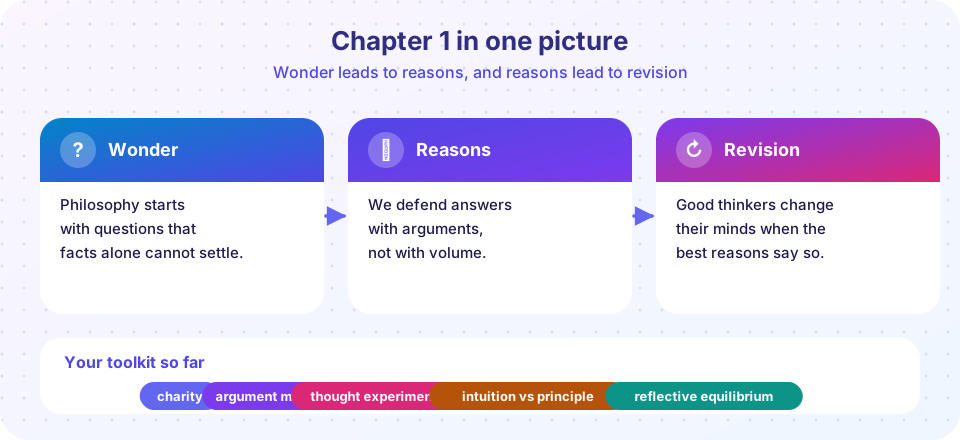
What you will learn
- A one-page recap of the chapter.
- Which lesson each tool came from.
- Where your understanding is still shaky.
Recap table
| Idea | One-line summary | Lesson |
|---|---|---|
| Course route | Tools (ch. 1-4), big questions (ch. 5-7), life together (ch. 8-9) | Course Map |
| Study loop | Read twice, map, test, write, revise | How to Study Philosophy |
| Standard form | Numbered premises, then the conclusion; add suppressed premises | How to Study Philosophy |
| Charity | Restate a view in its strongest form before replying | How to Study Philosophy |
| Thought experiment | An imagined case isolating one factor | Thought Experiments |
| Ship of Theseus | Identity over time; the rebuilt-ship twist | Thought Experiments |
| Trolley problem | Numbers of lives versus the way harm is caused | Thought Experiments |
| Reflective equilibrium | Adjust principles and case judgments until they fit | Thought Experiments |
Where this chapter leads
The next chapter asks what philosophy itself is: its branches, its origins with Socrates and its many traditions around the world. Chapter 3 then sharpens the argument-mapping skill into a full toolkit of logic.
Before the quiz, close this page and try to write each tool's definition from memory. Then compare. The gaps you find are exactly what to review.
Try it
Press Run (or Ctrl + Enter) to see the console output here.
No output.
Press Run (or Ctrl + Enter) to see the result here.
Program input · what you'd type while the program runs
Type the answers before you press Run, one per line. Each time the program reads a line (with input()), it gets the next line from this box.
Check your understanding
Quick check · 10 questions
of 10 answered You scored / 10 · perfect!
-
1. What are the four moves of the study loop?
The loop is read slowly, map the argument, test it with objections, and write your reasoning, then revise. -
2. Which of these is a conclusion indicator?
'Therefore' typically introduces the conclusion; the others usually introduce premises. -
3. A suppressed premise is
Suppressed (or hidden) premises are needed for the argument to work but are not written down. -
4. What does the principle of charity ask you to do?
Charity means addressing the best version of a view, so that any criticism is fair and informative. -
5. A counterexample shows that
It presents a case where all the premises hold but the conclusion does not, so the premises do not guarantee the conclusion. -
6. In the ship of Theseus, Hobbes's twist is that
Collecting the discarded planks and rebuilding them produces a rival candidate for being the original ship. -
7. The footbridge case is used to separate which two factors?
Both cases trade one life for five, but in the footbridge case the person is used as a means, which many people judge to matter. -
8. In Plato's ring of Gyges story, invisibility is used to ask whether
Glaucon removes the reputation and punishment that normally motivate justice, so we can ask whether justice is valuable for its own sake. -
9. Reflective equilibrium is reached when
Rawls's method adjusts both principles and case judgments, going back and forth, until they cohere. -
10. Which is the best use of intuitions in philosophy?
Intuitions carry weight but can reflect habit or framing, so they are balanced against principles and other evidence.
Summary
- The study loop (read, map, test, write, revise) is the engine of the whole course.
- Standard form and charity make arguments visible and fair.
- Thought experiments isolate factors; intuitions are fallible evidence; reflective equilibrium balances them with principles.
- Chapter 2 asks what philosophy is and where it came from.
Track your progress
Create a free account to tick off lessons and pick up where you left off on any device.
of Introduction to Philosophy lessons completed