


















Lesson 43 of 44 · Projects and Practice
Philosophy Cheat Sheet: The Whole Course on One Page
A one-page recap of the whole philosophy course: the six big areas, the main positions, the key thinkers and four habits for evaluating any argument.
This page compresses the course into something you can keep open while revising. It lists the main positions in each area, the thinkers to associate with them, and four habits that work on every topic. Use it as a map, and go back to the lessons for the arguments.
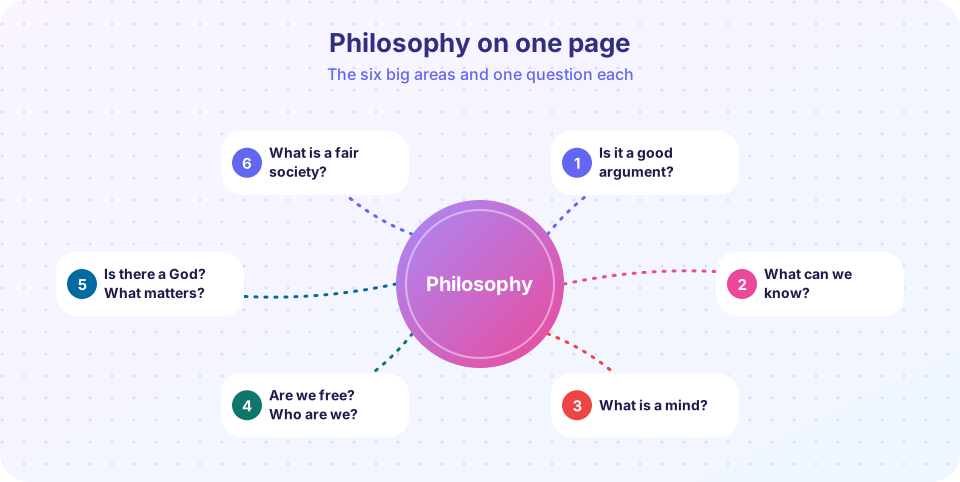
Positions at a glance
| Area | Question | Main positions | Key names |
|---|---|---|---|
| Argument | Does the conclusion follow? | Deductive vs inductive; valid vs sound | Aristotle, Frege |
| Knowledge | What can we know? | Rationalism, empiricism, skepticism | Descartes, Locke, Hume, Kant |
| Mind | How do mind and body relate? | Dualism, physicalism, functionalism, idealism | Descartes, Putnam, Searle, Berkeley |
| Consciousness | Why does experience exist? | Hard problem; global workspace, higher-order, IIT, illusionism | Nagel, Chalmers, Dennett |
| Free will | Are we free? | Compatibilism, libertarianism, hard determinism | Hume, van Inwagen, Frankfurt, Strawson |
| Identity | What makes you the same person? | Body, soul, psychological continuity, bundle | Locke, Reid, Parfit, Hume |
| Religion | Is there a God? | Theism, deism, agnosticism, atheism | Anselm, Aquinas, Paley, Pascal |
| Evil | Can God and evil coexist? | Free will defense, soul-making, skeptical theism | Mackie, Plantinga, Rowe, Hick |
| Meaning | What makes life meaningful? | Subjective, objective, hybrid, supernatural; absurdism | Taylor, Wolf, Camus, Nagel |
| Politics | What justifies the state? | Social contract; liberalism, libertarianism, welfare views | Hobbes, Locke, Rousseau |
| Justice | What is fair? | Utilitarian, Rawlsian, entitlement, capabilities | Mill, Rawls, Nozick, Sen |
| Liberty | How free should we be? | Negative, positive, republican; harm principle | Berlin, Mill, Pettit |
Four moves for any argument
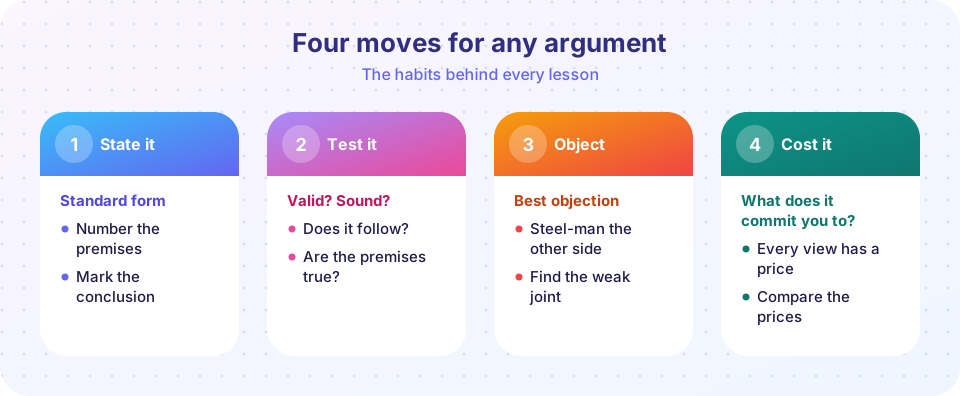
- State it. Number the premises and mark the conclusion. Look for the hidden premise.
- Test it. Is the inference valid? Are the premises true? These are different questions.
- Object. State the strongest objection to a specific premise, and a fair reply.
- Cost it. Every position has a price. Name it before you adopt the view.
Ten tests worth remembering
- Leibniz's Law: identical things share all properties (Descartes' dualism argument depends on it).
- Mary's room: do physical facts exhaust the facts?
- Chinese Room: is symbol manipulation enough for understanding?
- Zombie: is a physical duplicate without experience possible?
- Consequence argument: if determinism holds, is anything up to us?
- Frankfurt case: is responsibility possible without alternatives?
- Brave officer: is memory transitive, and so a good test of identity?
- Mackie's triad: can God, goodness and evil all be real together?
- Veil of ignorance: what rules would you choose without knowing your place?
- Harm principle: does the act harm others, or only offend or harm the actor?
If you have one hour before an exam or a discussion: read the table, redo each of the ten tests aloud in your own words, and write one objection to your own favorite view.
Try it
Press Run (or Ctrl + Enter) to see the console output here.
No output.
Check your understanding
Quick check · 4 questions
of 4 answered You scored / 4 · perfect!
-
1. Which test asks whether physical facts exhaust the facts?
Jackson's Mary knows all physical facts about color vision but may still learn something new. -
2. Which thinker is associated with the hard problem of consciousness?
David Chalmers introduced the easy/hard distinction in 1995. -
3. What are the four moves for any argument?
The same habits work on every area of the course. -
4. Which theorist is associated with the original position?
The original position and veil of ignorance are Rawls's devices.
Summary
- Six big areas, each with a main question and several positions.
- Ten tests (Leibniz's Law to the harm principle) are the key thinking tools.
- Four moves (state, test, object, cost) apply everywhere.
Next: Further study
Track your progress
Create a free account to tick off lessons and pick up where you left off on any device.
of Introduction to Philosophy lessons completed