


















Lesson 36 of 44 · Political and Social Philosophy
The Social Contract: Why Obey the State?
Why does the state have authority? Compare Hobbes, Locke and Rousseau, the state of nature and the objections of Hume, and see a game-theory model of why rules help.
You did not choose your country, its laws or its taxes, yet the state claims the right to command you and to use force if you disobey. What could justify that? One of the most influential answers is the social contract: legitimate authority is the sort that free and equal people would agree to. Seventeenth- and eighteenth-century thinkers used this idea to argue about kings, rights and revolution, and a modern version still shapes discussion of fairness. This lesson shows how three very different conclusions can come from the same starting device.
What you will learn
- What the "state of nature" is and why the thinkers used it.
- The main claims of Hobbes, Locke and Rousseau.
- The objections to contract theory, especially Hume's.
- How a simple game-theory model explains why people might want an enforcer.
Key terms
- State of nature: an imagined condition without government, used to test why we need one.
Sovereign: the authority that holds final power in a state.
Consent: agreement to be bound; explicit (you sign) or tacit (you stay and benefit).
General will (Rousseau): what the citizens would will together as a body, aimed at the common good.
Natural rights: claims people have simply as humans, before any government.
Hobbes: fear and the sovereign
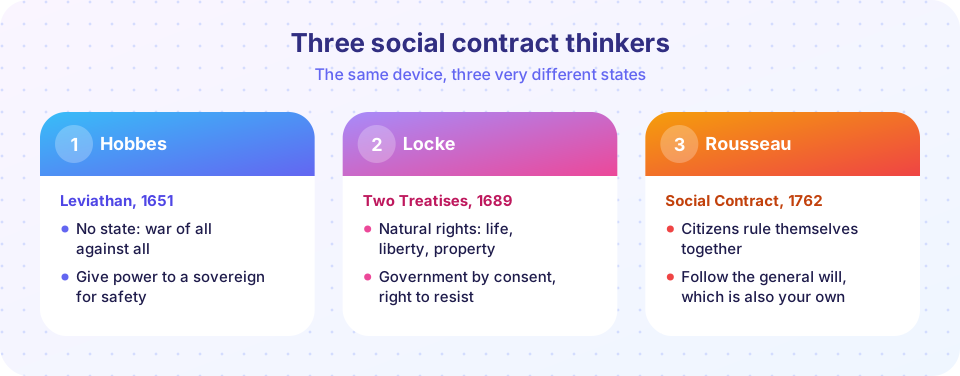
Thomas Hobbes wrote Leviathan (1651) in the shadow of the English Civil War. He asked what life would be like without any common power. People are roughly equal in strength and vulnerability, they compete for the same goods, they distrust one another, and each may strike first out of fear. The result, he argued, is a "war of all against all", in which there is no industry, no culture and life is, in his famous phrase, "solitary, poor, nasty, brutish, and short".
The way out is a contract: everyone gives up the right to use force at their own discretion and transfers it to a sovereign who can enforce peace. Because the point of the contract is safety, Hobbes thought the sovereign needs very strong power, undivided and not subject to the law. But the sovereign's claim ends if it cannot protect you. His conclusion is authoritarian, but his argument starts from individual self-interest, a novel move at the time.
Locke: rights and limits
John Locke's Second Treatise of Government (1689) paints the state of nature as less grim. There is a law of nature that applies even without government: no one may harm another's life, liberty or property. The problem is that everyone must judge and punish for themselves, which is unreliable and biased. So people consent to form a government to protect the rights they already have. Because the purpose is to protect rights, the government is limited: if it violates them systematically, the people may remove it. Locke's ideas deeply influenced later declarations of rights, including the American Declaration of Independence (1776), though the extent of that influence is debated.
Rousseau: freedom through self-rule
Jean-Jacques Rousseau opens The Social Contract (1762) with: "Man is born free, and everywhere he is in chains." He did not want to return to nature; he asked how we could live in society and still be free. His answer: obey laws that you yourselves make together. Through the contract, each person places themselves under the general will, which aims at the common good. Because you take part in making the law, you obey only yourself. Critics worry about the danger of this idea: who decides what the general will is, and what happens to the minority? Rousseau's phrase that people may be "forced to be free" has been read as both a deep insight and a warning.
Objections to contract theory
- Nobody signed. David Hume (Of the Original Contract, 1748) pointed out that real states were founded by force and custom, not contract, and that "tacit consent" by staying is a weak notion: he compared it to a man carried aboard a ship while asleep, who is then said to consent to the captain by not jumping into the sea. Hume suggested that we obey because it is useful, which is a different justification.
- Hypothetical consent is not consent. "You would have agreed" is not the same as "you agreed". Critics say a promise you never made does not bind you; defenders answer that the hypothetical agreement is a test of justifiability, not a promise.
- Who is left out? Historically the contract excluded women, the poor, enslaved people and colonized peoples. Carole Pateman (The Sexual Contract, 1988) and Charles Mills (The Racial Contract, 1997) argued that the contract tradition rested on hidden agreements that kept some groups subordinate. Others use the contract method to argue for inclusion.
Common misconceptions. (1) "The social contract was a real historical event." The thinkers treated it as a test of justification, though some wrote as if early peoples did consent. (2) "Hobbes thought people are simply evil." He said they are self-interested and fearful; the conclusion follows from the structure of the situation. (3) "The contract theory justifies whatever government exists." Locke's version justifies resistance to bad governments.
Try it
The first demo is a very simple game-theory model of the state of nature. It is an illustration of one idea, not a historical or empirical claim.
Press Run (or Ctrl + Enter) to see the result here.
Program input · what you'd type while the program runs
Type the answers before you press Run, one per line. Each time the program reads a line (with input()), it gets the next line from this box.
Press Run (or Ctrl + Enter) to see the console output here.
No output.
Check your understanding
Quick check · 5 questions
of 5 answered You scored / 5 · perfect!
-
1. Why did Hobbes think we need a sovereign?
Safety is the point of the contract. -
2. What makes Locke's government limited?
Because the contract protects life, liberty and property, systematic violations justify resistance. -
3. What is Rousseau's general will?
It is not simply the sum of private wishes. -
4. What was Hume's main objection to contract theory?
He argued that states are founded on force and custom and that obedience rests on utility. -
5. What does hypothetical consent claim?
Critics ask whether a merely possible agreement binds anyone.
Summary
- The social contract tests authority by asking what free and equal people would agree to.
- Hobbes: strong sovereign for peace. Locke: limited government to protect rights. Rousseau: citizens ruling themselves.
- Hume and later critics say consent is a fiction and the contract left some groups out.
- A simple game shows how enforcement can make cooperation stable.
Next: Justice and fairness
Track your progress
Create a free account to tick off lessons and pick up where you left off on any device.
of Introduction to Philosophy lessons completed