


















Lesson 7 of 44 · What Is Philosophy
Socrates and the Socratic Method
Meet Socrates, the Athenian who questioned everyone, learn how the Socratic method of cross-examination works, and see why the Euthyphro question still matters.
Socrates wrote nothing. Yet nearly everything we call philosophical conversation descends from the way he talked: stopping people in the marketplace of Athens, asking them what they meant by words like "courage" and "justice", and gently showing that they did not know as much as they thought. He was put to death by his city in 399 BCE, and the dialogues of his student Plato turned him into the most famous figure in the history of philosophy.
This lesson sets Socrates in his world, explains the method that bears his name, and applies it to a question that is still discussed in ethics and religion today.
What you will learn
- Who Socrates was and how we know about him.
- How the Socratic method (the elenchus) works step by step.
- What the Euthyphro question asks and why it is important.
- What Plato and Aristotle added.
Key terms
- Elenchus: Socratic cross-examination, which tests a definition by drawing out its consequences.
- Aporia: a state of puzzlement in which one realizes the first answer fails.
- Dialogue: Plato's writing form, a conversation between characters.
- Socratic problem: the difficulty of recovering the real Socrates from sources that differ.
Before Socrates
The earliest Greek thinkers, from around 600 BCE, lived in cities on the coast of what is now Turkey and in southern Italy. Thales of Miletus asked what the world is made of and proposed water. Heraclitus stressed constant change; Parmenides argued that change is an illusion. These are called the Presocratics, and they asked about nature. Socrates, who was born around 470 BCE, turned attention to how we should live.
What we know about Socrates
Socrates was an Athenian, the son of a stonemason and a midwife according to later sources, who fought as a soldier and then spent his days in conversation. We know him mainly through three authors: his student Plato, his admirer Xenophon, and the comic playwright Aristophanes, who mocked him in The Clouds (423 BCE). They paint different pictures, so the Socratic problem is real: scholars cannot be sure how much of Plato's Socrates is the historical man and how much is Plato's own thought. Early Plato dialogues (such as Euthyphro, Apology and Crito) are usually thought to be closest to the historical figure.
In Plato's Apology, Socrates recounts that a friend asked the oracle at Delphi whether anyone was wiser than Socrates, and the oracle said no. Puzzled, Socrates questioned people with a reputation for wisdom and found that they thought they knew things they did not. He concluded that he was wiser only in this small respect: he did not think he knew what he did not know. The slogan "I know that I know nothing" is a later paraphrase; his claim was more modest and more precise.
In 399 BCE a jury of several hundred Athenian citizens convicted him of impiety and of corrupting the young. He was sentenced to death by drinking hemlock. In the Apology he declares that "the unexamined life is not worth living for a human being", which became a motto for the whole subject.
The Socratic method in five moves
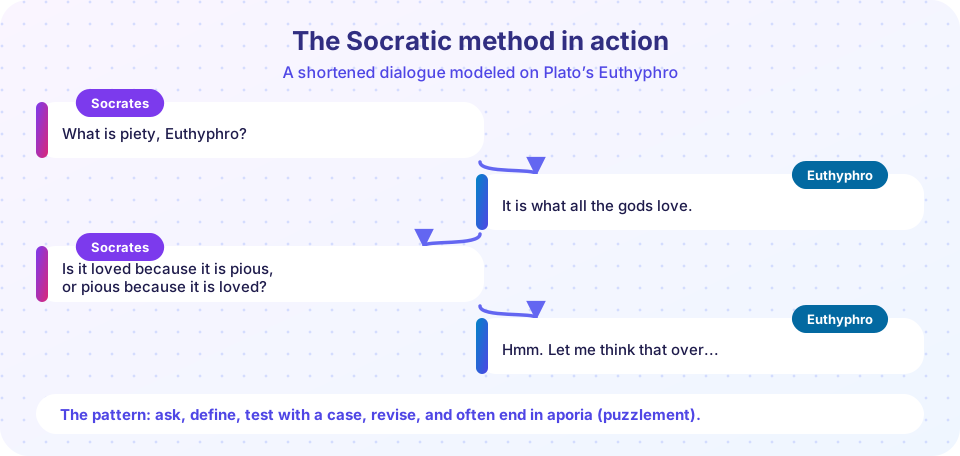
Socrates' typical conversation, called an elenchus (cross-examination), runs like this:
- Ask a "What is X?" question. What is courage? What is piety?
- Elicit a definition. The partner offers an answer, usually confident.
- Test it with a case. Socrates builds a counterexample or draws a consequence.
- Spot the tension. The partner realizes that the definition clashes with something else they believe.
- Revise, or end in aporia. A new definition is offered and tested, or the dialogue ends in honest puzzlement.
Notice what the method does not do: Socrates seldom states his own view. The partner's own beliefs do the work. Modern teachers use a relaxed version, called the Socratic method in law schools and seminars, where questions lead students to examine their reasoning.
A worked example: the Euthyphro dilemma
In Plato's Euthyphro, Socrates meets a man who is about to prosecute his own father for a death and is confident that this is pious. Socrates asks for a definition of piety. Euthyphro first says that piety is what the gods love. Socrates points out that the gods quarrel, so some acts would be loved by some gods and hated by others, and so be both pious and impious. Euthyphro refines: piety is what all the gods love. Then comes the question that made the dialogue famous: is the pious loved by the gods because it is pious, or is it pious because the gods love it?
The two options are not equivalent:
| Option | Meaning | Problem |
|---|---|---|
| Loved because pious | Piety has a nature of its own that the gods recognize | Then piety is explained independently of the gods, so "what the gods love" is not the definition |
| Pious because loved | Whatever the gods love becomes pious by their say-so | Then piety looks arbitrary: if they loved cruelty, cruelty would be pious |
Translated into modern ethics: is something good because God commands it, or does God command it because it is good? Defenders of religious ethics have given many replies (for example, that God's nature is the standard of goodness, so neither horn applies), and critics have replied in turn. You do not have to settle it here, but notice how a short exchange exposes the structure of a debate that continues.
Plato and Aristotle
Plato (around 428 to 348 BCE) founded the Academy in Athens around 387 BCE, the model for later universities. He wrote dialogues on knowledge, justice, love and the soul, and argued that behind changing things there are unchanging Forms, like Beauty itself. Aristotle (384 to 322 BCE) studied at the Academy for twenty years, then founded his own school, the Lyceum. He wrote on logic, biology, ethics, politics and physics, and his syllogistic logic dominated European thought for two thousand years. You will meet both again in later lessons.
Try the Socratic method on yourself. Take a word you use often, such as "fair" or "freedom", write your best definition, then try to find a case that fits the definition but is not what you mean, or a case you mean that does not fit.
Common misconceptions
"Socrates said he knew nothing." He claimed to lack the kind of expert knowledge others claimed, while holding firm views, such as that doing wrong harms the wrongdoer more than the victim.
"Socrates taught students a doctrine." He denied teaching anyone anything. He said he helped people examine their own beliefs, comparing himself to a midwife (a metaphor from Plato's Theaetetus).
"The Socratic method is just asking questions." Its force comes from testing the answers against cases and against the partner's other beliefs.
Try it
Press Run (or Ctrl + Enter) to see the result here.
Program input · what you'd type while the program runs
Type the answers before you press Run, one per line. Each time the program reads a line (with input()), it gets the next line from this box.
Check your understanding
Quick check · 6 questions
of 6 answered You scored / 6 · perfect!
-
1. Why is there a 'Socratic problem'?
We know him through others' writings, and scholars debate how much of Plato's Socrates is historical. -
2. What is an elenchus?
Elenchus (cross-examination) is the core of Socratic method: asking for a definition and testing it with cases. -
3. What does the Euthyphro question ask?
It asks which comes first, piety or the gods' approval, and in modern form asks whether something is good because God commands it. -
4. Which statement about Socrates is most accurate?
The Apology presents him as wiser only in recognizing his ignorance, but he still defended definite moral convictions. -
5. What is aporia?
Many early dialogues end in aporia, with the partners admitting that they do not yet know the answer. -
6. Which school did Plato found?
Plato founded the Academy around 387 BCE. Aristotle later founded the Lyceum.
Summary
- Socrates (c. 470 to 399 BCE) questioned Athenians about how to live and was executed on charges of impiety.
- We know him through Plato, Xenophon and Aristophanes, so the Socratic problem remains.
- The elenchus asks for a definition, tests it with cases, and ends in revision or aporia.
- The Euthyphro dilemma still structures debates about morality and religion.
- Plato's Academy and Aristotle's Lyceum carried the tradition forward.
Track your progress
Create a free account to tick off lessons and pick up where you left off on any device.
of Introduction to Philosophy lessons completed