


















Lesson 12 of 44 · Logic and Argument
Deduction, Induction and Abduction
Compare deductive certainty with inductive probability and inference to the best explanation, learn what makes an inductive argument strong, and meet the black swan.
Valid arguments guarantee their conclusions, but most of our everyday reasoning does not work that way. You decide the milk is spoiled because it smells sour. A doctor suspects a cause because it best explains the symptoms. A scientist trusts a law because it has held in every test so far. None of these is deductively valid, yet they are often excellent reasoning. They belong to the other two main families: induction and abduction.
This lesson maps the three families, shows how to judge the strength of an inductive argument, and introduces one of philosophy's most famous worries about it: if induction can never be certain, why trust it?
What you will learn
- The difference between deduction, induction and abduction.
- What makes an inductive argument strong or weak.
- Common kinds of induction: generalization, analogy and causal reasoning.
- Why correlation does not establish causation.
Key terms
- Deduction: reasoning in which the conclusion follows with certainty if the premises are true.
- Induction: reasoning from cases to a probable general claim or prediction.
- Abduction: reasoning to the best explanation of the evidence.
- Strong argument: one whose premises, if true, make the conclusion probable.
- Cogent argument: strong, with all premises true.
Deduction: certainty if the premises hold
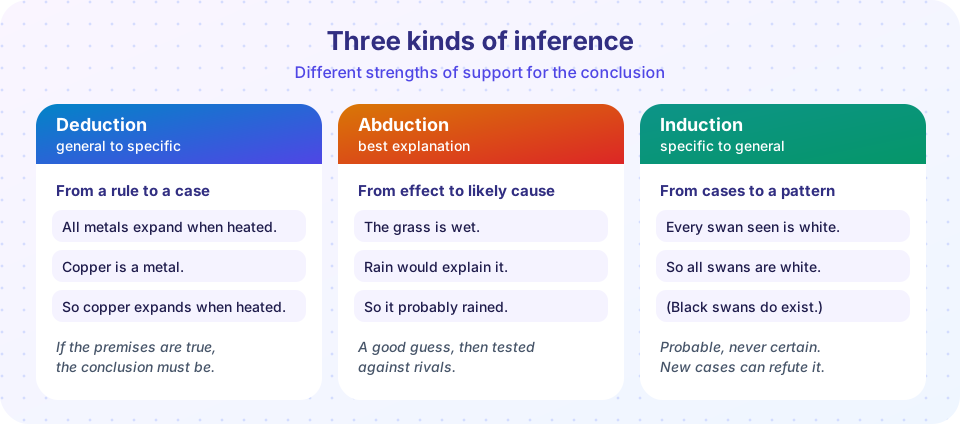
In a deductive argument the conclusion is already contained in the premises. From "All metals expand when heated" and "Copper is a metal" it follows with certainty that "Copper expands when heated". Nothing new about the world is added: deduction makes explicit what was implicit. That is why it can be certain, and also why it cannot, by itself, discover new facts about nature.
Induction: from cases to patterns
An inductive argument goes beyond its premises. "Every swan I have seen is white, so all swans are white" claims something about swans I have not seen. That is a source of power (science depends on it) and of risk. However many white swans you collect, the conclusion is never guaranteed. In the seventeenth century European explorers found black swans in Australia, and a belief that had been supported by every European observation had to go.
Inductive arguments are not valid or invalid. They are strong or weak, by degree, and when the premises are also true they are cogent.
What makes an inductive generalization strong?
- Sample size: more cases generally mean a more reliable pattern, though with diminishing returns.
- Representativeness: the sample must resemble the whole group. A poll that reaches only people who answer landlines misrepresents the population.
- Variety: observations from different circumstances strengthen the case.
- Modesty: "most swans I have seen are white" is easier to support than "all swans are white".
- No known counterexamples: one genuine counterexample defeats a universal claim.
Argument by analogy
Another form compares two things: "My phone and my friend's phone are the same model, hers lasts all day, so mine will too." Strength depends on how many relevant similarities there are and whether any important difference is ignored (perhaps my phone is five years old).
Causal reasoning
We often reason about causes: "Since I started a morning walk, I sleep better." Here two cautions apply. First, correlation is not causation: two things that move together may both be caused by a third. Ice cream sales and drownings both rise in summer, but neither causes the other: warm weather increases both. Second, the order of events does not prove a cause: the rooster crows before dawn, but does not make the sun rise. Careful studies use controls, comparison groups and randomization to separate cause from coincidence.
Abduction: inference to the best explanation
The philosopher Charles Sanders Peirce (1839 to 1914) named a third kind of inference, abduction, which starts from a surprising observation and proposes the hypothesis that would best explain it. You find your garden wet: the best explanation might be that it rained overnight. A physician infers an infection from a fever and a rash. Abduction is how hypotheses are generated; they are then tested by deduction (what else should be true if the hypothesis holds?) and induction (do the new observations match?).
A good explanation tends to fit all the evidence, be simple, explain without ad hoc additions and make testable predictions. Rival explanations must be ruled out: the wet grass might also come from a sprinkler.
Hume's worry about induction
The Scottish philosopher David Hume (1711 to 1776) pressed a deep question. Our belief that the sun will rise tomorrow rests on the fact that it has risen on every previous day. But that reasoning assumes that the future will resemble the past. How do we know that? Not by deduction: it is not a contradiction to suppose nature changes. Not by induction, because that would use the very principle in question. So, Hume suggested, our reliance on induction is a habit of the mind, not something reason can prove.
Philosophers have responded in many ways. Karl Popper argued that science does not need induction because it works by trying to refute hypotheses (a theory that survives severe tests is corroborated, not proven). Others defend induction as a successful practice, or argue that without it there would be no reason to expect anything at all. This is a first taste of the problems of chapter 4.
Common misconceptions
"Deduction goes from general to specific and induction from specific to general." This slogan is a rough guide, but not exact. Some deductions have general conclusions, and some inductions have specific ones. The real difference is whether the premises guarantee the conclusion.
"Induction is unreliable, so science is just guessing." Inductive reasoning, used with care, is the backbone of well-tested knowledge. Hume's challenge is a philosophical one about justification, not a reason to ignore evidence.
"A larger sample always means a better result." A huge unrepresentative sample can mislead more than a small random one.
"Correlation proves nothing." It is evidence worth investigating. It simply does not prove causation by itself.
Try it
Press Run (or Ctrl + Enter) to see the result here.
Program input · what you'd type while the program runs
Type the answers before you press Run, one per line. Each time the program reads a line (with input()), it gets the next line from this box.
Press Run (or Ctrl + Enter) to see the console output here.
No output.
Check your understanding
Quick check · 6 questions
of 6 answered You scored / 6 · perfect!
-
1. What best separates deduction from induction?
The key difference is the strength of support. Valid deduction guarantees the conclusion; induction only makes it more or less probable. -
2. Which of these would weaken an inductive generalization the most?
If the sample does not resemble the whole population, even a large sample can be misleading. -
3. Wet grass leads you to think it rained overnight. This is
You pick the hypothesis that best explains the observation, while remaining open to rivals such as a sprinkler. -
4. Ice cream sales and drownings both rise in summer. What should you conclude?
A shared cause (a confounder) can produce a correlation with no direct causal link. -
5. Hume's problem of induction asks
Justifying induction seems to require assuming that nature is uniform, which is itself an inductive assumption. -
6. A cogent argument is
Cogency is the inductive counterpart of soundness: strength plus true premises.
Summary
- Deduction guarantees its conclusion; induction supports it to a degree; abduction picks the best explanation.
- Inductive strength depends on sample size, representativeness, variety and modesty of the claim.
- Beware confusing correlation with causation.
- Peirce named abduction; Hume asked what justifies induction; Popper stressed refutation.
Track your progress
Create a free account to tick off lessons and pick up where you left off on any device.
of Introduction to Philosophy lessons completed