


















Lesson 26 of 44 · Free Will and Personal Identity
Free Will and Determinism
Laplace's demon, the consequence argument, libertarianism, hard determinism and the Libet experiments, explained with care for what science does and does not show.
Last night you decided what to have for dinner. It felt like a choice: you weighed some options and picked one. But your decision was produced by your brain, which is made of matter obeying physical laws, shaped by your genes and your history. If all of that was already in place before you were born, in what sense were the other options really open? This lesson lays out the problem, the best-known argument that makes it sharp, and the four main positions.
What you will learn
- What determinism is and how it differs from fatalism and from predictability.
- How the consequence argument works, and where critics push back.
- The four positions: compatibilism, hard determinism, libertarianism and luck skepticism.
- What the Libet experiments and their successors do and do not show.
Key terms
- Determinism: given the laws of nature and the state of the world at one time, exactly one future is possible.
Incompatibilism: free will and determinism cannot both be true.
Libertarianism (in this debate): determinism is false and we have free will. It has nothing to do with the political view.
Hard determinism: determinism is true and so there is no free will.
Principle of alternate possibilities: you are responsible only if you could have done otherwise.
Laplace's demon
In 1814 the French mathematician Pierre-Simon Laplace imagined an intellect that knew the positions and forces of every particle in the universe at one moment, and could compute with them. For such a being, he wrote, nothing would be uncertain: the future, like the past, would be present to its eyes. Philosophers call it Laplace's demon. It is a way of stating determinism, not a prediction that such a being could exist.
Two points prevent confusion. First, determinism is not fatalism. Fatalism says that what will happen will happen whatever you do. Determinism says what happens is fixed by causes, including your choices. Second, determinism is not the same as predictability. The logistic map in the demo below is deterministic but, for practical purposes, unpredictable, because tiny differences in the starting point grow quickly.
Is determinism true? Classical physics was deterministic. Standard interpretations of quantum mechanics include real chance, but some interpretations (such as Bohm's) are deterministic, and in any case the brain operates at scales where the average behavior is hard to link with single quantum events. So physics alone has not settled it, and philosophers consider both possibilities.
The consequence argument
The most influential argument for incompatibilism is Peter van Inwagen's consequence argument (1983). It says: if determinism is true, our acts are consequences of the laws of nature and events in the remote past; but it is not up to us what the laws are or what happened before we were born; so the consequences are not up to us either.
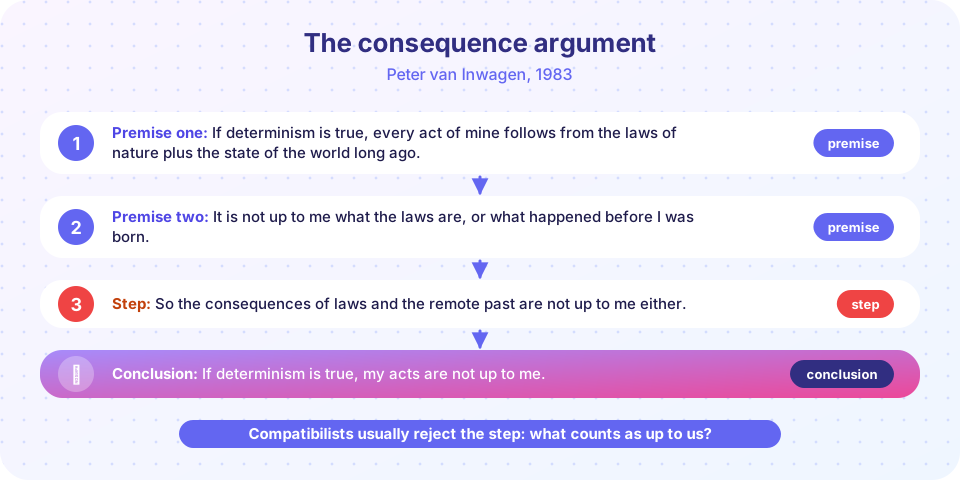
The argument is strong because it is hard to find a premise to reject. Compatibilists usually reject the transfer from "not up to me" to "the consequences are not up to me", or argue that "could have done otherwise" means "would have done otherwise if I had chosen otherwise", a different, conditional reading. The next lesson follows that route.
Four answers
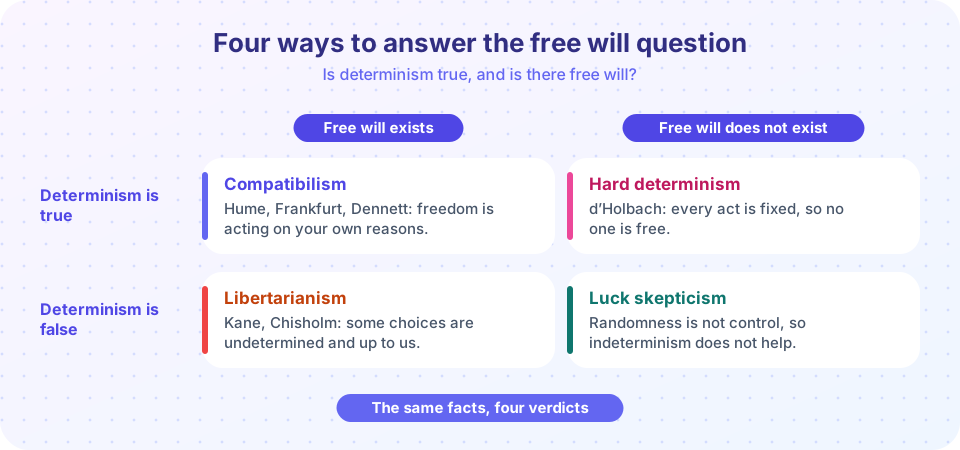
- Hard determinism (the 18th-century Baron d'Holbach is a classic source). Determinism is true; so, because we are not ultimately the source of our choices, there is no free will. Contemporary versions (Derk Pereboom's hard incompatibilism) allow that determinism might be false but claim that neither determinism nor chance gives the control that moral responsibility needs.
- Libertarianism. Determinism is false and we have free will. Some libertarians (Roderick Chisholm) appeal to agent causation: the agent, not just prior events, causes the act. Others (Robert Kane) look for event-causal accounts, where indeterminacy in the brain at moments of struggle ("self-forming actions") gives us alternatives, and our own efforts decide between them.
- Compatibilism. Free will is compatible with determinism. This is perhaps the most common view among professional philosophers, though surveys do not show unanimity.
- Luck skepticism. Indeterminism does not help. If your choice is a random event, it is no more yours than if it were caused: it just happens. This is the luck objection to libertarianism.
What does neuroscience show?
In 1983, Benjamin Libet and colleagues asked people to flex a wrist whenever they felt like it, and note on a fast-moving clock when they became aware of the urge. EEG recordings showed a slow build-up of brain activity (the "readiness potential") beginning hundreds of milliseconds before the reported moment of awareness. Many commentators claimed that this shows free will is an illusion.
The conclusion is much less secure than the headline. The task is an arbitrary flick, not a deliberate decision about something that matters. Reporting the moment you became aware of an urge is difficult and imprecise. Later work (for example by Aaron Schurger and colleagues in 2012) suggested the readiness potential may reflect background fluctuations in neural activity that the brain tips over a threshold, not a prior decision. Functional MRI studies found patterns that predict a simple left or right choice several seconds ahead, but only somewhat better than chance. These studies show that processes outside awareness contribute to decisions. They do not show that your reasons play no role, and they do not settle determinism.
Common misconceptions. (1) "If determinism is true, nothing I do matters." Your choices are among the causes of what happens; that is the difference from fatalism. (2) "Quantum randomness gives us free will." Randomness is not control (the luck objection). (3) "Believing there is no free will makes people behave worse." A well-known 2008 study (Vohs and Schooler) reported that reading an anti-free-will passage increased cheating, but larger replication attempts did not find a reliable effect, so treat it as unsettled.
Try it
Press Run (or Ctrl + Enter) to see the result here.
Program input · what you'd type while the program runs
Type the answers before you press Run, one per line. Each time the program reads a line (with input()), it gets the next line from this box.
Check your understanding
Quick check · 5 questions
of 5 answered You scored / 5 · perfect!
-
1. What distinguishes determinism from fatalism?
In a deterministic world your deliberation is part of the causal chain. -
2. What is the central idea of the consequence argument?
From 'laws and the past are not up to us' it concludes the acts that follow from them are not up to us. -
3. Which position says determinism is true and there is no free will?
Hard determinism accepts determinism and rejects free will. -
4. What does the 'luck objection' say?
Indeterminism may remove the cause, but it does not add control. -
5. What is a reasonable conclusion from the Libet experiments?
The task, the timing measure and the meaning of the readiness potential are all disputed.
Summary
- Determinism is a thesis about laws and states, not about fate or predictability.
- The consequence argument supports incompatibilism with few assumptions.
- Four positions: compatibilism, hard determinism, libertarianism, luck skepticism.
- Neuroscience shows that unconscious processes contribute to decisions; it has not refuted free will.
Track your progress
Create a free account to tick off lessons and pick up where you left off on any device.
of Introduction to Philosophy lessons completed