


















Lesson 21 of 44 · Mind and Reality
Dualism and the Mind-Body Problem
Descartes, the interaction problem, property dualism, epiphenomenalism and Jackson's Mary: a clear guide to why many thinkers say mind is not just matter.
Imagine that tomorrow a complete map of your brain exists: every neuron, every connection, every chemical level. Would that map contain your toothache? Dualists say it would describe the cause and the behavior, but not the ache itself. This lesson looks at the oldest and most famous answer to the mind-body problem, why it is attractive, and why it has been under pressure for nearly four centuries.
What you will learn
- What dualism claims, and the difference between substance dualism and property dualism.
- How Descartes argued for it and where the argument is weak.
- The interaction problem raised by Princess Elisabeth of Bohemia.
- Why epiphenomenalism and Frank Jackson's "Mary" thought experiment still matter.
Key terms
- Substance dualism: the view that mind and body are two different kinds of thing.
Property dualism: the view that there is one kind of thing (physical), but it has two kinds of properties, physical and mental.
Interactionism: mind and body causally affect each other.
Epiphenomenalism: physical events cause mental ones, but mental events cause nothing.
Leibniz's Law: if A and B are really identical, they share every property.
Descartes and the separate mind
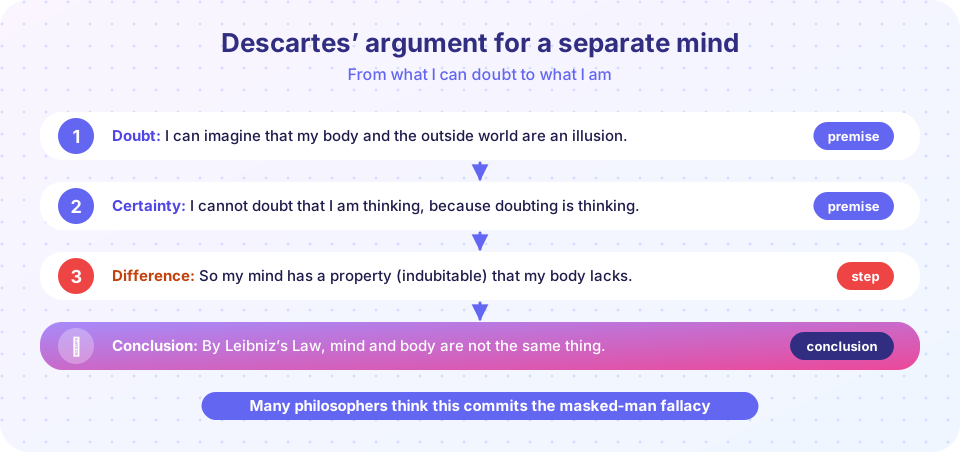
René Descartes published his Meditations in 1641. He began by trying to doubt everything he could. He could imagine that his senses deceive him, even that an evil demon feeds him false experiences. But he could not doubt that he was doubting, and so thinking, and so existing: "I think, therefore I am" (the cogito).
From this he argued that he is, at bottom, a thinking thing (res cogitans) whose essence is thought, while bodies are extended things (res extensa) whose essence is occupying space. Thought has no size or location; matter has both. So they are different kinds of substance.
Where the argument is weak
The key move uses Leibniz's Law: if mind has a property body lacks, they are different. But is "being something I cannot doubt exists" a real property of a thing, or a fact about how I think about it? Consider a classic parallel. You can doubt that the masked man is your father, yet you cannot doubt that your father is your father. Does it follow that the masked man and your father are two people? Not if the masked man is your father: different ways of thinking about one thing do not make two things. Philosophers call this the masked-man fallacy. Descartes' defenders reply that his case is special, because the properties are about the nature of the thing itself. The debate is not settled, but you now know the exact place to push.
Princess Elisabeth's objection
In 1643 Princess Elisabeth of Bohemia wrote to Descartes with a short, sharp question. If the mind is not extended and has no place, how can it push a body? In ordinary physics, pushing needs contact and a surface. Descartes' reply was that mind and body are joined in a "primitive notion" that we understand through lived experience, not geometry, and he proposed that the link happens in the pineal gland, a small midline structure of the brain. Modern anatomy found nothing special there for this role. Elisabeth was not satisfied by the answer, and many philosophers still think her point stands.
Today the same worry appears as an argument from physics. The brain is a physical system, and physics describes it as causally closed: every physical event has a sufficient physical cause. If a nonphysical decision also caused your arm to move, there would be two causes for the same movement, or the energy books would not balance. Defenders of interactionism reply that physics does not actually show that the brain is a closed system, and that a nonphysical influence might change which of several physically allowed outcomes occurs without adding energy. Critics respond that this is speculation with no supporting evidence.
Common misconception. "Dualism is just a religious idea." Dualism has religious versions, but it is also defended on purely philosophical grounds (by David Chalmers, for example, who does not rely on religion). "Physicalism is just what science proves" is also too quick: physicalism is a philosophical thesis about what the sciences ultimately describe, not a laboratory result.
Other forms of dualism
Substance dualism pays a heavy price, so most modern dualists choose something lighter.
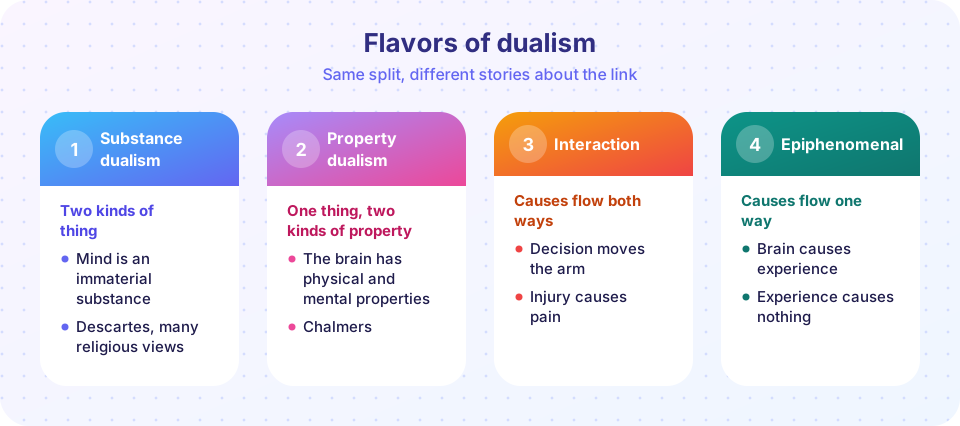
- Property dualism keeps the brain as the only substance but says it has irreducibly mental properties, such as the felt quality of seeing red. It avoids ghost-like stuff but still needs a story about why those properties go with brains.
- Parallelism (Leibniz) and occasionalism (Malebranche) are historical answers: mind and body never interact, but God arranges them to keep in step. Few people hold these today.
- Epiphenomenalism, named in the 19th century (T. H. Huxley compared mental life to the steam whistle of a locomotive), says experience is a by-product: the brain causes it, but it does not cause anything in return. It sits well with physics, but it seems to imply that your pain never makes you say "ouch", which most people find hard to believe.
Mary in the black-and-white room
In 1982 Frank Jackson proposed a thought experiment. Mary is a brilliant scientist who knows every physical fact about color vision: wavelengths, retina, neural processing, the physics of speech about color. But she has lived her whole life in a black-and-white room. When she leaves and sees a red tomato for the first time, does she learn something?
If yes, said Jackson, then there are facts about color experience that are not physical facts, so physicalism is false. Replies vary. Some say Mary gains no new fact, only a new ability (to imagine or recognize red). Others say she learns an old fact in a new way, through a different concept. Interestingly, Jackson himself later rejected his original conclusion (around 2003), which shows that even the author of an argument can change his mind. The thought experiment is useful because it makes the question exact: do the physical facts exhaust the facts?
Try it
The first demo is a small Leibniz's Law checker. The second is a toy energy ledger for the closure argument. Both are demonstrations of the reasoning, not evidence about real brains.
Press Run (or Ctrl + Enter) to see the console output here.
No output.
Check your understanding
Quick check · 5 questions
of 5 answered You scored / 5 · perfect!
-
1. What is the core claim of substance dualism?
Substance dualism says mind and body are two distinct kinds of substance. The other options describe anatomy or idealism. -
2. What was Princess Elisabeth's objection to Descartes?
She asked how something with no location could push a body, which looks like a problem for interaction. -
3. What does epiphenomenalism say about mental events?
Epiphenomena are by-products. Brain events cause experience, but experience has no causal effect. -
4. What is the masked-man fallacy?
Leibniz's Law applies to real properties, not to what someone happens to know or believe about a thing. -
5. What was Jackson's Mary argument meant to show?
If Mary learns something new on seeing red, then complete physical knowledge left something out.
Summary
- Dualism says the mental is not just physical: either a separate substance or an irreducible kind of property.
- Descartes' argument relies on Leibniz's Law and is open to the masked-man objection.
- The interaction problem (Elisabeth, later the closure argument) is the main pressure on substance dualism.
- Property dualism and epiphenomenalism are modern, lighter variants, each with its own costs.
- Jackson's Mary makes the question exact: do physical facts exhaust all facts?
Track your progress
Create a free account to tick off lessons and pick up where you left off on any device.
of Introduction to Philosophy lessons completed