


















Lesson 24 of 45 · Viruses
Viruses: structure and classification
Learn what a virion is made of: capsid shapes, envelopes, DNA and RNA genomes, giant viruses, and the Baltimore system that groups viruses by how they make mRNA.
If you could hold a virion in your hand, you would find that it is almost nothing: a molecule of DNA or RNA and a shell of protein. Yet within that minimal design there is a surprising amount of variety. Some virions are perfect geometric solids, some are rods, some look like lunar landers, and some wrap themselves in a stolen piece of cell membrane.
This lesson gives you the vocabulary and the logic of virus classification. You will see how the parts fit together, why the shell is built from many copies of one or a few proteins, and how virologists organize thousands of different viruses using a scheme that follows one question: how does this virus make messenger RNA?
What you will learn
- The parts of a virion: genome, capsid, capsomers and envelope
- How icosahedral, helical, enveloped and complex virions differ
- Why viruses can have DNA or RNA genomes, single- or double-stranded
- How the Baltimore classification organizes viruses by their route to mRNA
- What viroids and prions are, and why they are not viruses
Key terms
Capsid: the protein shell that surrounds the viral genome.
Capsomer: a visible subunit of a capsid made of several protein molecules.
Nucleocapsid: the capsid together with the genome it contains.
Envelope: a lipid membrane, taken from the host cell, that covers some virions.
Spike (peplomer): a viral glycoprotein sticking out of the envelope that binds the host cell.
The parts of a virion
Every virion has a genome and a capsid. The genome carries the genes. The capsid protects it and, in the simplest viruses, also helps the virion attach to a cell. The idea that protein shells are built from many identical pieces came from Francis Crick and James Watson in 1956. A genome only has room for a few genes, so it cannot encode one giant protein large enough to enclose itself. Instead it encodes a small protein that assembles, copy after copy, into a symmetrical shell. This is efficient: a few genes can build a large, strong structure.
Icosahedral capsids
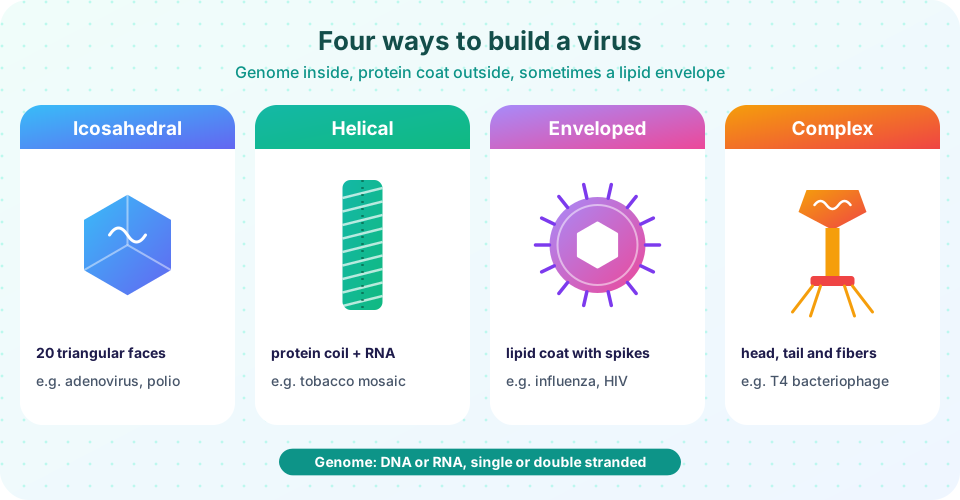
An icosahedron is a solid with 20 triangular faces, 12 corners and 30 edges. It is the most efficient way to build a closed shell from identical subunits, a bit like a soccer ball that has curved plates. Many viruses, including adenoviruses, herpesviruses and poliovirus, use this shape. The simplest icosahedral capsid has 60 identical protein subunits. Larger capsids add more subunits following the Caspar–Klug rules, and their sizes are described by a triangulation number T. A capsid with number T has 60 x T protein subunits, built from 12 pentamers (five-sided clusters at the corners) and 10 x (T − 1) hexamers (six-sided clusters). The calculator at the end of the lesson lets you try this.
Helical capsids
A helical virus has protein subunits stacked in a spiral around the genome, like a spring with RNA threaded through the middle. Tobacco mosaic virus, the first virus ever crystallized, is a rigid rod about 300 nm long and 18 nm wide with 2,130 copies of one coat protein. Helical viruses with an envelope, such as the influenza virus and the measles virus, have a flexible nucleocapsid coiled inside the membrane.
Enveloped viruses
An envelope is a layer of lipid, with embedded viral proteins, wrapped around the nucleocapsid. The virus picks it up as it buds out of an infected cell, so the lipids come from the host. The envelope carries spikes, such as the hemagglutinin of influenza, the spike of SARS-CoV-2 and the gp120 of HIV, which attach to receptors on the next cell. This has practical consequences. Because the envelope is a lipid membrane, it is vulnerable to soap, alcohol and drying. That is why washing hands with soap and water, or using alcohol sanitizer, works well against enveloped viruses. Non-enveloped (naked) viruses, such as norovirus and poliovirus, are tougher and can survive on surfaces and in the gut's acid.
Complex virions
Some viruses do not fit any of these shapes. A T4 bacteriophage has an icosahedral head holding its DNA, a hollow tail, a contractile sheath, a baseplate and tail fibers. The fibers latch onto the bacterial surface, the sheath contracts like a spring, and the tail pushes through the cell wall to inject the DNA, like a syringe. Poxviruses, such as the smallpox virus, are another complex group: brick-shaped, with internal structures, and large enough to be seen in a light microscope at the upper end of the range.
Giant viruses
In 2003 researchers described Mimivirus, found in an amoeba, with a particle about 400 nm across and a genome of roughly 1.2 million base pairs, larger than the genomes of some bacteria. More giant viruses followed, such as Pandoravirus, whose particles reach about a micrometer. Giant viruses blurred the old rule that viruses are always smaller than cells, but they still depend on a host for translation and metabolism.
Genomes: DNA or RNA, single or double
A cell always stores genes in double-stranded DNA. Viruses do not follow that rule. A virus genome can be DNA or RNA but, with rare exceptions, never both in the same virion, and it can be single-stranded or double-stranded, linear or circular, in one piece or split into segments. Influenza A, for example, has eight separate RNA segments. Genome sizes cover a huge range, from a few thousand bases (some phages and parvoviruses, about 5,000) to over a million. The graph in the first demonstration makes that spread visible.
The Baltimore classification
In 1971 David Baltimore, who later shared a Nobel Prize, proposed a classification based on a unifying fact: every virus must make messenger RNA (mRNA) that the host ribosomes can read, because only mRNA can be translated into proteins. The way a virus gets from its genome to mRNA defines seven groups.
| Class | Genome | Path to mRNA | Examples |
|---|---|---|---|
| I | double-stranded DNA | transcribed by host or viral RNA polymerase | adenovirus, herpesviruses, poxviruses |
| II | single-stranded DNA | made double-stranded, then transcribed | parvovirus B19 |
| III | double-stranded RNA | virion carries an RNA polymerase to copy it | rotavirus |
| IV | positive-sense single-stranded RNA | the genome itself is mRNA | poliovirus, SARS-CoV-2, hepatitis C |
| V | negative-sense single-stranded RNA | virion carries a polymerase to make a complementary mRNA | influenza, measles, rabies |
| VI | single-stranded RNA with reverse transcriptase | RNA copied into DNA, then transcribed | HIV |
| VII | double-stranded DNA with reverse transcriptase | RNA intermediate, copied back into DNA | hepatitis B virus |
A positive-sense strand has the same sequence as mRNA, so ribosomes can translate it immediately when it enters a cell. A negative-sense strand is the complement, so the virus must carry its own enzyme to transcribe it. This explains why a negative-sense virion, unlike a positive-sense one, cannot start an infection with its naked RNA alone: the enzyme is a necessary part of the virion. Retroviruses such as HIV carry reverse transcriptase, an enzyme that makes DNA from an RNA template. It is a prime target of anti-HIV drugs, because human cells normally do not have it.
The scheme has limits. It says nothing about how closely related two viruses are, which is handled by the formal taxonomy of the International Committee on Taxonomy of Viruses (ICTV) with ranks from realm to species. But the Baltimore groups are very useful for biology, because they predict what a virus needs to carry and which drugs might work.
Simpler than a virus: viroids and prions
Viroids are short, circular, naked RNA molecules, a few hundred bases long, that infect plants. The potato spindle tuber viroid has about 359 bases. They code for no protein and rely entirely on host enzymes. Prions are infectious proteins with no nucleic acid. A normal protein in the brain, called PrP, can refold into an abnormal shape that causes other PrP molecules to misfold the same way. Prions cause diseases such as Creutzfeldt–Jakob disease in humans, scrapie in sheep and bovine spongiform encephalopathy ("mad cow disease"). Stanley Prusiner proposed the prion idea in 1982 and received a Nobel Prize for it in 1997. Neither viroids nor prions are viruses, since neither has a protein coat around a genome.
Common misconceptions
"Viruses are always smaller than bacteria." Usually, but not always. Giant viruses such as Mimivirus are larger than some bacteria. What defines a virus is its non-cellular, parasitic nature, not its size.
"Viruses are all made of RNA." Many have DNA genomes. Smallpox, herpes and the phage T4 are all DNA viruses.
"The envelope makes a virus stronger." It is the other way round. Enveloped viruses are easier to inactivate with soap, alcohol and drying, though they can be good at evading the immune system.
Try it
First, compare genome sizes. The values are approximate and given in thousands of bases (kilobases, kb) or base pairs. A bacterium is shown for scale.
Press Run (or Ctrl + Enter) to see the result here.
Program input · what you'd type while the program runs
Type the answers before you press Run, one per line. Each time the program reads a line (with input()), it gets the next line from this box.
Second, a calculator for the Caspar–Klug rules. It applies the formulas from this lesson. Real capsids have special cases, so treat it as a model.
Press Run (or Ctrl + Enter) to see the result here.
Program input · what you'd type while the program runs
Type the answers before you press Run, one per line. Each time the program reads a line (with input()), it gets the next line from this box.
Check your understanding
Quick check · 5 questions
of 5 answered You scored / 5 · perfect!
-
1. Why can a small genome build a large capsid?
Repeating identical subunits needs few genes, a principle first pointed out by Crick and Watson. -
2. Where does a virus envelope come from?
Enveloped viruses wrap themselves in host membrane that carries inserted viral spike proteins. -
3. Which genome type can serve directly as mRNA when it enters the cell?
A positive-sense strand has the same sequence as mRNA, so ribosomes can translate it at once. -
4. Which enzyme is carried by retroviruses such as HIV?
It copies RNA into DNA, the first step of the retroviral life cycle. -
5. What makes a prion different from a virus?
Prions are misfolded proteins that spread by converting normal protein, so there is no genome.
Summary
- A virion is a genome (DNA or RNA) in a protein capsid, sometimes inside a host-derived lipid envelope with spikes.
- Capsids are icosahedral, helical or complex; an icosahedral capsid has 60 x T subunits.
- Envelopes make viruses sensitive to soap, alcohol and drying; naked viruses are hardier.
- The Baltimore classification has seven classes that all lead to mRNA, and predicts what enzymes a virion must carry.
- Giant viruses blur the size boundary. Viroids and prions are infectious agents but not viruses.
Track your progress
Create a free account to tick off lessons and pick up where you left off on any device.
of Microbiology lessons completed