


















Lesson 34 of 45 · Microbes and Disease
Antimicrobials and resistance
Learn how antibiotics target bacterial cells, what MIC and spectrum mean, how bacteria become resistant, and what stewardship can do to slow antimicrobial resistance.
In 1928 Alexander Fleming returned from holiday to find that a mold had contaminated one of his bacterial plates and killed the bacteria around it. By the 1940s Howard Florey, Ernst Chain and their colleagues had turned that mold's product, penicillin, into a medicine, and Selman Waksman's work on soil bacteria gave streptomycin, the first drug that worked against tuberculosis. The age of antibiotics had begun, and infections that had killed people for thousands of years became treatable.
The success has come under threat. Bacteria evolve, and wherever antibiotics are used, resistant bacteria are favored. This lesson explains how antibiotics work, how bacteria avoid them and what can be done to keep these medicines working.
Educational information. This lesson explains the biology of antimicrobial drugs. It is not medical advice. Antibiotics should only be taken as prescribed by a qualified health professional.
What you will learn
- The main targets of antibiotics and example drugs for each
- The difference between bactericidal and bacteriostatic, narrow and broad spectrum
- How to read an MIC and a disk diffusion test
- The mechanisms of resistance and how resistance genes spread
- Why resistance is a global problem and what stewardship means
Key terms
Antimicrobial: a drug that kills or stops the growth of microbes; antibiotics act on bacteria.
Selective toxicity: harming the microbe without harming the host.
MIC: minimum inhibitory concentration, the lowest drug concentration that stops visible growth.
Spectrum: the range of bacteria a drug is active against.
Resistance: the ability of a microbe to survive a drug that would normally stop it.
The principle: selective toxicity
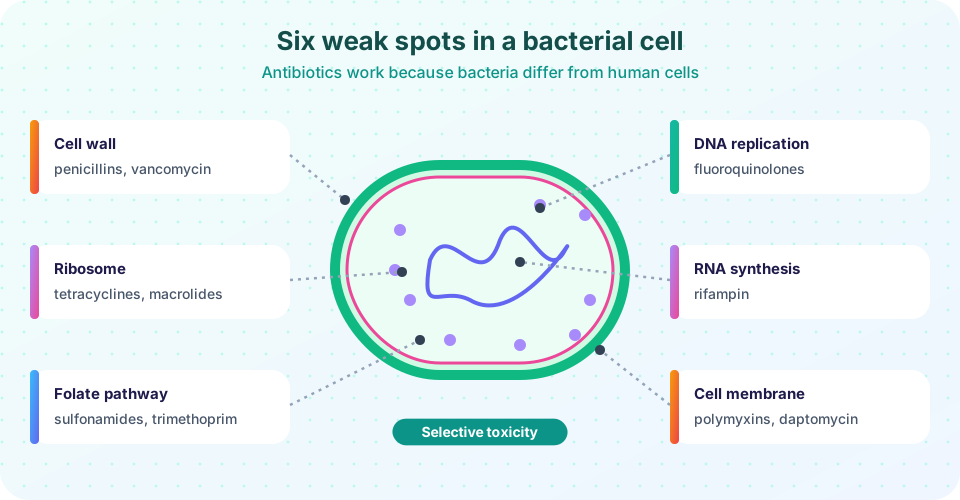
An effective antibiotic has to be toxic to bacteria and safe for people. Paul Ehrlich called such drugs "magic bullets". The trick is to find a target that bacteria have and human cells do not, or one that is clearly different. The picture above shows the six most important targets.
- Cell wall synthesis. Human cells have no cell wall, so a drug that blocks it is very selective. Beta-lactams, such as penicillins and cephalosporins, block the enzymes (penicillin-binding proteins) that cross-link the peptidoglycan. Growing bacteria with a weakened wall burst. Vancomycin binds the ends of the peptidoglycan precursors (D-alanyl-D-alanine) and blocks their use.
- Protein synthesis. Bacterial ribosomes are the 70S type, made of 30S and 50S subunits, different from our 80S ribosomes. Tetracyclines and aminoglycosides (such as gentamicin and streptomycin) bind the 30S subunit; macrolides (erythromycin, azithromycin) and chloramphenicol bind the 50S subunit.
- Folate pathway. Bacteria make their own folate, whereas we obtain it from food. Sulfonamides block one enzyme of the pathway and trimethoprim another, so the two together give a strong double block.
- DNA replication. Fluoroquinolones (ciprofloxacin) block DNA gyrase and topoisomerase IV, bacterial enzymes that manage the coiling of DNA.
- RNA synthesis. Rifampin blocks bacterial RNA polymerase and is a mainstay of tuberculosis treatment.
- Cell membrane. Polymyxins disrupt the outer membrane of Gram-negative bacteria and are reserved for difficult cases because of toxicity; daptomycin depolarizes the membrane of Gram-positive bacteria.
Drugs are also described by how they act. A bactericidal drug kills bacteria (beta-lactams, aminoglycosides), whereas a bacteriostatic drug stops them multiplying and lets the immune system finish the job (tetracyclines, macrolides). A narrow-spectrum drug works on few kinds of bacteria, for example only Gram-positives; a broad-spectrum drug works on many. Narrow drugs do less damage to the microbiota, so they are preferred when the cause is known.
Antibiotics do not work against viruses, which have none of these targets, so taking them for a cold or influenza only adds side effects and promotes resistance. Antiviral and antifungal drugs, described in the chapters on viruses and fungi, have their own targets.
Testing susceptibility
To choose the right drug, a laboratory tests the bacterium. In a broth dilution test, tubes contain a series of two-fold dilutions of the antibiotic (for example 64, 32, 16 ... 0.25 micrograms per milliliter). Each is inoculated with a standard number of bacteria and incubated overnight. The minimum inhibitory concentration (MIC) is the lowest concentration with no visible growth. The MIC is compared with agreed breakpoints, to classify the isolate as susceptible, intermediate or resistant.
In the Kirby–Bauer disk diffusion test, paper disks with antibiotic are placed on an agar plate spread with the bacterium. The drug diffuses outward and bacteria cannot grow where its concentration is high enough, giving a clear zone of inhibition. A bigger zone usually means greater susceptibility.
How bacteria become resistant
Intrinsic resistance is a built-in property: Gram-negative bacteria are naturally protected from some drugs by their outer membrane. Acquired resistance is the more worrying kind, and it appears in two ways: by mutation of the bacterium's own genes, or by acquiring resistance genes from other bacteria.
The main mechanisms are:
- Destroying the drug. Beta-lactamase enzymes cut the beta-lactam ring of penicillins; extended-spectrum beta-lactamases and carbapenemases extend this to more drugs.
- Changing the target. Methicillin-resistant Staphylococcus aureus (MRSA) makes an altered penicillin-binding protein, PBP2a, that beta-lactams cannot bind. Vancomycin-resistant enterococci change the cell wall precursor.
- Pumping the drug out. Efflux pumps in the membrane expel several antibiotics at once.
- Blocking entry. Changes in membrane channels (porins) keep the drug out.
- Bypassing the block. The bacterium takes another route around the blocked enzyme.
Resistance genes spread horizontally, between cells and even between species, through conjugation (direct transfer of plasmids, which are small circular DNA molecules, through a pilus), transformation (picking up free DNA) and transduction (transfer by phages). A single plasmid can carry several resistance genes, so a bacterium can become resistant to many drugs in one step. This is why you will hear of "multidrug-resistant" organisms.
Selection, not creation
An important point is that antibiotics do not cause resistance mutations. Random mutations occur in a population, without regard to the drug; a very few already confer resistance. When the drug is added, it kills the susceptible majority and the resistant ones survive and multiply: this is natural selection. Salvador Luria and Max Delbrück showed in 1943 that the mutations for phage resistance occur before the selective agent is added, and Joshua and Esther Lederberg confirmed it for antibiotics in 1952 with replica plating. The resistance project in chapter 9 simulates this.
The global problem
A study published in 2022 estimated that bacterial antimicrobial resistance directly caused about 1.27 million deaths worldwide in 2019 and was associated with nearly five million. Hospital-acquired infections with MRSA, carbapenem-resistant bacteria and drug-resistant tuberculosis are among the largest threats. Resistance is driven by use: in human medicine, where antibiotics are often given for viral infections or prescribed for too long, and in agriculture, where antibiotics are used in livestock. Poor sanitation and infection control spread resistant bacteria, and few new classes of antibiotics have reached the market in recent decades.
Antimicrobial stewardship is the effort to use these drugs wisely. Measures include prescribing an antibiotic only when it is needed, choosing a narrow-spectrum drug when possible, giving the correct dose for the correct time, following the course as directed by the prescriber, preventing infection in the first place by hygiene and vaccines, improving diagnostics, and cutting unnecessary use in animals. Research aims at new drugs, at phage therapy, and at combinations that block resistance mechanisms, such as a beta-lactam together with a beta-lactamase inhibitor.
Common misconceptions
"My body gets resistant to antibiotics." Bacteria become resistant, not people. Resistant bacteria can infect anyone.
"Antibiotics work on colds and flu." They do not, because these are viral illnesses.
"Resistance appears because bacteria 'learn' from the drug." Resistance mutations arise randomly. The drug selects those that are already present.
Try it
The first demonstration simulates a broth dilution test. The true MIC is a model parameter, and the program shows which tubes show growth. The tubes are a two-fold dilution series.
Press Run (or Ctrl + Enter) to see the result here.
Program input · what you'd type while the program runs
Type the answers before you press Run, one per line. Each time the program reads a line (with input()), it gets the next line from this box.
The second demonstration estimates how many resistant mutants are present before any drug is added, using the Poisson distribution. The mutation rate and population size are model values.
Press Run (or Ctrl + Enter) to see the result here.
Program input · what you'd type while the program runs
Type the answers before you press Run, one per line. Each time the program reads a line (with input()), it gets the next line from this box.
Check your understanding
Quick check · 6 questions
of 6 answered You scored / 6 · perfect!
-
1. Why are beta-lactam antibiotics very selective for bacteria?
Human cells have no cell wall, so blocking its construction harms bacteria but not us. -
2. Which drug class binds the 30S ribosomal subunit?
Tetracyclines and aminoglycosides bind 30S; macrolides bind 50S. -
3. What is an MIC?
MIC is read from the lowest clear tube in a dilution series. -
4. How does MRSA resist beta-lactams?
PBP2a has a low affinity for beta-lactams, so wall synthesis continues. -
5. What did Luria and Delbruck's 1943 experiment show?
The variation in number of resistant colonies showed that mutations occur spontaneously. -
6. Which is an example of antimicrobial stewardship?
Narrow-spectrum use reduces selection pressure and microbiota damage.
Summary
- Antibiotics exploit selective toxicity: cell wall, ribosome, folate, DNA and RNA enzymes, and membranes.
- Drugs are bactericidal or bacteriostatic, narrow or broad spectrum; MIC and disk diffusion tests guide choice.
- Resistance comes from drug destruction, target change, efflux, reduced entry and bypass, and spreads by plasmids, transformation and transduction.
- Antibiotics select for resistant mutants that already exist; they do not create them.
- Stewardship, infection prevention and new research are essential to keep antibiotics working.
Next: Chapter 7 review
Track your progress
Create a free account to tick off lessons and pick up where you left off on any device.
of Microbiology lessons completed