


















Lesson 37 of 45 · Applied and Environmental Microbiology
Food and industrial microbiology
How microbes make bread, yogurt, beer and cheese, how food is kept safe, and how bioreactors produce antibiotics, enzymes and recombinant medicines like insulin.
Fermented foods are among the oldest human technologies. Archaeologists have found evidence of beer and wine making that goes back thousands of years, long before anyone could see a microbe. Cooks learned by trial and error that dough left in a warm place would rise, that milk left standing would thicken and turn sour, and that cabbage packed with salt would keep through the winter. Today we know exactly what is happening: particular microbes are changing the food chemically in ways we like, and their products keep out the microbes we do not want.
Industrial microbiology takes the same idea to a larger scale. A stainless-steel tank of several hundred thousand liters, fed with sugar and air and monitored by computers, is a farm for cells. It is how we make antibiotics, enzymes, vitamins, vaccines and human insulin. This lesson covers both: food microbes and their safety first, then industrial fermentation and genetic engineering.
What you will learn
- What fermentation is in biochemistry and how yeast and lactic acid bacteria differ
- How bread, beer, wine, yogurt, cheese and vinegar are made
- How food is preserved, and the main foodborne pathogens
- How industrial fermenters produce antibiotics, enzymes and other products
- How recombinant DNA technology lets microbes make human proteins such as insulin
Key terms
Fermentation (biochemical): making ATP from sugar without oxygen, with NADH recycled by turning pyruvate into a product such as ethanol or lactate.
Starter culture: a selected mix of microbes added to start a fermentation.
Pasteurization: heating a food to kill most harmful microbes without cooking it.
Recombinant DNA: DNA from different sources joined together, for example a human gene placed in a bacterium.
Secondary metabolite: a product, such as an antibiotic, made after the main growth phase.
The biochemistry of fermentation
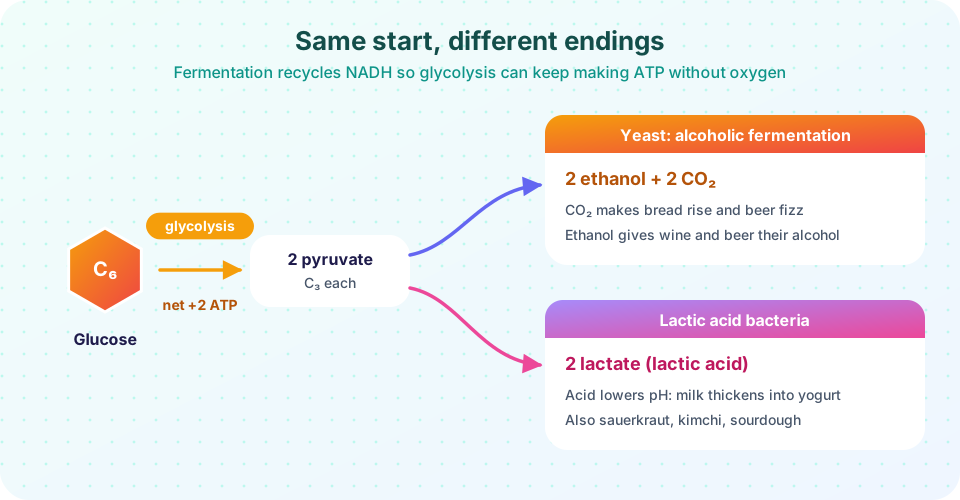
Every cell that uses glucose starts with glycolysis, a ten-step pathway in the cytoplasm that splits one glucose (six carbons) into two pyruvate (three carbons each) and gives a net gain of two ATP and two NADH. If oxygen is available, many organisms burn pyruvate completely in respiration, which gives far more ATP. Without oxygen, a cell still needs to turn NADH back into NAD⁺, or glycolysis would stop. Fermentation does this by using pyruvate, or a molecule made from it, as the electron acceptor. The ATP yield is small, two per glucose, but it is enough to let a cell survive without oxygen, and the end products are the flavors, acids and gases we use.
- Alcoholic fermentation (yeast, some bacteria): pyruvate loses a carbon atom as carbon dioxide to give acetaldehyde, which is reduced to ethanol. Overall: C₆H₁₂O₆ → 2 C₂H₅OH + 2 CO₂.
- Lactic acid fermentation (lactic acid bacteria, muscle cells): pyruvate is reduced directly to lactate. Overall: C₆H₁₂O₆ → 2 C₃H₆O₃.
The first reaction is shown in the demonstration below as a mass balance, which gives a theoretical yield of 0.511 g of ethanol and 0.489 g of carbon dioxide for each gram of glucose.
Food fermentations
- Bread. Saccharomyces cerevisiae ferments sugars from the flour. The carbon dioxide is trapped by gluten and makes the dough rise; the ethanol evaporates during baking. Sourdough adds lactic acid bacteria, which give the sour taste.
- Beer and wine. For beer, barley starch is first converted to sugar (malting and mashing), then yeast ferments the sugars to ethanol. Ale yeasts (S. cerevisiae) work at warmer temperatures, lager yeasts (S. pastorianus) at cooler ones. For wine, yeast ferments grape sugar directly. Fermentation stops when the sugar is gone, or when the alcohol, about 12 to 15 percent by volume, becomes toxic to the yeast.
- Yogurt and cheese. Yogurt is milk fermented by Streptococcus thermophilus and Lactobacillus delbrueckii subsp. bulgaricus, which turn lactose into lactic acid. The falling pH makes the milk protein casein clump into a gel. For cheese, a starter culture acidifies the milk, rennet (the enzyme chymosin) curdles it, the whey is drained, and the curd is salted and ripened. Mold ripens some cheeses: Penicillium roqueforti in blue cheese and P. camemberti in camembert.
- Sauerkraut, kimchi, pickles. Salt draws water from vegetables and favors lactic acid bacteria such as Leuconostoc and Lactiplantibacillus, which acidify the mixture.
- Vinegar. Acetobacter bacteria oxidize ethanol to acetic acid, a process that needs oxygen, so strictly it is not a fermentation but an oxidation.
- Soy sauce and miso. The mold Aspergillus oryzae (koji) breaks down soy protein and grain starch with its enzymes before yeast and bacteria finish the job.
Food preservation and safety
Fermentation itself preserves food: acids and alcohol keep many spoilage microbes out. Other methods control the factors microbes need. Refrigeration slows growth; freezing stops it; drying, salting and sugaring lower water availability; acids (pickling) lower pH; heat kills. In pasteurization, Louis Pasteur's idea, milk is heated to, for example, 72 °C for 15 seconds, enough to kill pathogens such as Salmonella and Listeria while leaving the taste almost unchanged. Canning heats sealed containers: low-acid foods (pH above about 4.6) must be heated to around 121 °C under pressure to destroy the spores of Clostridium botulinum, which produce the deadly botulinum toxin in the absence of oxygen.
The common foodborne pathogens include Salmonella (poultry, eggs), Escherichia coli O157:H7 (undercooked beef, raw vegetables), Listeria monocytogenes (which grows even in the refrigerator and is dangerous in pregnancy), Campylobacter (poultry), Staphylococcus aureus (whose toxin survives cooking) and norovirus. Safe practice follows the chain of infection: keep raw and cooked foods separate, cook to a safe core temperature, chill promptly (the "danger zone" for fast growth is roughly 5 to 60 °C), wash hands and surfaces, and use safe water.
Industrial microbiology
An industrial process starts with a high-performing strain, often developed by decades of selection and mutation. The microbes are grown in a bioreactor: a stirred, aerated, temperature-controlled tank, with probes for pH, oxygen and temperature. In batch culture all the nutrients are added at the start; in fed-batch culture nutrients are added as the culture grows, avoiding overload; in continuous culture medium flows in and out at a constant rate. After the run, downstream processing separates and purifies the product from the broth: filtration, centrifugation, chromatography and crystallization.
The products fall into two groups. Primary metabolites, such as ethanol, amino acids and organic acids, are made during active growth. Citric acid, used in food and drinks, is made on an enormous scale by the mold Aspergillus niger. Secondary metabolites, which include most antibiotics, are produced when growth slows. Penicillin is made by Penicillium chrysogenum in large fed-batch fermenters, and the yield per liter is hundreds of times higher than Fleming's original mold, thanks to strain improvement. Many other antibiotics come from soil bacteria called actinomycetes, especially Streptomyces.
Microbes also make enzymes for industry: amylases and proteases in laundry detergent and starch processing, and lipases and others in baking and leather. The sweetener high-fructose corn syrup is produced with enzymes from bacteria. Biofuels include ethanol fermented from sugar cane or corn starch, and biogas, mainly methane, from the anaerobic digestion of waste by mixed microbial communities. Some bacteria make biodegradable plastics (polyhydroxyalkanoates) as storage compounds. Bacillus thuringiensis makes a protein toxin that kills certain insect larvae and is used as a biological pesticide.
Recombinant DNA: microbes that make human medicines
Diabetes patients once depended on insulin extracted from pig and cow pancreases. In 1978 scientists at Genentech made human insulin in E. coli by joining the human genes to a plasmid. The first recombinant human insulin, Humulin, was approved in 1982, and it was the first genetically engineered human drug. The method is general. A gene for a protein is cut out, or synthesized, and inserted into a plasmid with signals that tell the host to read it; the plasmid is put into bacteria or yeast; the cells are grown in a fermenter and the protein is purified. Today, recombinant microbes produce growth hormone, clotting factors, the hepatitis B vaccine antigen (in yeast), interferons and many therapeutic proteins. Chymosin for cheese making, once taken from calf stomachs, has been made by recombinant microbes since 1990.
Two more microbial tools come from basic research. Taq polymerase, from the heat-loving bacterium Thermus aquaticus, survives the high temperatures of the polymerase chain reaction (PCR), which copies DNA in the laboratory. CRISPR is a bacterial immune system against phages, adapted into a gene-editing method. These examples show that curiosity about bacteria has repeatedly produced technologies nobody planned.
Common misconceptions
"Pasteurized means sterile." Pasteurization kills most harmful microbes but not all; that is why pasteurized milk still spoils and needs refrigeration.
"Cooking always makes food safe." Heat kills most bacteria, but some toxins, such as that of Staphylococcus aureus, survive cooking, and food can be recontaminated after it.
"Fermenting is the same as brewing alcohol." Alcohol is only one of many fermentation products. Yogurt and sauerkraut contain none to speak of.
Try it
The first demonstration is a stoichiometry calculator for alcoholic fermentation. It uses molar masses, a typical actual efficiency of 92 percent, and the density of ethanol to estimate the alcohol content of a wine made from a must with a given sugar concentration.
Press Run (or Ctrl + Enter) to see the result here.
Program input · what you'd type while the program runs
Type the answers before you press Run, one per line. Each time the program reads a line (with input()), it gets the next line from this box.
The second demonstration shows how lactic acid lowers the pH of a solution. It is an unbuffered model, so it is a simplification: real milk is buffered by proteins and phosphate, so more acid is needed to reach the same pH.
Check your understanding
Quick check · 6 questions
of 6 answered You scored / 6 · perfect!
-
1. Why does fermentation recycle NADH?
Glycolysis needs NAD+; fermentation regenerates it by reducing pyruvate or a derivative. -
2. Which microbes make yogurt from milk?
These lactic acid bacteria ferment lactose to lactic acid, which makes the milk protein gel. -
3. Why must low-acid canned foods be heated to about 121 °C under pressure?
The spores are heat resistant and germinate in low-acid, oxygen-free cans, producing botulinum toxin. -
4. How was the first recombinant human insulin produced?
Human insulin genes were joined to a plasmid and expressed in E. coli. -
5. Antibiotics such as penicillin are typically which kind of microbial product?
Antibiotics are secondary metabolites, produced mostly in the later phase. -
6. Which pair is correct?
Acetobacter oxidizes ethanol to acetic acid; blue cheese uses Penicillium roqueforti; beer uses yeast.
Summary
- Fermentation regenerates NAD⁺ without oxygen: yeast makes ethanol and CO₂, lactic acid bacteria make lactate.
- Food fermentations include bread, beer, wine, yogurt, cheese, sauerkraut, vinegar and soy products.
- Food safety uses temperature, pH, water activity, pasteurization, canning and hygiene against pathogens such as Salmonella, E. coli O157:H7, Listeria and C. botulinum.
- Bioreactors run batch, fed-batch or continuous processes and make primary and secondary metabolites, enzymes and biofuels.
- Recombinant DNA lets microbes produce insulin, vaccines and enzymes; Taq polymerase and CRISPR came from basic microbial research.
Next: Environmental microbes
Track your progress
Create a free account to tick off lessons and pick up where you left off on any device.
of Microbiology lessons completed