


















Lesson 16 of 45 · Bacterial Structure and Growth
Chapter 3 Review: Bacterial Structure and Growth
Review the bacterial envelope, appendages, endospores, binary fission, growth curve, oxygen classes and microbial control with a recap table and a ten-question quiz.
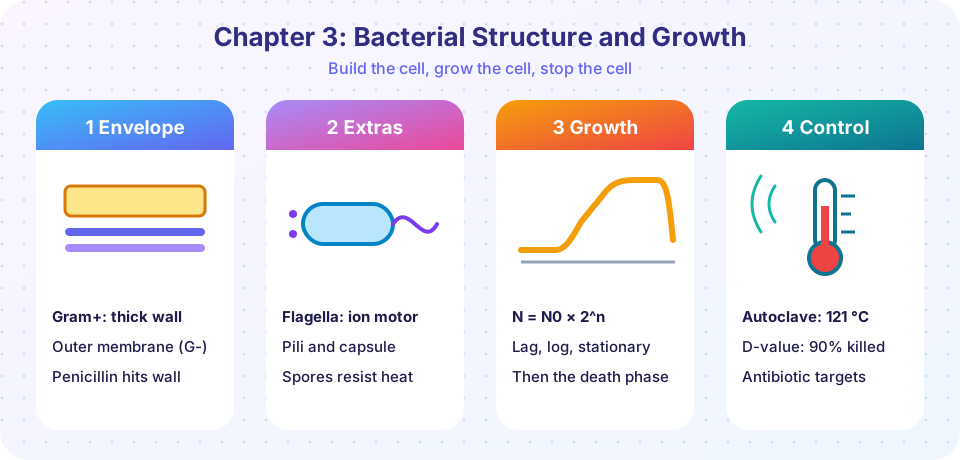
Chapter 3 followed one theme from many angles: a bacterial cell is a small, fast, tough machine, and its structure explains its behavior. The wall holds back the water pressure and decides how the cell answers the Gram stain and penicillin. The appendages let it swim, stick and hide. The endospore lets some species outlast almost anything. The growth curve and the doubling arithmetic describe how a handful of cells becomes billions, and the conditions-and-control lesson shows how we steer that growth.
What you will learn
- The key facts and formulas of Chapter 3.
- How the structures you studied connect to growth and control.
The chapter at a glance
| Lesson | Big idea | Facts and formulas |
|---|---|---|
| Cell envelope | The wall resists osmotic pressure | Π = C R T; Gram+: thick peptidoglycan and teichoic acids; Gram−: thin wall, outer membrane, LPS (lipid A is an endotoxin); penicillin blocks cross-links |
| Shapes, appendages, endospores | Structure fits function | cocci, bacilli, spirals; flagella driven by ion flow; pili attach; capsule hides; spores survive 100 °C |
| Growth curve | Growth means more cells | N = N₀ × 2ⁿ; g = t / n; lag, log, stationary, death |
| Conditions and control | Remove a condition to stop growth | 5 oxygen classes; autoclave 121 °C; t = D × log₁₀(N₀/N); selective toxicity |
Connections
Consider a single event: a surgeon's instrument is contaminated with Bacillus spores. Boiling will not sterilize it because the spores' dehydrated core and coat protect them (Lesson 3.2). An autoclave at 121 °C does, because the moist heat penetrates, and the D-value calculation tells you how long to run it (Lesson 3.4). If a spore survived and germinated in a wound, it would pass through a lag phase and then grow exponentially (Lesson 3.3), unless an antibiotic that blocks wall synthesis caught it while it was growing (Lesson 3.1). Every concept in the chapter shows up in that one story.
Worked mini-problems
Work each one on paper first, then read the solution.
Problem 1. A culture contains 4 × 10⁴ cells/mL and has a generation time of 25 minutes. How many cells/mL after 2 hours 30 minutes of exponential growth? Solution: 150 min ÷ 25 min = 6 generations, so N = 4 × 10⁴ × 2⁶ = 2.56 × 10⁶ cells/mL.
Problem 2. A broth at an OD that corresponds to 10⁶ cells/mL reaches 10⁹ cells/mL in 5 hours. What is the generation time? Solution: log₁₀(10⁹/10⁶) = 3, so n = 3.32 × 3 ≈ 10 generations; g = 300 min ÷ 10 = 30 min.
Problem 3. A heat treatment has D = 0.25 min at a certain temperature. How long to cut a spore population from 10⁸ to 10²? Solution: that is 6 logs, so t = 0.25 × 6 = 1.5 min.
Problem 4. A cell in pure water holds 0.25 mol/L of solute at 37 °C (310 K). What outward pressure does the wall face? Solution: Π = 0.25 × 0.0821 × 310 ≈ 6.4 atm.
Study checklist
Be sure you can sketch both envelope types and label every layer, say which one has LPS, and explain why penicillin kills only growing cells. You should also be able to name three structures that help bacteria survive or colonize (capsule, pili and endospores), define the four phases of the growth curve, convert a generation time into a cell count, list the five oxygen classes with an example of each, and tell sterilization from disinfection.
Mixed practice
Practice problems build speed. Try them before opening the solution.
Review quiz
Quick check · 10 questions
of 10 answered You scored / 10 · perfect!
-
1. Which part of a Gram-negative envelope contains lipid A?
Lipid A anchors LPS in the outer leaflet of the outer membrane. -
2. Penicillin kills growing bacteria because it...
Without cross-links the new wall is weak and the cell bursts. -
3. A cell with internal solute 0.30 mol/L is placed in pure water at 37 °C (310 K). Using Π = C R T with R = 0.0821 L·atm/(mol·K), the pressure is about...
0.30 × 0.0821 × 310 ≈ 7.6 atm. -
4. Which structure is the bacterial equivalent of a compass?
Magnetotactic bacteria align with magnetic fields using chains of magnetosomes. -
5. How does the bacterial flagellar motor get its energy?
Proton (or sodium) flow through the basal body turns the motor. -
6. A population grows from 2 × 10⁴ to 1.28 × 10⁶ cells in 3 hours of exponential growth. What is the generation time?
1.28 × 10⁶ / 2 × 10⁴ = 64 = 2⁶, so 6 generations in 180 min gives 30 min each. -
7. Which growth phase is characterized by a constant doubling time?
Log phase is exponential growth at a constant rate. -
8. An organism requires oxygen for respiration and grows only at the top of a tube. It is...
Obligate aerobes need oxygen and grow where it is available. -
9. Which of these kills endospores?
Autoclaving is the standard method. Alcohol, short boiling and cold do not destroy spores. -
10. What is selective toxicity?
Selective toxicity targets structures or pathways that the host lacks.
Summary
- The envelope, the appendages and the endospore explain how bacteria survive, move, stick and respond to drugs.
- Growth is exponential in the log phase; calculations use
N = N₀ × 2ⁿand generation timeg = t / n. - Oxygen, pH, water activity and temperature limit growth, and heat, filters, radiation, chemicals and antibiotics control it.
Next: Chapter 4 Overview: Metabolism and Genetics of Microbes
Track your progress
Create a free account to tick off lessons and pick up where you left off on any device.
of Microbiology lessons completed