


















Lesson 8 of 45 · The Microbial World
Bacteria and Archaea: Diversity and Extremes
Tour the major groups of bacteria and archaea, from cyanobacteria to methanogens, and learn how temperature, pH and salt define extremophile lifestyles.
Bacteria and archaea are the oldest and most abundant cells on Earth. Their combined numbers are estimated at on the order of 10³⁰ (a 1 followed by 30 zeros), although that figure is a rough estimate. They have been on the planet for at least 3.5 billion years, and in that time they have invented almost every way of making a living that biology has ever used: eating sugar, eating rock, breathing iron, breathing sulfur, making methane, and turning sunlight into chemical energy.
This lesson is a guided tour. You will meet the major groups, learn why microbiologists care so much about habitat, and see how temperature and acidity define the lifestyles of the extremophiles. The goal is not to memorize every genus but to understand what kinds of difference exist among prokaryotes.
What you will learn
- The major bacterial groups and one thing each is known for.
- The main archaeal groups and why they matter.
- How to classify an organism as a psychrophile, mesophile, thermophile or hyperthermophile.
- Why most microbes in nature have never been grown in the laboratory.
Key terms
Extremophile: an organism that grows best under conditions that are extreme for humans.
Mesophile: an organism with an optimum between about 20 and 45 °C; most human pathogens fall here.
Methanogen: an archaeon that makes methane gas as a by-product of its energy metabolism.
Cyanobacteria: photosynthetic bacteria that release oxygen.
Metagenomics: sequencing all the DNA in an environmental sample, without growing anything.
A tour of the bacteria
Bacteria are classified into dozens of phyla. Seven are important to the rest of this course.
| Group | Known for | Examples |
|---|---|---|
| Pseudomonadota (Proteobacteria) | the largest, most varied phylum; includes many Gram-negative pathogens and nitrogen fixers | Escherichia coli, Salmonella, Vibrio cholerae, Rhizobium |
| Bacillota (Firmicutes) | mostly Gram-positive; includes endospore formers and lactic acid bacteria | Bacillus, Clostridium, Staphylococcus, Lactobacillus |
| Actinomycetota (Actinobacteria) | filamentous soil bacteria that make many antibiotics, and the tuberculosis bacterium | Streptomyces, Mycobacterium |
| Cyanobacteria | oxygen-producing photosynthesis | Anabaena, Prochlorococcus |
| Spirochaetota | corkscrew-shaped cells that swim by internal flagella | Treponema pallidum, Borrelia |
| Chlamydiota | tiny parasites that live only inside host cells | Chlamydia trachomatis |
| Bacteroidota | abundant in the human gut, digesting plant fibers | Bacteroides |
Cyanobacteria deserve a moment. Around 2.4 billion years ago their oxygen began to accumulate in the atmosphere, an event called the Great Oxidation Event. It killed off many anaerobic organisms and prepared the way for aerobic life. Cyanobacteria also gave rise to the chloroplasts of plants and algae, as you saw in Three Domains and Classification. Prochlorococcus, a tiny marine cyanobacterium, is probably the most abundant photosynthetic cell on Earth.
Bacteria also vary in size. Most are 0.5 to 5 µm, but some mycoplasmas are only around 0.2 µm, the smallest known free-living cells, while Epulopiscium, a gut bacterium of surgeonfish, reaches about half a millimeter, and Thiomargarita magnifica, reported in 2022, forms filament-like cells up to about two centimeters long and is visible to the naked eye.
A tour of the archaea
Archaea were first found in extreme places, which is why they have a reputation as "extremophiles", but we now know they also live in soil, oceans and the human gut. Four groups to know:
- Methanogens. They get energy by converting hydrogen and carbon dioxide to methane:
4 H₂ + CO₂ → CH₄ + 2 H₂O. They live in oxygen-free places: wetlands, rice paddies, the guts of cattle and termites, sewage digesters. Methane is a strong greenhouse gas, so these archaea matter to climate science. - Halophiles. Extreme halophiles such as Halobacterium thrive in saturated brines like salt lakes and salt-evaporation ponds, often at 15 to 30% salt. Some use a light-driven proton pump (bacteriorhodopsin) that gives their ponds a purple-red color.
- Thermoacidophiles. Sulfolobus grows near 75 to 80 °C at a pH of about 2 to 3 in volcanic hot springs.
- Ammonia-oxidizing archaea. Tiny archaea that are abundant in oceans and soils and oxidize ammonia to nitrite. They are a key part of the nitrogen cycle (Chapter 8).
No archaeon is known to cause an established infectious disease in humans, a notable contrast with bacteria.
Extremophiles and the cardinal temperatures
Every microbe has three cardinal temperatures: a minimum below which it does not grow, an optimum where growth is fastest, and a maximum above which its proteins and membranes fail. The span between them classifies the organism.
| Group | Optimum (approx.) | Example |
|---|---|---|
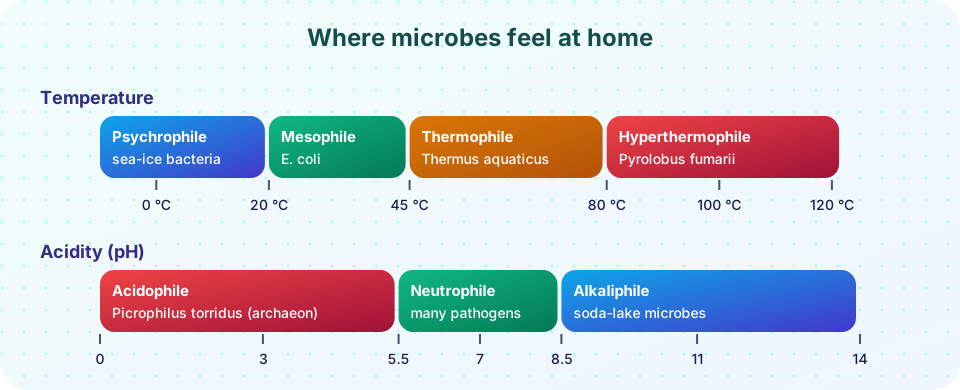
| Psychrophile | 15 °C or lower; does not grow above about 20 °C | bacteria in polar sea ice |
| Mesophile | 20 to 45 °C | E. coli, 37 °C |
| Thermophile | 45 to 80 °C | Thermus aquaticus |
| Hyperthermophile | above 80 °C | Pyrolobus fumarii, up to 113 °C |
The highest temperature at which any organism has been reported to grow is about 122 °C, for an archaeon from a deep-sea hydrothermal vent, where pressure keeps the water liquid. Enzymes from thermophiles are valuable: the heat-stable DNA polymerase of Thermus aquaticus (Taq) made the polymerase chain reaction practical, because it survives the repeated heating steps.
Growth rate does not rise smoothly with temperature. It climbs slowly from the minimum, peaks at the optimum and then crashes within a few degrees as enzymes denature. The plot below uses a standard shape called the cardinal temperature model with invented parameters to show the four classes.
Press Run (or Ctrl + Enter) to see the result here.
Program input · what you'd type while the program runs
Type the answers before you press Run, one per line. Each time the program reads a line (with input()), it gets the next line from this box.
Acid, alkali and salt
The same logic applies to pH and salt. Most microbes are neutrophiles (optimum near pH 7). Acidophiles grow below about pH 5: Picrophilus torridus, an archaeon, thrives near pH 0.7. Alkaliphiles grow above about pH 9, as in soda lakes. Microbes adapt by pumping protons, strengthening membranes and making protective proteins. Halophiles accumulate salts or small organic solutes inside the cell to keep water from leaving.
The great plate count anomaly
If you count the cells under a microscope in a sample of seawater or soil and then count the colonies that grow on a plate, the plate yields only about 1% or even fewer of the microscope count. This is the great plate count anomaly. It does not mean the other cells are dead. It means we do not know how to grow them: they may need other species, slow growth, or unusual conditions. Metagenomics sidesteps the problem by sequencing DNA straight from the environment, and it has revealed whole phyla known only from their genes. The tree of life contains many branches that no one has ever seen alive.
Common misconceptions
"Archaea only live in extreme places." Many archaea live in oceans, soils and animal guts at ordinary temperatures.
"All bacteria cause disease." Most bacteria are harmless or beneficial; cyanobacteria, for example, produce a large part of the oxygen we breathe.
"We know what most microbes look like." Most environmental microbes have never been cultured, so we know many only from their DNA.
Check your understanding
Quick check · 5 questions
of 5 answered You scored / 5 · perfect!
-
1. Which organisms produce methane as a by-product of energy metabolism?
Methanogens are archaea that combine hydrogen and carbon dioxide into methane in oxygen-free habitats. -
2. An organism grows best at 37 °C and cannot grow above about 46 °C. It is a...
Mesophiles have optima between about 20 and 45 °C. -
3. What did the Great Oxidation Event, about 2.4 billion years ago, result from?
Photosynthesis by cyanobacteria released oxygen that accumulated in the atmosphere. -
4. Why is the Taq polymerase important for PCR?
Taq comes from the thermophile Thermus aquaticus, so it is not destroyed by the heating cycles. -
5. The great plate count anomaly refers to...
Most microbes in nature cannot be grown under standard laboratory conditions, so plate counts are far lower than microscope counts.
Summary
- Bacteria include seven key phyla: Pseudomonadota, Bacillota, Actinomycetota, Cyanobacteria, Spirochaetota, Chlamydiota and Bacteroidota.
- Archaea include methanogens, halophiles, thermoacidophiles and ammonia oxidizers; no archaeon is a well-established human pathogen.
- Cardinal temperatures sort microbes into psychrophiles, mesophiles, thermophiles and hyperthermophiles; the same idea applies to pH and salt.
- Most environmental microbes have not been cultured; metagenomics reads their DNA directly.
Track your progress
Create a free account to tick off lessons and pick up where you left off on any device.
of Microbiology lessons completed