


















Lesson 32 of 45 · Microbes and Disease
Infection and pathogenesis
How microbes cause disease: virulence factors, exotoxins and endotoxin, the five stages of infection, transmission routes, Koch's postulates and epidemiology terms.
Why does one bacterium cause a mild stomach upset while a close relative causes a life-threatening illness? Why do some people exposed to the same microbe get sick while others do not? Pathogenesis is the study of how a microbe causes disease, and the answer always has two sides: what the microbe brings (its virulence) and what the host does in response.
This lesson follows a pathogen through a typical infection: how it gets in, how it sticks, how it damages the host and how the disease unfolds in time. You will also see how scientists prove that a specific microbe causes a specific disease, and the vocabulary that epidemiologists use to describe outbreaks.
What you will learn
- The difference between pathogenicity and virulence, and what ID50 means
- The main virulence factors: adhesins, capsules, enzymes, toxins and iron grabbing
- The difference between exotoxins and endotoxin
- The five stages of an infectious disease
- Koch's postulates and their limits, plus key epidemiology terms
Key terms
Pathogenicity: the ability of a microbe to cause disease at all.
Virulence: the degree of harm a pathogen causes; a measure of how severe.
Virulence factor: a molecule or structure that helps a pathogen colonize, invade or damage the host.
ID50: the infectious dose that infects half of the exposed hosts.
Toxin: a poisonous substance made by a microbe.
Getting started: dose, entry and attachment
A microbe has to arrive in sufficient numbers. The infectious dose varies widely. Some pathogens, such as Shigella, can cause disease with only a few tens of cells, while Salmonella usually needs thousands to millions. The ID50 is the dose that infects half of the hosts exposed. Low-dose pathogens spread easily; those that need a high dose usually require food that lets them multiply before it is eaten.
It then needs a way in, the portal of entry. A pathogen that is swallowed has to survive stomach acid and bile. One that is inhaled has to reach the lungs past the mucus and cilia. Skin is a tough barrier, so entry happens through cuts, bites and injections. Each pathogen has a preferred portal: Vibrio cholerae infects only through the gut, and Clostridium tetani spores grow in deep, oxygen-poor wounds.
Next the microbe must attach. Without attachment, it would be swept away by flowing fluids such as urine or washed from the gut wall by peristalsis. Bacteria carry adhesins, proteins on the cell surface or on hair-like pili (fimbriae), that bind specific receptors on host cells. Uropathogenic E. coli has pili that grip the lining of the bladder. Many bacteria also form biofilms, communities embedded in a slimy matrix, on tissues and medical devices such as catheters; cells in a biofilm resist both defenses and antibiotics.
Virulence factors
Once established, pathogens use a toolkit of virulence factors.
- Capsules are slimy polysaccharide layers that make it hard for phagocytes to grab the bacterium. Streptococcus pneumoniae is far more dangerous with a capsule than without one, as shown by Frederick Griffith's 1928 experiments, which later led to the discovery that DNA is the genetic material.
- Enzymes such as hyaluronidase digest the tissue "glue" and help a microbe spread; coagulase from Staphylococcus aureus clots plasma around the bacteria; some enzymes destroy antibodies.
- Iron-grabbing molecules, called siderophores, steal iron from the host, because free iron is scarce in the body and microbes need it.
- Secretion systems are molecular syringes, such as the type III system, that inject bacterial proteins directly into host cells.
- Antigenic variation lets a microbe change surface molecules so that antibodies no longer match. This is how Trypanosoma and influenza virus keep ahead of immunity.
- Intracellular life. Some pathogens, such as Mycobacterium tuberculosis and Listeria, hide inside host cells, even inside the phagocytes that should destroy them.
Toxins
Toxins are the best-known virulence factors, and there are two types.
Exotoxins are proteins secreted by living bacteria (often Gram-positive, but also some Gram-negative). They are usually very potent and specific. Botulinum toxin from Clostridium botulinum blocks the release of acetylcholine at nerve endings and causes paralysis; it is one of the most toxic substances known. Tetanus toxin blocks inhibitory signals in the spinal cord and causes spasms. Cholera toxin makes gut cells pump out water and salts, causing severe watery diarrhea. Diphtheria toxin blocks protein synthesis. Many exotoxins can be turned into toxoids, inactivated forms that make safe vaccines, as for tetanus and diphtheria.
Endotoxin is a part of the outer membrane of Gram-negative bacteria, the lipid A portion of lipopolysaccharide (LPS). It is released when the bacteria die or divide. It is less specific than exotoxins and acts by overstimulating the immune system: fever, a drop in blood pressure and, in severe cases, septic shock. Because endotoxin is not destroyed by heating, it must be removed from injectable medicines.
The stages of an infectious disease
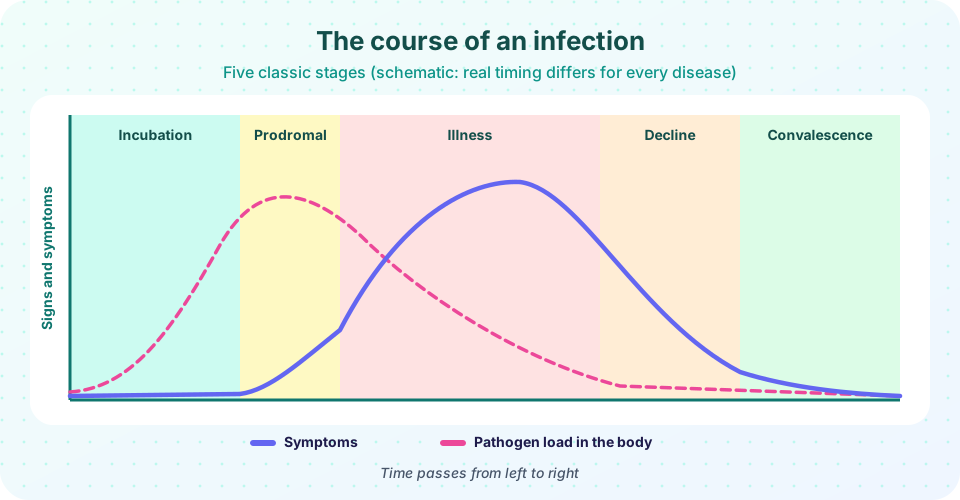
As the graph at the top of the lesson shows, a typical acute infection passes through five stages, although the timing differs greatly.
- Incubation period. The pathogen multiplies, but there are no symptoms yet. It may last hours (food poisoning with Staphylococcus toxin), days (influenza, about one to four) or weeks to years (hepatitis B, HIV).
- Prodromal period. Mild, non-specific symptoms appear, such as tiredness, headache and low fever.
- Illness (acme). The disease is at its peak with characteristic signs and symptoms. Pathogen numbers and the immune response are both high.
- Decline. Symptoms fall as the immune system and treatment gain control.
- Convalescence. The person returns to normal, although some damage may take longer to repair.
In the figure the pathogen load peaks before the symptoms do. This is typical: people can be most infectious before they feel the worst. Some infections are chronic, persisting for a long time, such as hepatitis C, or latent, with the microbe silent and able to reactivate, such as herpes viruses. A subclinical infection produces no noticeable symptoms but can still spread.
Proving a microbe causes a disease
In 1884 Robert Koch, building on work by Friedrich Loeffler, set out criteria for linking a microbe to a disease, now called Koch's postulates:
- The microbe is found in every case of the disease and not in healthy individuals.
- It can be isolated and grown in pure culture.
- The pure culture causes the disease when introduced into a healthy, susceptible host.
- The same microbe can be re-isolated from the experimentally infected host.
They were a landmark for anthrax, tuberculosis and cholera, but they have limits. Some pathogens cannot be grown on artificial media (many viruses, and the leprosy bacterium). Some cause disease only in humans, so the third step cannot ethically be done. Asymptomatic carriers break the first postulate. Some diseases need several microbes. In 1988 Stanley Falkow proposed molecular Koch's postulates, which link a gene to virulence: the gene should be found in pathogenic strains, and removing it should reduce virulence while putting it back should restore it.
Spreading and counting: epidemiology words
How pathogens move between people is the mode of transmission. In direct contact, such as touching or sexual contact, the microbe passes from host to host. Droplets are larger respiratory particles that travel short distances and fall quickly, while smaller aerosols can stay in the air and travel farther, especially indoors. Fomites are objects such as door handles that carry microbes. Vehicles such as food and water carry microbes to many people at once. Vectors, such as mosquitoes, ticks and fleas, carry pathogens between hosts. Vertical transmission is from mother to child, across the placenta or during birth. A zoonosis is an infection transmitted from animals, such as rabies or brucellosis. Healthcare-associated infections are acquired in hospitals.
Epidemiologists also count. The incidence is the number of new cases in a given time, and prevalence is the number of existing cases at a given time. A disease that is regularly present in an area is endemic; a sudden increase above the expected level is an outbreak or epidemic; and one that spreads across continents is a pandemic. The basic reproduction number R₀ is the average number of people one case infects in a fully susceptible population: if R₀ is above 1 the disease spreads, and below 1 it dies out. The case fatality rate is the share of diagnosed cases who die. The SIR model project in chapter 9 explores R₀ with a simulation.
Common misconceptions
"Virulent means contagious." Virulence is about severity; contagiousness is about how easily something spreads. A common cold virus is highly contagious but rarely severe, while rabies is highly virulent but hard to spread from person to person.
"Pathogens evolve to be harmless." Virulence can increase, decrease or stay the same, depending on how the pathogen spreads. If a pathogen needs a sick host to spread, for example by diarrhea, it may remain virulent.
"Endotoxin is the same as exotoxin." Endotoxin is a structural part of Gram-negative cell walls; exotoxins are proteins secreted by living bacteria.
Try it
The first demonstration is a dose-response curve. The simplest model assumes that each microbe has a small independent chance of starting an infection. Then the chance of infection after a dose d is 1 − e^(−r d). The values of r below are invented to show the shapes, not real data for any named pathogen.
Press Run (or Ctrl + Enter) to see the result here.
Program input · what you'd type while the program runs
Type the answers before you press Run, one per line. Each time the program reads a line (with input()), it gets the next line from this box.
The second demonstration is a small model of the course of infection inside one host. The pathogen grows, the immune effectors respond to it, and the pathogen is eventually cleared. It reproduces the shape of the stage graph above. All values are model parameters in arbitrary units.
Press Run (or Ctrl + Enter) to see the result here.
Program input · what you'd type while the program runs
Type the answers before you press Run, one per line. Each time the program reads a line (with input()), it gets the next line from this box.
Check your understanding
Quick check · 6 questions
of 6 answered You scored / 6 · perfect!
-
1. What is the difference between pathogenicity and virulence?
A microbe is pathogenic if it can cause disease at all; virulence measures the degree of harm. -
2. Which statement about endotoxin is correct?
Endotoxin is part of LPS, heat stable, and overstimulates the immune system. -
3. In which stage of disease are symptoms mild and non-specific?
The prodromal stage brings vague symptoms such as tiredness and low fever. -
4. Why can Koch's postulates fail for some pathogens?
Unculturable microbes and human-only pathogens cannot satisfy all steps. -
5. A pathogen has an ID50 of 10 cells. What does this suggest?
A low ID50 means few organisms are enough, so it spreads easily. -
6. What does an R0 of 3 mean?
R0 is the average number of secondary cases per case when everyone is susceptible.
Summary
- Pathogenicity is the ability to cause disease; virulence is the severity; ID50 measures the dose that infects half the hosts.
- Microbes attach with adhesins and pili, evade phagocytes with capsules and use enzymes, siderophores and toxins.
- Exotoxins are secreted proteins (botulinum, tetanus, cholera, diphtheria); endotoxin is lipid A of Gram-negative cell walls.
- The five stages are incubation, prodromal, illness, decline and convalescence.
- Koch's postulates link a microbe to a disease but have limits; epidemiology uses terms such as incidence, endemic, epidemic, pandemic and R0.
Track your progress
Create a free account to tick off lessons and pick up where you left off on any device.
of Microbiology lessons completed