


















Lesson 17 of 45 · Metabolism and Genetics of Microbes
Chapter 4 Overview: Metabolism and Genetics of Microbes
A roadmap to how microbes get energy and use genes: nutrition types, fermentation and respiration, replication, gene expression, mutation and gene transfer.
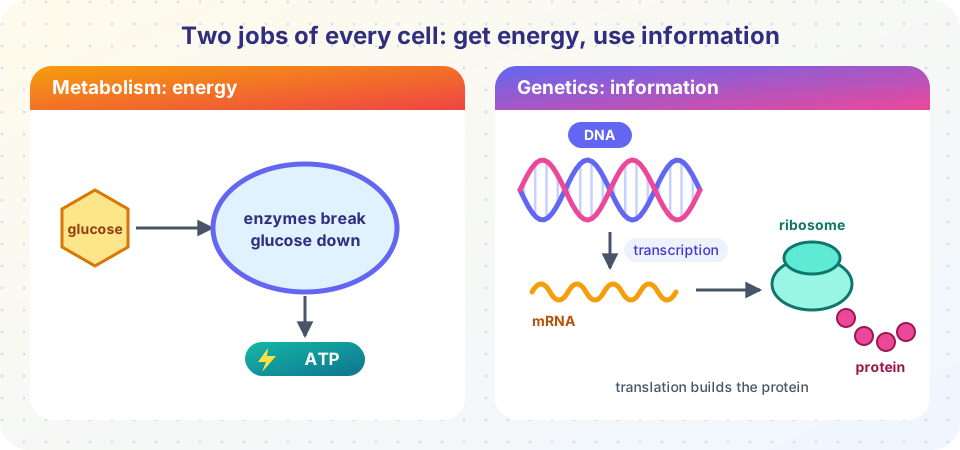
Every living cell has to solve two problems. The first is energy: how to turn food, light or minerals into the chemical energy that powers growth. The second is information: how to store the instructions for building the cell, copy them accurately, and read them when needed. Microbes solve both problems in a bewildering range of ways, and that range is the reason microbiology matters for medicine, industry and the planet.
Chapter 4 is about those two problems. The first half (metabolism) is about chemistry: enzymes, ATP, fermentation and respiration. The second half (genetics) is about information: DNA replication, transcription, translation, regulation, mutation and the exchange of genes between bacteria, which is the process behind the spread of antibiotic resistance.
What you will learn
- How the chapter's lessons are organized.
- The central vocabulary of metabolism and genetics.
- Why microbial diversity depends on both.
Key terms
Metabolism: all the chemical reactions in a cell, split into catabolism (breaking down) and anabolism (building up).
Enzyme: a protein that speeds up one specific reaction.
ATP: adenosine triphosphate, the cell's universal energy currency.
Gene: a stretch of DNA that carries the instructions for a protein or functional RNA.
Horizontal gene transfer: passing genes between cells that are not parent and offspring.
A map of the chapter
Part 1: Getting energy
Burning the fuel
Part 2: Using information
Change and sharing
The lessons
- Energy, Enzymes and Nutrition. ATP, how enzymes work (with a Michaelis-Menten plot), and the four ways microbes make a living.
- Fermentation and Respiration. Glycolysis, fermentation products, the electron transport chain and how many ATP a cell gets.
- DNA, Gene Expression and Regulation. Replication, transcription, translation and the lac operon.
- Mutation and Gene Transfer. How genomes change, how genes move between bacteria and how resistance spreads.
- Chapter 4 Review. A summary and a ten-question quiz.
How to read this chapter
Two habits will help. First, always ask where the electrons go. Metabolism is largely about moving electrons from a food molecule to an acceptor, and the energy released depends on how far they fall. That one idea connects glycolysis, fermentation, respiration and even photosynthesis. Second, always ask where the information flows. In genetics the direction is nearly always DNA to RNA to protein, and the interesting questions concern what starts, stops and changes that flow.
The two halves meet in practice. An enzyme is a protein, so its amount is set by gene expression; a gene is switched on by a molecule such as lactose, so regulation responds to metabolism; and a mutation in a gene for an enzyme can change what food a microbe is able to use. Whenever the lessons seem to be about different subjects, look for this loop between chemistry and code.
Why microbes are a metabolic and genetic playground
A human cell burns organic food with oxygen. Microbes do that, but they also eat hydrogen gas, iron, sulfur, ammonia and even electricity. Some make food from sunlight and carbon dioxide; others from chemicals alone in the dark. Their genomes are small (an E. coli chromosome has about 4,300 genes, a human genome around 20,000), they divide fast, and they swap genes freely. The result is a living laboratory where evolution can be watched in days, and the toolbox that biotechnology borrows: restriction enzymes, polymerases, CRISPR systems, plasmid vectors.
Check your understanding
Quick check · 3 questions
of 3 answered You scored / 3 · perfect!
-
1. Which molecule is called the universal energy currency of the cell?
ATP carries energy to the reactions that need it. -
2. Horizontal gene transfer means...
It moves DNA sideways between neighbors, including between species. -
3. An E. coli chromosome has about how many genes?
About 4,300 genes in roughly 4.6 million base pairs.
Summary
- Cells need energy (metabolism) and information (genetics); this chapter covers both.
- Microbes have an extraordinary range of ways to make ATP and to exchange genes.
- Understanding both is the key to antibiotic action, biotechnology and the spread of resistance.
Track your progress
Create a free account to tick off lessons and pick up where you left off on any device.
of Microbiology lessons completed