


















Lesson 21 of 45 · Metabolism and Genetics of Microbes
Mutation and Gene Transfer
Learn how mutations arise and are repaired, how bacteria swap genes by transformation, transduction and conjugation, and how antibiotic resistance spreads.
When people say bacteria "adapt" to a drug, it can sound as if the cells decide to change. They do not. Change in bacteria comes from two sources, and both are blind to the needs of the cell. The first is mutation: random errors and damage that alter the DNA sequence. The second is horizontal gene transfer: the passing of whole genes from one cell to another, even across species. Selection, such as an antibiotic, then acts on this variation by killing most of the population and leaving the few that happen to be resistant.
This lesson explains both sources and how they combine. It is the basis for understanding why bacteria evolve so rapidly, why a resistance gene that appears in one hospital can turn up in another country, and how scientists use the same mechanisms in genetic engineering.
What you will learn
- The types of mutation and their effect on a protein.
- How mutations are caused, repaired and detected (the Ames test).
- Why mutations are random with respect to need (the Luria-Delbrück result).
- The three mechanisms of horizontal gene transfer.
- How resistance genes spread and what mechanisms of resistance exist.
Key terms
Mutation: a heritable change in the base sequence of DNA.
Mutagen: an agent that increases the mutation rate, such as UV light or certain chemicals.
Plasmid: a small circular DNA that replicates independently of the chromosome.
Transposon: a segment of DNA that can move from one place in the genome to another.
Competence: the ability of a bacterial cell to take up free DNA from its surroundings.
Mutations
DNA polymerase is accurate, but not perfect, and DNA is damaged by radiation and chemicals. An estimated one base in a billion to ten billion is copied wrongly after proofreading, so in a culture of a hundred million cells a particular mutation is rare but not impossible. Because bacteria are haploid (one copy of each gene), a mutation shows its effect immediately.
Types of point mutation
A point mutation changes one base. Its effect on the protein depends on the codon that results:
| Type | What changes | Effect | Example |
|---|---|---|---|
| Silent | a codon changes to another codon for the same amino acid | none | GCT to GCC, still alanine |
| Missense | one amino acid is replaced by another | may be harmless or may disable the protein | GCT to GAT, alanine to aspartate |
| Nonsense | a codon becomes a stop codon | protein is cut short | AAA (lysine) to TAA (stop) |
| Frameshift | one or two bases are inserted or deleted | every codon after the change is read in the wrong frame | deleting one base |
Larger mutations include deletions, duplications, inversions, and the insertion of a transposon.
Causes, repair and detection
Spontaneous mutations come from replication errors and occasional chemical shifts in bases. Induced mutations come from mutagens: ultraviolet light makes adjacent thymines bond into thymine dimers; chemicals such as nitrous acid change bases; base analogs such as 5-bromouracil are mistaken for normal bases; ionizing radiation breaks DNA.
Cells fight back. DNA polymerase proofreads; a mismatch repair system fixes errors it missed; photolyase uses visible light to reverse thymine dimers; nucleotide excision repair cuts out damaged stretches. Under heavy damage the SOS response switches on error-prone polymerases that allow survival at the cost of more mutations.
The Ames test (developed by Bruce Ames in the 1970s) screens chemicals for mutagenicity. It uses Salmonella strains that cannot make histidine and so cannot grow on a histidine-free plate unless a mutation restores that ability. If a test chemical increases the number of colonies that grow, it is a mutagen, and since many mutagens also cause cancer, it is a quick first screen. Because the bacteria lack human liver enzymes, a liver extract is added to activate substances that only become mutagenic after metabolism.
Are mutations random?
Mutations arise whether or not they are useful. In 1943 Salvador Luria and Max Delbrück tested this with E. coli and a virus (phage T1). If resistance were induced only when the bacteria met the phage, every culture would give about the same small number of resistant colonies (a Poisson distribution). If resistance came from random mutations before exposure, most cultures would have none and a few would have huge "jackpots" of descendants of an early mutant. They found jackpots. In 1952 Joshua and Esther Lederberg confirmed the result with replica plating: resistant colonies existed on a plate that had never met the antibiotic.
Press Run (or Ctrl + Enter) to see the result here.
Program input · what you'd type while the program runs
Type the answers before you press Run, one per line. Each time the program reads a line (with input()), it gets the next line from this box.
Horizontal gene transfer
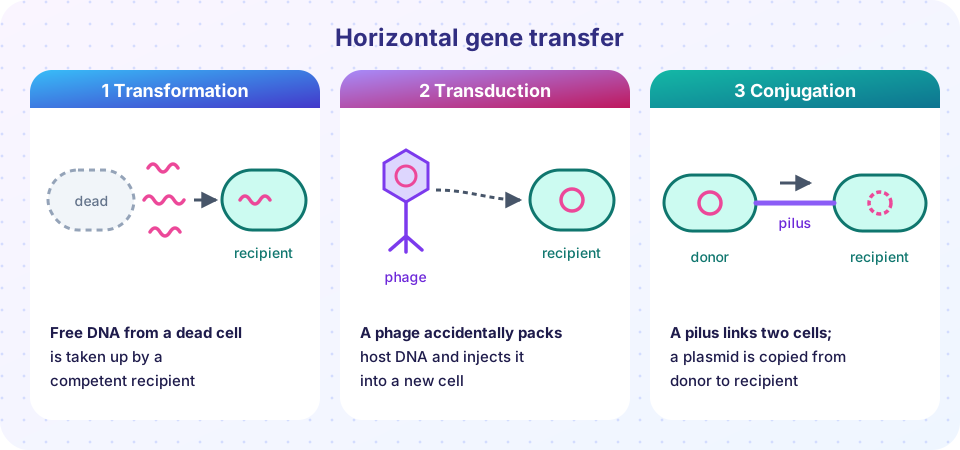
Bacteria reproduce by division, passing genes vertically to daughters. But they also trade genes horizontally, and a surprising share of a typical bacterial genome (in some species a few to tens of percent) was acquired this way. The three classic mechanisms are shown in the picture.
Transformation
A recipient takes up naked DNA from its surroundings, often released by dead cells. Cells able to do this are competent. Some species (Streptococcus pneumoniae, Bacillus subtilis, Neisseria, Haemophilus) become naturally competent when signaling molecules show that the population is dense. Griffith's mouse experiments in 1928 and the experiments of Avery, MacLeod and McCarty in 1944 were about transformation: a harmless strain took up a gene for a capsule and became deadly, and the "transforming principle" was shown to be DNA. In the laboratory, E. coli is made artificially competent by calcium chloride and heat shock or by electroporation (a brief electric pulse) so that scientists can insert plasmids.
Transduction
A bacteriophage (a virus that infects bacteria) moves DNA between hosts. In generalized transduction, a phage that is assembling new particles by mistake packages a piece of the host's DNA instead of its own, and injects it into the next cell. In specialized transduction, a prophage excises itself imperfectly from the host chromosome and takes some neighboring bacterial genes with it. Phage-carried genes explain why toxins such as the cholera toxin, the diphtheria toxin and the Shiga toxin appear in some strains and not others. Chapter 5 returns to phages.
Conjugation
In conjugation a donor connects to a recipient through a sex pilus, and DNA passes through. Joshua Lederberg and Edward Tatum discovered it in E. coli in 1946. The donor carries the F plasmid (fertility factor), which encodes the pilus (tra genes). A relaxase nicks one strand at the origin of transfer, one strand moves across while the donor copies what remains, and the recipient synthesizes the complementary strand, so both cells end with a plasmid. Occasionally the F plasmid is integrated in the chromosome (an Hfr strain) and drags chromosomal genes into the recipient, and timing the interrupted mating allowed the first genetic map of E. coli. Conjugation works across species barriers, which is how R plasmids carrying several resistance genes jump among species.
Transposons and integrons
Transposons ("jumping genes", first found in maize by Barbara McClintock) copy or cut themselves and reinsert elsewhere, moving genes between plasmids and chromosomes. Integrons are gene-capture systems that collect resistance gene cassettes in a row. Together these let a plasmid accumulate resistance to many drugs.
Antibiotic resistance
Resistance evolves when antibiotic exposure selects the few resistant cells in a large population. The main mechanisms are:
- Inactivating the drug: beta-lactamase enzymes cleave penicillins.
- Altering the target: methicillin-resistant Staphylococcus aureus (MRSA) makes a modified penicillin-binding protein (PBP2a, from the mecA gene) with low affinity for drugs.
- Efflux pumps: membrane pumps remove the drug.
- Reduced permeability: fewer porins let the drug in.
Resistance genes are often on plasmids and transposons, so they spread by conjugation as well as by division. Sometimes resistant bacteria bear a fitness cost and lose out when the drug is absent, but compensating mutations often reduce the cost. The model below follows a plasmid in a growing population, with illustrative constants.
Press Run (or Ctrl + Enter) to see the result here.
Program input · what you'd type while the program runs
Type the answers before you press Run, one per line. Each time the program reads a line (with input()), it gets the next line from this box.
This is educational information about how resistance evolves. If you are prescribed an antibiotic, follow your doctor's or pharmacist's instructions, and never use antibiotics for viral illnesses such as colds and flu.
Common misconceptions
"Bacteria mutate because they need to." Mutations occur at random; the antibiotic merely selects those that happen to help. The Luria-Delbrück experiment shows this.
"The patient becomes resistant." The bacteria become resistant, not the person.
"Sex in bacteria means reproduction." Conjugation transfers DNA but does not make new cells; reproduction is separate binary fission.
"All mutations are harmful." Many are silent or neutral, and a few are beneficial in a given environment.
Check your understanding
Quick check · 6 questions
of 6 answered You scored / 6 · perfect!
-
1. A mutation changes GCT to GCC in a codon for alanine. This is a...
Both codons code for alanine, so the protein is unchanged. -
2. Which transfer mechanism requires direct cell-to-cell contact via a pilus?
Conjugation uses a sex pilus to connect donor and recipient. -
3. What did the Luria-Delbrück fluctuation test show?
Large culture-to-culture variation (jackpots) showed mutants existed before the selecting agent. -
4. How does a bacteriophage move bacterial genes in generalized transduction?
A packaging error puts host DNA into a phage particle. -
5. MRSA resists methicillin mainly because it...
The mecA gene encodes PBP2a, which keeps building the wall in the presence of the drug. -
6. The Ames test detects...
More revertant colonies mean the chemical increases the mutation rate.
Summary
- Mutations (silent, missense, nonsense, frameshift) arise at random from replication errors and mutagens, and cells repair most damage.
- Luria and Delbrück showed that resistance mutations exist before selection.
- Bacteria exchange genes by transformation (free DNA), transduction (phage carriers) and conjugation (pilus and plasmid).
- Plasmids, transposons and integrons assemble multidrug resistance, which spreads by selection and gene transfer.
Track your progress
Create a free account to tick off lessons and pick up where you left off on any device.
of Microbiology lessons completed