


















Lesson 28 of 45 · Fungi and Parasites
Fungi: yeasts and molds
Learn how fungi are built, how yeasts bud and molds form hyphae and spores, which fungi cause disease, and how antifungal drugs exploit ergosterol and chitin.
Think of bread, beer, blue cheese, mushrooms and the dust on an old orange. Every one of these involves a fungus. Fungi are a whole kingdom of eukaryotes that has been at work on the planet for hundreds of millions of years, and they perform a task almost nothing else can: they digest the toughest plant materials, such as wood, and return the nutrients to the soil. Without them the world would be buried in dead plants.
For microbiology, fungi are interesting for three reasons. They are useful, because yeast ferments and molds make antibiotics. They are harmful, because some cause infections ranging from athlete's foot to life-threatening lung disease. And they are a puzzle for drug designers, because they are so closely related to us. This lesson covers their structure, growth and the main human diseases, in that order.
What you will learn
- The structure of a fungal cell, its wall and its membrane
- How molds (hyphae and spores) and yeasts (budding) differ, and what dimorphic fungi are
- The main fungal groups and a typical species for each
- How fungi cause disease, and why people with weak defenses are at risk
- How the main classes of antifungal drugs work
Key terms
Hypha: a thread-like fungal cell or filament; many hyphae together form a mycelium.
Yeast: a single-celled fungus that usually reproduces by budding.
Spore: a tiny reproductive cell, often resistant, that spreads the fungus.
Dimorphic fungus: one that grows as a mold in the environment and as a yeast in the body.
Ergosterol: the main sterol of fungal membranes, the counterpart of cholesterol.
The fungal cell
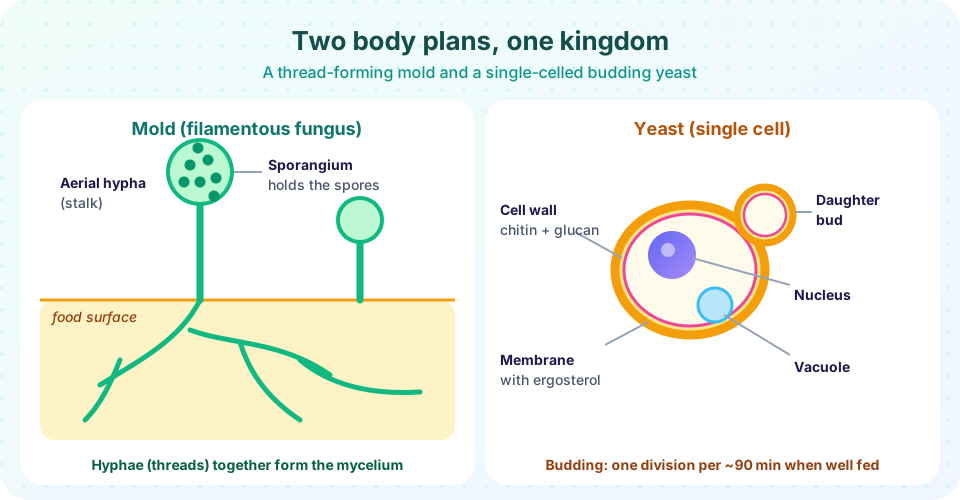
A fungal cell looks a lot like an animal cell with an extra layer on the outside. It has a nucleus, mitochondria, an endoplasmic reticulum and large vacuoles. Outside the plasma membrane is a rigid cell wall, built from the polysaccharides chitin and β-glucans along with proteins. The plasma membrane contains ergosterol instead of cholesterol. These last two details, the wall and the sterol, are the main reasons fungi can be treated without equal damage to the patient.
Fungi are heterotrophs that feed by absorption. A mold secretes digestive enzymes into the material it is growing on, such as cellulose-degrading enzymes into wood, and then absorbs the small molecules that result. This is the opposite of eating: the digestion happens outside the body. It also explains why fungi can grow on almost any organic surface, including leather, paint and your skin.
Two body plans: molds and yeasts
Molds grow as hyphae, thin tubes about 2 to 10 micrometers wide that extend at their tips and branch. In some fungi the hyphae are divided into compartments by cross-walls called septa (septate hyphae); in others, such as Rhizopus, the hypha is one long multinucleate tube without septa (coenocytic). A tangle of hyphae is a mycelium, the feeding body that grows into the food. Where the mycelium meets the air it sends up specialized stalks that make spores, the fuzz you see on moldy bread. A single spore is so tiny, and so resistant to drying, that the air is full of them.
Yeasts are single-celled fungi, round to oval, typically 5 to 10 micrometers in diameter. Saccharomyces cerevisiae, the baker's and brewer's yeast, reproduces by budding: a small daughter cell grows out of the mother, receives a copy of the nucleus and pinches off, leaving a bud scar. In a rich medium a population doubles about every 90 minutes. Yeast was the first eukaryote to have its genome sequenced, in 1996 (about 12 million base pairs and around 6,000 genes), and it is a favorite model organism for cell biology, because the basic machinery of the cell cycle and protein trafficking is shared with us.
Some fungi switch form. A dimorphic fungus grows as a mold at room temperature in soil and as a yeast at body temperature in the host. Examples include Histoplasma capsulatum (bat and bird droppings), Coccidioides (desert soils) and Blastomyces. The same fungus has two different looks, which can fool a student who only expects to see one. Candida albicans is another shape-shifter: it can form yeast cells or hyphae, and the hyphal form helps it invade tissue.
Reproduction
Fungi can reproduce asexually, by producing spores called conidia or sporangiospores, or by budding or fragmentation of hyphae. They can also reproduce sexually: compatible mating types fuse, the nuclei combine and meiosis makes new, genetically varied spores. Many pathogenic fungi are known only in their asexual form, which makes them hard to classify. The structures that hold the sexual spores are used to divide fungi into groups.
The main groups
| Group | Typical features | Examples |
|---|---|---|
| Chytrids | aquatic, spores with flagella | Batrachochytrium dendrobatidis, which harms amphibians |
| Mucoromycetes (formerly "zygomycetes") | coenocytic hyphae, fast growth | Rhizopus (bread mold), Mucor |
| Ascomycetes | spores in a sac (ascus); the biggest group | Saccharomyces, Penicillium, Aspergillus, Candida, morels |
| Basidiomycetes | spores on a club (basidium) | mushrooms, rusts, Cryptococcus |
Fungi also form partnerships. Lichens are a fungus living with an alga or cyanobacterium. Mycorrhizae are partnerships between fungal hyphae and plant roots, which help most land plants take up water and minerals in return for sugar.
Fungi and people
Helpful fungi
Yeast fermentation produces the carbon dioxide that raises bread and the ethanol in beer and wine (see fermentation in food and industry in chapter 8). Penicillium molds ripen blue cheeses and camembert. In 1928 Alexander Fleming noticed that a Penicillium mold contaminating a plate had killed the bacteria around it, a discovery that led to penicillin in the 1940s. Fungi also make citric acid, enzymes and cholesterol-lowering statin drugs.
Harmful fungi
Fungal diseases are called mycoses. They are grouped by how deep they go.
- Superficial and cutaneous mycoses affect skin, hair and nails. The dermatophytes, which feed on keratin, cause ringworm (tinea), athlete's foot and nail infections. They are common and rarely dangerous.
- Mucosal infections include thrush and vaginal yeast infection, caused by Candida albicans, which normally lives harmlessly on mucous membranes.
- Systemic mycoses invade the lungs and internal organs. The dimorphic fungi cause these in healthy people if they inhale enough spores, and opportunistic fungi do so mostly in people with weak defenses: Aspergillus fumigatus (aspergillosis), Cryptococcus neoformans (meningitis), Pneumocystis jirovecii (pneumonia, especially in advanced HIV) and Candida in the bloodstream. A newer concern is Candida auris, a yeast that spreads in hospitals and is resistant to several drugs.
- Mycotoxins are poisons made by molds. Aflatoxin from Aspergillus flavus, growing on stored peanuts and grain, is among the strongest known natural carcinogens. Ergot, from Claviceps purpurea on rye, caused outbreaks of poisoning in the Middle Ages.
Fungi also damage crops and wildlife. Wheat rusts cost harvests, white-nose syndrome has killed millions of bats, and chytrid fungus has contributed to amphibian declines. The Irish potato famine, often attributed to a fungus, was caused by Phytophthora infestans, an oomycete, a different group that looks like a fungus.
Antifungal drugs
Because fungi and humans are both eukaryotes, antifungal drugs use the few differences available.
| Class | Example | Target |
|---|---|---|
| Polyenes | amphotericin B, nystatin | bind ergosterol and make the membrane leak |
| Azoles | fluconazole, itraconazole | block ergosterol synthesis (the enzyme lanosterol 14α-demethylase) |
| Echinocandins | caspofungin | block synthesis of β-1,3-glucan in the wall |
| Allylamines | terbinafine | block an earlier step in ergosterol synthesis (squalene epoxidase) |
Amphotericin B is powerful but can damage kidneys, because it also binds cholesterol a little. Echinocandins are well tolerated because human cells have no cell wall at all. Resistance develops through changes in the drug target and by pumping the drug out.
Common misconceptions
"Mold is always dangerous." Most molds are harmless to healthy people, and many are useful. Risks depend on the species, the dose and the person's health. Damp buildings should still be dried and cleaned, because spores can trigger allergies and asthma.
"Yeast infections are always caught from somebody." Candida is part of normal microbiota. Infection often happens when the balance changes, for example after antibiotic treatment.
"Mushrooms are the whole fungus." The mushroom is the fruiting body, a spore-releasing structure. Most of the fungus is the hidden mycelium underground.
Try it
The first demonstration compares exponential and logistic growth of a yeast culture. The values are model parameters, not measurements. A doubling time of 90 minutes comes from the text; the carrying capacity is chosen for illustration.
Press Run (or Ctrl + Enter) to see the result here.
Program input · what you'd type while the program runs
Type the answers before you press Run, one per line. Each time the program reads a line (with input()), it gets the next line from this box.
The second demonstration is a simplified model of how temperature affects dough rising. Real dough is more complex; the curve rises with temperature, as enzymes speed up, and falls to zero as the yeast is killed.
Check your understanding
Quick check · 5 questions
of 5 answered You scored / 5 · perfect!
-
1. What does the fungal cell membrane contain in place of cholesterol?
Ergosterol is the fungal sterol, and several antifungal drugs target it or its synthesis. -
2. How does a mold obtain its food?
Fungi digest outside the body and absorb the small molecules. -
3. What is a dimorphic fungus?
Temperature switches the form: mold at about 25 °C, yeast at 37 °C. -
4. Which drug class blocks synthesis of β-glucan in the fungal cell wall?
Echinocandins such as caspofungin inhibit glucan synthase, an enzyme humans lack. -
5. Why do opportunistic fungi such as Aspergillus mainly harm people with weak immunity?
A healthy person clears the spores; with weak immunity the fungus can invade.
Summary
- Fungal cells are eukaryotic, with chitin and glucan walls and ergosterol membranes, and they feed by external digestion and absorption.
- Molds form hyphae, mycelia and spores; yeasts are single cells that reproduce by budding; some fungi are dimorphic.
- Main groups: chytrids, mucoromycetes, ascomycetes and basidiomycetes.
- Fungi are essential in fermentation and antibiotic discovery, but cause mycoses and mycotoxin poisoning.
- Antifungal drugs target ergosterol and the cell wall; resistance is rising.
Track your progress
Create a free account to tick off lessons and pick up where you left off on any device.
of Microbiology lessons completed