


















Lesson 27 of 45 · Fungi and Parasites
Chapter 6 overview: Fungi and parasites
Meet the eukaryotic microbes: fungi, protozoa and parasitic worms. See what unites them, how they differ and why they are harder to treat than bacteria.
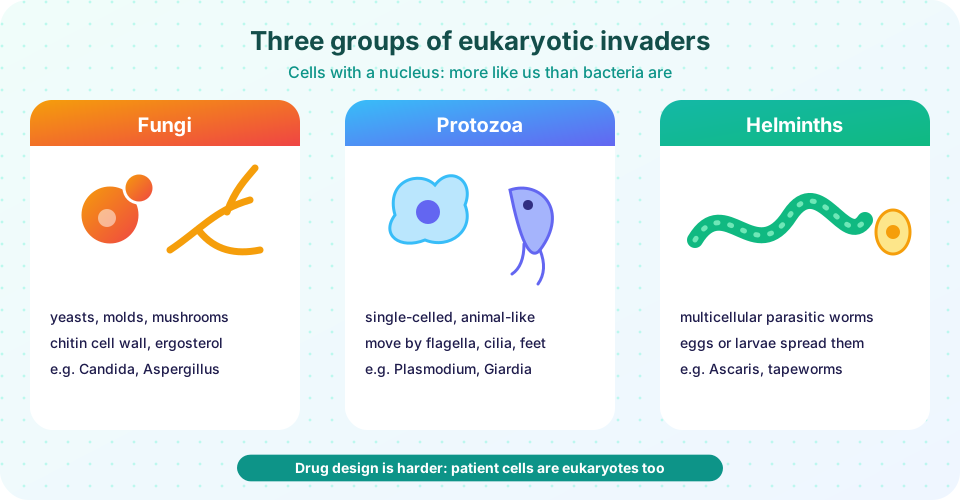
Bacteria and viruses get most of the attention, but a third set of microbes shares a very important feature with you: they are eukaryotes. Their cells have a nucleus, internal compartments and a cytoskeleton built on the same plan as yours. This chapter introduces three groups of them: the fungi (yeasts, molds and mushrooms), the protozoa (single-celled, animal-like microbes) and the helminths (parasitic worms, which are really tiny animals but are studied in microbiology because of the diseases they cause).
The shared eukaryotic design explains both their power and their problems for medicine. A drug that damages a fungal or protozoan cell is likely to damage ours too, so effective treatments must find the small differences that exist, and there are fewer of them than between bacteria and humans.
What you will learn
- What makes fungi, protozoa and helminths eukaryotic, and how they differ from bacteria
- How the three groups are defined and what typical examples look like
- Why eukaryotic pathogens are hard to treat
- What the next three lessons cover and how the groups connect to disease
Key terms
Eukaryote: an organism whose cells have a membrane-bound nucleus and organelles.
Fungus: a eukaryote with chitin cell walls that feeds by absorbing nutrients.
Protozoan: a single-celled eukaryote that is not a fungus, a plant or an alga.
Helminth: a parasitic worm: a roundworm, tapeworm or fluke.
Parasite: an organism that lives on or in a host and harms it while feeding on it.
What the three groups have in common
All three groups are eukaryotic, which sets them apart from bacteria and archaea. Their DNA lies in a nucleus, and they have mitochondria (or their remnants), an endoplasmic reticulum, a Golgi apparatus and ribosomes of the larger 80S type. The cell membranes of animals and protozoa contain cholesterol, while fungal membranes contain a similar molecule, ergosterol. These shared features mean that a lot of the biology you learned about human cells applies to them. Many are heterotrophs: they cannot make their own food and must eat or absorb organic material.
The groups are very different in other ways. Fungi usually live by secreting enzymes into their surroundings and absorbing the digested food, and have rigid walls made of chitin (the same polymer that makes insect shells) and glucans. Protozoa are mostly motile cells without walls, that move by flagella, cilia or pseudopods, and they eat by engulfing prey or absorbing nutrients. Helminths are multicellular animals with organ systems, usually without a gut or with a simple one, and complex life cycles.
Why they are hard to treat
An antibiotic can be harmless to a patient because bacteria have cell walls made of peptidoglycan and 70S ribosomes, and human cells have neither. A fungus or protozoan offers far fewer unique targets. Antifungal drugs therefore exploit differences such as ergosterol versus cholesterol, or the cell wall glucan, and antiparasitic drugs target enzymes specific to the parasite's metabolism or its nervous system. Resistance is a growing problem, and the choice of drugs is limited and often more toxic than antibiotics.
The groups also have a different relationship with the immune system. Many fungi are harmless to a healthy person but dangerous when the defenses are weak, for example in people with HIV, people receiving chemotherapy, or patients on immunosuppressive drugs. Parasites, on the other hand, have evolved ways to hide from or manipulate the immune response over years of infection, and a worm can live in a person for a decade.
A tour of the chapter
- Fungi: yeasts and molds explains the fungal body plans, reproduction by spores and budding, the main groups, the usefulness of yeasts and the diseases fungi cause, with the logic of antifungal drugs.
- Parasites: protozoa and helminths covers the major protozoan and worm diseases, the life cycle of the malaria parasite in detail, and the ideas of hosts and vectors.
- Chapter review compares all three groups in one table and checks your understanding with a ten-question quiz.
Eukaryotic microbes
Shared features
Bacteria have none of these
Why it matters
How they spread
Size and place in the microbial world
Fungal cells are typically larger than bacteria: a yeast is about 5 to 10 micrometers across, compared with 1 to 5 micrometers for common bacteria. Protozoan cells range from about 2 micrometers (some Plasmodium stages) to more than 100 micrometers. Helminths are much bigger: a pinworm is about a centimeter long, and an adult tapeworm can reach several meters in the gut. Because they are large, eggs and cysts of the bigger parasites can be seen with a simple light microscope, which is how many infections are diagnosed.
Common misconceptions
"Fungi are plants." Fungi have no chlorophyll, do not photosynthesize and have chitin walls. Genetically they are closer to animals than to plants.
"Ringworm is caused by a worm." It is a fungal infection of the skin. The name comes from the ring-shaped rash.
"Parasites are always worms." Many of the most deadly parasites are single-celled protozoa, such as the malaria parasite.
Try it
The first demonstration is a chart of typical size ranges on a logarithmic axis. The ranges are rounded and summarize many species.
Press Run (or Ctrl + Enter) to see the result here.
Program input · what you'd type while the program runs
Type the answers before you press Run, one per line. Each time the program reads a line (with input()), it gets the next line from this box.
The second demonstration is a quick classifier. Tick the features of a microbe and see which group they point to. It is a study aid, not a diagnostic tool.
Check your understanding
Quick check · 5 questions
of 5 answered You scored / 5 · perfect!
-
1. Which feature do fungi, protozoa and helminths all share?
All three are eukaryotes, with their DNA in a nucleus. -
2. What is the main structural component of a fungal cell wall?
Fungal walls contain chitin, the same polymer found in insect exoskeletons, together with glucans. -
3. Why are antifungal drugs harder to design than antibiotics?
Humans and fungi are both eukaryotes, so many cell components are similar. -
4. Which sentence about ringworm is correct?
The ring-shaped skin rash is caused by dermatophyte fungi, not worms. -
5. A single-celled eukaryote without a cell wall that moves by flagella is most likely a:
Protozoa are single-celled, wall-less eukaryotes that often move with flagella, cilia or pseudopods.
Summary
- Fungi, protozoa and helminths are eukaryotes: nucleus, mitochondria and 80S ribosomes.
- Fungi absorb food and have chitin walls; protozoa are single cells that move; helminths are multicellular worms.
- Treating eukaryotic pathogens is harder because the targets are close to our own cells.
- Fungi often exploit weak immunity; parasites can persist for years by evading it.
- The chapter covers fungi, parasites and a comparison review.
Next: Fungi: yeasts and molds
Track your progress
Create a free account to tick off lessons and pick up where you left off on any device.
of Microbiology lessons completed