


















Lesson 1 of 45 · Getting Started
Course Map: Welcome to Microbiology
Start here: who this microbiology course is for, how the nine chapters fit together, how to study, and a first look at the living world you cannot see.
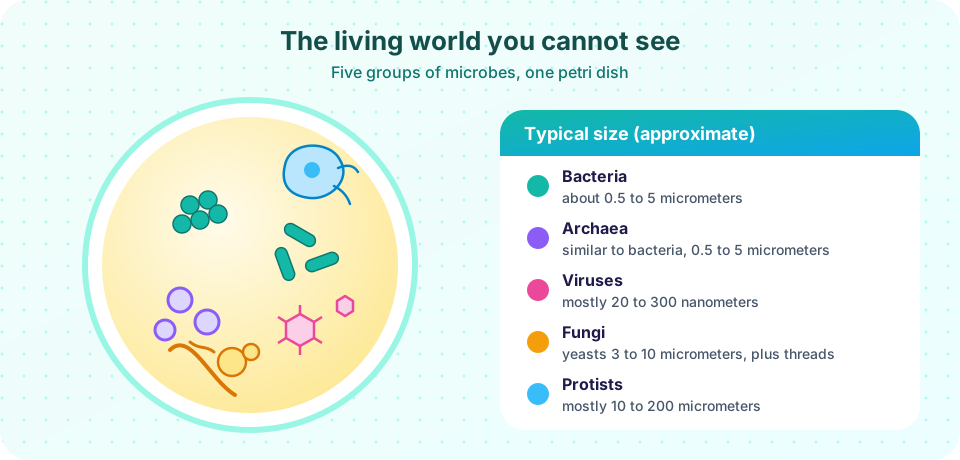
Microbiology is the study of living things too small to see clearly without a microscope: bacteria, archaea, many fungi, protists, and (although they sit on the edge of the definition of "alive") viruses. These organisms were on Earth for billions of years before the first animal appeared. They recycle the carbon and nitrogen that every plant depends on, they live in your gut by the trillion, they make bread rise and cheese ripen, and a small fraction of them cause the infections that shaped human history.
This course is a complete tour of the subject. It is written for learners of about 14 to 18 who are meeting microbiology in an international biology syllabus (IGCSE, A Level, IB or AP), for first-year university students, and for adults who want to understand the news about antibiotics, vaccines and food safety. You do not need any lab experience. You do need a basic idea of what a cell is and a willingness to handle some arithmetic with powers of ten.
This course is educational information. It explains how microbes work and how infections spread, but it cannot diagnose or treat anything. If you or someone you know is unwell, talk to a doctor or a local health service.
What you will learn
- How the nine chapters build on one another, from tools to ecosystems.
- What you need to know before you start, and how to study efficiently.
- The rough scale of the microbial world, from viruses to protists.
- Which chapters matter most for your own goal (medicine, food, environment or research).
The nine chapters
Foundations
The bacterial cell
Beyond bacteria
Microbes and people
Put it to work
Chapters 1 to 4 are this half of the course
Chapters 1 to 4 give you the tools and the bacterial cell. Chapters 5 to 9 then widen the lens to viruses, eukaryotic microbes, disease and applications. The order matters because later ideas reuse earlier ones: you cannot understand why penicillin works without the cell wall from Chapter 3, and you cannot understand antibiotic resistance without the gene transfer in Chapter 4.
How to use each lesson
Every content lesson follows the same pattern so you always know where you are.
- What you will learn states the goals. Read it first and again at the end.
- Key terms collects the vocabulary. Microbiology has a lot of Latin and Greek, but the roots repeat (coccus is a sphere, bacillus a rod, -phile means "loving"), so the terms get easier quickly.
- The body explains an idea with a picture, a worked example and real numbers.
- Common misconceptions names the mistakes students usually make.
- Try it gives you interactive widgets and Python simulations. They are demonstrations: they apply the same equations real laboratories use, but they are not experiments and they report no real results.
- Check your understanding is a short quiz. Wrong answers are useful; the explanations tell you why.
Study in short bursts. Read one lesson, close the page, and write the three most important ideas from memory. Then check. Retrieving an idea teaches you far more than rereading it.
Key terms
Microorganism (microbe): a living thing too small to be seen clearly without magnification.
Prokaryote: a cell with no membrane-bound nucleus. Bacteria and archaea are prokaryotes.
Eukaryote: a cell with a nucleus and other membrane-bound organelles. Fungi, protists, plants and animals are eukaryotes.
Pathogen: a microbe that can cause disease.
Micrometer (µm): one millionth of a meter, the usual unit for cells.
Nanometer (nm): one billionth of a meter, the usual unit for viruses.
A first feel for scale
Most of the trouble beginners have with microbiology comes from not feeling how small things are. A micrometer is a thousandth of a millimeter. A typical bacterium such as Escherichia coli is about 2 µm long, so roughly 500 of them laid end to end would span one millimeter, about the thickness of a coin. A virus is smaller again: many are 100 nanometers across, so about twenty of them side by side would span the length of one E. coli. (Remember that 1,000 nm = 1 µm.)
The plot below shows approximate size ranges on a logarithmic axis, which is the only way such different sizes fit on one chart. Each gridline is ten times larger than the last. Run it, then change the numbers to see how the picture changes.
Press Run (or Ctrl + Enter) to see the result here.
Program input · what you'd type while the program runs
Type the answers before you press Run, one per line. Each time the program reads a line (with input()), it gets the next line from this box.
Which chapters matter most to you?
Everyone should read Chapters 1 to 4 in order. After that you can choose a route. The widget below suggests one. It is a simple lookup, not a career test.
Common misconceptions
"Microbes are germs, and germs are bad." Only a small fraction of microbial species cause disease in humans. Most are harmless, and many are essential: your gut microbes help digest food, and soil microbes make nitrogen usable for crops.
"Bacteria and viruses are the same thing." Bacteria are living cells that can grow on their own and are killed by antibiotics. Viruses are not cells, cannot grow without a host cell, and are not affected by antibiotics.
"Microbiology is just memorizing names." Names help, but the real skill is reasoning: given a cell structure or a growth condition, predict what the microbe can and cannot do.
Check your understanding
Quick check · 4 questions
of 4 answered You scored / 4 · perfect!
-
1. Which of these is a prokaryote?
Bacteria (and archaea) are prokaryotes with no membrane-bound nucleus. Yeasts, protists and human cells are eukaryotes. -
2. A typical bacterium is about 2 micrometers long. About how many fit end to end across 1 millimeter?
1 mm = 1,000 µm, and 1,000 / 2 = 500. -
3. Why does the size chart use a logarithmic axis?
Viruses are about 0.02 to 0.3 µm while protists can reach 200 µm, a thousandfold range, so each gridline stands for a tenfold step. -
4. Which statement about viruses is correct?
Viruses are not cells and need a host's machinery to make new virus particles. Antibiotics target bacterial processes, and viruses are usually smaller than bacteria.
Summary
- Microbiology covers bacteria, archaea, fungi, protists and viruses, most of which are harmless or helpful.
- The course runs from tools and diversity (Chapters 1 and 2), through the bacterial cell (3 and 4), to viruses, eukaryotic microbes, disease and applications (5 to 9).
- Sizes span about four powers of ten, from 20 nm viruses to 200 µm protists, so you will meet micrometers and nanometers constantly.
- Interactive widgets in this course are demonstrations, not real experiments.
Track your progress
Create a free account to tick off lessons and pick up where you left off on any device.
of Microbiology lessons completed