


















Lesson 26 of 45 · Viruses
Chapter 5 review: Viruses
A review of virus structure, the Baltimore classes, phage cycles, animal virus replication and counting methods, with a ten-question mixed quiz.
Viruses are small, but the ideas in this chapter fit together neatly. A virion is a genome in a protein coat. How that genome becomes messenger RNA decides its Baltimore class. Replication follows a standard set of steps that every antiviral drug and vaccine tries to interrupt, and the way scientists count viruses is built on one simple observation: one infectious particle makes one plaque.
Use this page to check that the pieces connect. Read the picture and the table first, then run the two short demonstrations, and finish with the quiz. If you miss a question, the explanation tells you which lesson to revisit.
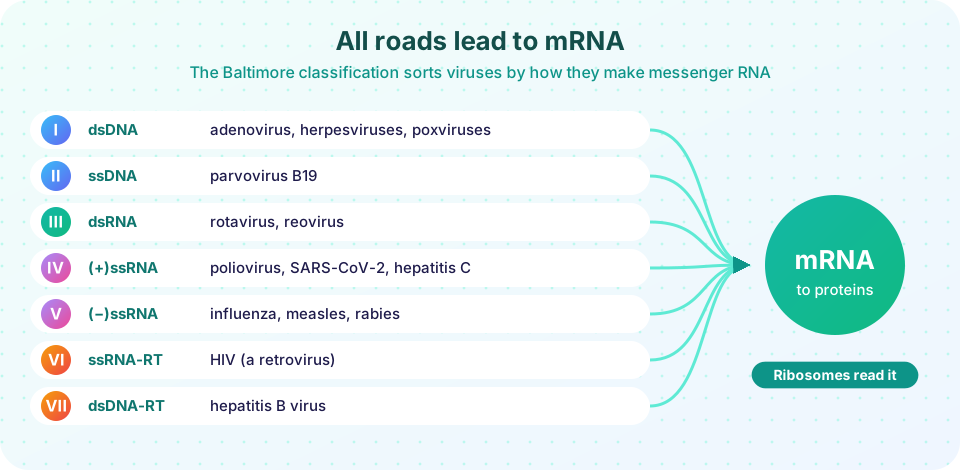
The chapter in one table
| Idea | Key facts | Lesson |
|---|---|---|
| What a virus is | non-cellular, genome in a capsid, obligate intracellular parasite, 20 to 300 nm typical | Overview |
| Shapes | icosahedral (60 x T subunits), helical, enveloped, complex | Structure |
| Envelope | host lipid with spikes; weak to soap, alcohol and drying | Structure |
| Baltimore classes | I dsDNA, II ssDNA, III dsRNA, IV (+)ssRNA, V (−)ssRNA, VI retrovirus, VII hepadnavirus | Structure |
| Replication steps | attachment, entry, uncoating, synthesis, assembly, release | Replication |
| Phage cycles | lytic bursts the cell; lysogenic integrates a prophage; UV induces | Replication |
| Counting | plaque assay (PFU/mL), MOI follows Poisson | Replication |
| Simpler agents | viroids (naked RNA, plants), prions (infectious protein) | Structure |
What you should be able to do
- Sketch the four virion architectures and name an example of each.
- Say which Baltimore class a virus belongs to from its genome, and what enzyme it must carry.
- Compare the lytic and lysogenic cycles and explain induction.
- Calculate a titer from plaque counts and the fraction of uninfected cells at a given MOI.
A worked example: reading a virus from its genome
Suppose a lab reports a new virus whose genome is a single strand of RNA, about 30,000 bases long, wrapped in a lipid envelope with large spikes. What can you say about it without any more information?
First, an envelope means the virion is fragile outside the body. Soap, alcohol and drying will inactivate it, so hand washing and surface cleaning are effective measures. Second, a single-stranded RNA genome puts it in class IV, V or VI. If tests show that the purified RNA alone can start an infection when put into cells, the genome is positive-sense, which means class IV: the ribosomes can translate it at once, and the virion does not need to carry its own polymerase. A very long positive-strand genome is typical of coronaviruses. If the RNA alone is not infectious, it would be negative-sense and the virion would have to carry its polymerase (class V). If the virion contains reverse transcriptase, it is a retrovirus (class VI).
Third, because RNA polymerases that copy RNA genomes make many errors, such a virus will mutate quickly, which affects how long vaccines stay matched. Fourth, the receptor on the spike will decide which species and tissues can be infected. That is the sort of reasoning that a virologist does in the first hour of an outbreak, and it uses only ideas from this chapter.
Traps to avoid in exams
- Mixing up "positive-sense" with "positive result". Sense refers to whether the strand has the same sequence as mRNA.
- Forgetting that the eclipse period is inside the latent period: during eclipse nothing infectious can be recovered from inside the cell, while the latent period is measured outside, as the time to the first free phage.
- Saying that a lytic phage "eats" bacteria. It redirects the cell's machinery.
- Treating a prion or a viroid as a virus.
- Quoting an MOI of 1 as "every cell infected". About 37% of cells receive none.
Try it
The first demonstration is a small rule-based helper. Given a genome description, it prints the Baltimore class and the key enzyme the virion needs. Add your own examples to the list.
Press Run (or Ctrl + Enter) to see the console output here.
No output.
The second demonstration shows why exponential growth, the pattern of early infection, looks like a straight line on a logarithmic axis. The numbers are a model, not data from a real patient.
Press Run (or Ctrl + Enter) to see the result here.
Program input · what you'd type while the program runs
Type the answers before you press Run, one per line. Each time the program reads a line (with input()), it gets the next line from this box.
Check your understanding
Quick check · 10 questions
of 10 answered You scored / 10 · perfect!
-
1. Which description fits a virion?
A virion is non-cellular: genome plus capsid, and in some viruses a lipid envelope. -
2. Why does alcohol hand sanitizer work well against influenza virus?
Alcohol and soap dissolve lipids, so they inactivate enveloped viruses. -
3. A virus has positive-sense single-stranded RNA. What is true?
Positive-sense RNA has the same sequence as mRNA, so ribosomes can read it immediately. -
4. Which Baltimore class does HIV belong to?
HIV is a retrovirus: single-stranded RNA copied into DNA by reverse transcriptase. -
5. What is the purpose of the eclipse period in a phage infection?
No complete, infectious virions can be recovered from the cell during the eclipse period. -
6. A plate at a 10^-6 dilution, with 0.1 mL plated, shows 60 plaques. What is the titer?
60 / (10^-6 x 0.1 mL) = 6 x 10^8 PFU/mL. -
7. What does induction of a prophage mean?
Stress such as DNA damage inactivates the repressor, and the phage switches to lytic growth. -
8. Which of these is NOT a virus?
A prion is an infectious protein with no nucleic acid. -
9. At a multiplicity of infection of 1, about what fraction of cells receives no virion?
The Poisson probability of zero is e^-1, about 0.37. -
10. How does lysogenic conversion make a harmless bacterium dangerous?
Diphtheria, cholera and Shiga toxin genes are carried by prophages.
Summary
- A virion is a genome in a capsid, with or without an envelope; it is not a cell.
- The Baltimore system groups viruses by how they make mRNA, and tells you which enzymes the virion must carry.
- Replication has six steps, and each is a possible drug or vaccine target.
- Lytic phages burst the host; temperate phages can integrate and wait. Prophages can carry toxin genes.
- Plaque assays count infectious particles; MOI is a Poisson process.
Track your progress
Create a free account to tick off lessons and pick up where you left off on any device.
of Microbiology lessons completed