


















Lesson 18 of 45 · Metabolism and Genetics of Microbes
Energy, Enzymes and Nutrition
Learn how ATP stores energy, how enzymes work and are inhibited (with a Michaelis-Menten plot), and how microbes are classed as photo- or chemotrophs and auto- or heterotrophs.
A growing bacterium is a busy chemical factory. In every generation it must build a new cell wall, copy its genome, make thousands of proteins and run its pumps and motors, and it must do this within 20 minutes in the fastest cases. All this work needs three things: a way to speed up chemical reactions (enzymes), a way to carry energy from where it is released to where it is needed (ATP and electron carriers), and a supply of raw materials and fuel (nutrition).
This lesson is about those three. You will see how an enzyme speeds up a reaction, how competitive and noncompetitive inhibitors change the rate, why ATP is the cell's currency, and how microbes are classified by the energy and carbon sources they use. The classification is one of the most useful ideas in microbial ecology, because it tells you at once what a microbe does for a living.
What you will learn
- What metabolism, catabolism and anabolism mean.
- How enzymes lower the activation energy and how Michaelis-Menten kinetics describes them.
- How competitive and noncompetitive inhibition differ, and how feedback inhibition regulates pathways.
- Why ATP is the energy currency, and what redox reactions are.
- The four nutritional types of microbes.
Key terms
Catabolism / anabolism: reactions that break molecules down and release energy / reactions that build molecules and use energy.
Activation energy: the energy barrier a reaction must cross before it proceeds.
Cofactor: a non-protein helper (a metal ion or a small organic molecule) that an enzyme needs.
Redox reaction: a reaction in which electrons move from one molecule (oxidized) to another (reduced).
Autotroph / heterotroph: an organism that builds its organic carbon from CO₂ / one that must take in organic carbon.
Metabolism: breaking down and building up
Metabolism is the sum of all the chemical reactions in a cell. Catabolic pathways break big molecules into small ones and release energy (digesting glucose to CO₂). Anabolic pathways use energy to build big molecules from small ones (making amino acids into proteins). A cell couples the two: catabolism pays for anabolism, and the shared currency is ATP.
Enzymes: biological catalysts
Most reactions in a cell are far too slow to be useful at body temperature. Enzymes, which are almost all proteins, speed them up by factors of millions. An enzyme binds its substrate at a pocket called the active site, holds it in a shape that makes the reaction easier, and releases the product. It lowers the activation energy but does not change the overall energy released, and it is not used up. Enzymes are specific: lactase splits lactose and nothing else.
Many enzymes need a cofactor: metal ions (Mg²⁺, Zn²⁺, Fe²⁺) or organic coenzymes such as NAD⁺ (made from the vitamin niacin) that carry electrons. This is one reason vitamins are essential: many are precursors of coenzymes.
Enzyme activity depends on conditions. Raising the temperature increases the rate until the protein starts to unfold (denature); then activity collapses. pH changes the charges in the active site and also denatures. Each enzyme has an optimum, and that is the underlying reason for the cardinal temperatures and pH ranges you met earlier.
How fast? Michaelis-Menten kinetics
Leonor Michaelis and Maud Menten described how the reaction rate v depends on the substrate concentration [S]:
v = Vmax × [S] / (Km + [S])
Vmax is the maximum rate when every enzyme molecule is busy. Km is the substrate concentration at which the rate is half of Vmax; a low Km means the enzyme binds its substrate tightly. At low [S] the rate rises almost in proportion; at high [S] it levels off at Vmax.
Inhibition
- A competitive inhibitor resembles the substrate and competes for the active site. It raises the apparent
Kmbut does not changeVmax, because enough substrate can outcompete it. Sulfonamide antibiotics work this way: they resemble para-aminobenzoic acid (PABA), which bacteria need to make folate. - A noncompetitive inhibitor binds elsewhere on the enzyme and lowers
Vmax, whatever the substrate concentration. - Feedback (end-product) inhibition is how cells avoid waste. The final product of a pathway binds an allosteric site on the first enzyme and switches it off when there is enough product.
Press Run (or Ctrl + Enter) to see the result here.
Program input · what you'd type while the program runs
Type the answers before you press Run, one per line. Each time the program reads a line (with input()), it gets the next line from this box.
ATP and electron carriers
Cells store usable energy in the bonds of ATP. Adenosine triphosphate has three phosphate groups; removing the last one (hydrolysis to ADP and inorganic phosphate, Pi) releases about 30 kJ per mole under standard conditions, and more in a living cell, where ATP is kept far above equilibrium. Enzymes couple this hydrolysis to unfavorable reactions, so they can be driven forward, in the way a falling weight can lift another weight.
ATP is made in three ways:
- Substrate-level phosphorylation: an enzyme transfers a phosphate directly from an energy-rich intermediate to ADP (this happens in glycolysis and fermentation).
- Oxidative phosphorylation: electrons flow through an electron transport chain, pumping protons across the membrane; the proton flow back through ATP synthase makes ATP.
- Photophosphorylation: the same chemiosmotic idea, but the electrons are energized by light.
Electrons travel between reactions on carriers, most famously NAD⁺/NADH. A molecule that loses electrons is oxidized; one that gains them is reduced ("OIL RIG": oxidation is loss, reduction is gain). The next lesson follows these electrons through fermentation and respiration.
Four ways to make a living
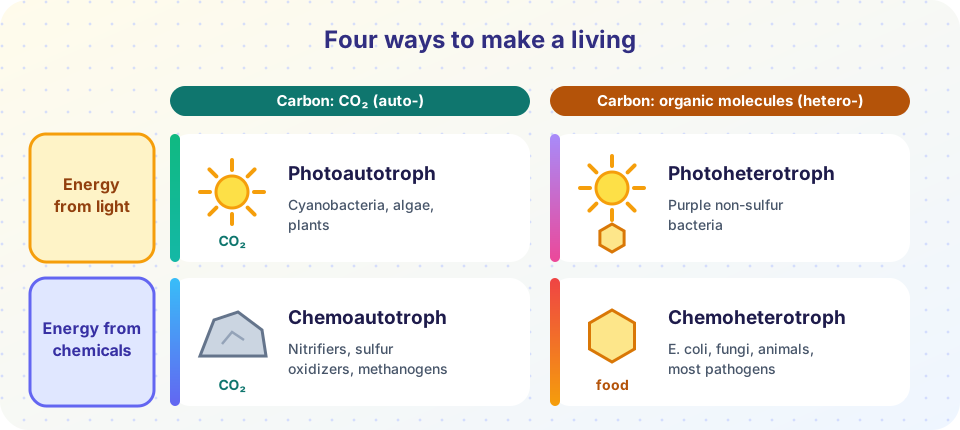
Microbes are classified by their energy source and their carbon source.
| Energy source | Carbon source | Name | Examples |
|---|---|---|---|
| Light | CO₂ | photoautotroph | cyanobacteria, algae, plants |
| Light | organic molecules | photoheterotroph | purple non-sulfur bacteria |
| Chemicals | CO₂ | chemoautotroph (chemolithotroph if the chemical is inorganic) | nitrifying bacteria, sulfur oxidizers, methanogens |
| Chemicals | organic molecules | chemoheterotroph | E. coli, fungi, animals, most pathogens |
Photoautotrophs fix CO₂ into sugar using light energy. Cyanobacteria and plants use water as the electron donor and release O₂; some other photosynthetic bacteria use hydrogen sulfide or hydrogen and do not release oxygen. Chemolithoautotrophs such as Nitrosomonas (oxidizes ammonia to nitrite) and Nitrobacter (nitrite to nitrate) get energy from inorganic compounds and build their cells from CO₂, in total darkness. They are essential to the nitrogen cycle in Chapter 8. Chemoheterotrophs, including nearly all human pathogens, eat organic compounds for both energy and carbon.
The same microbe can sometimes switch: many purple bacteria photosynthesize in light and respire on organic compounds in the dark. Such flexibility is common in nature and is called metabolic versatility.
Common misconceptions
"Enzymes are used up in a reaction." They are recycled; one enzyme molecule can process thousands of substrate molecules per second.
"Energy is stored in the phosphate bond itself, like a spring." The energy comes from the whole reaction: hydrolysis of ATP is favorable because the products are more stable and are kept far from equilibrium by the cell.
"Autotroph means a plant." Many autotrophs are bacteria or archaea, some of them living in complete darkness on chemicals.
"Heterotroph means a bad microbe." It only describes the carbon source: most bacteria, fungi and animals are heterotrophs.
Check your understanding
Quick check · 5 questions
of 5 answered You scored / 5 · perfect!
-
1. An enzyme works by...
Enzymes lower the activation energy and are not consumed, but they do not change the total energy change of the reaction. -
2. A competitive inhibitor changes the Michaelis-Menten curve how?
High substrate concentration can outcompete the inhibitor, so Vmax is reached, but more substrate is needed to reach half of it. -
3. Which is a chemolithoautotroph?
Nitrosomonas gets energy from an inorganic chemical (ammonia) and carbon from CO₂. -
4. Which method makes ATP by transferring a phosphate directly from an intermediate to ADP?
In substrate-level phosphorylation an enzyme moves a phosphate from a high-energy substrate to ADP. -
5. Sulfonamide antibiotics resemble PABA and block folate synthesis. This is an example of...
The drug competes with the natural substrate for the active site.
Summary
- Catabolism releases energy; anabolism uses it; ATP links them.
- Enzymes lower activation energy;
v = Vmax[S]/(Km + [S]). Competitive inhibitors raise Km; noncompetitive inhibitors lower Vmax. - ATP is made by substrate-level phosphorylation, oxidative phosphorylation or photophosphorylation.
- Microbes are photo- or chemotrophs (energy) and auto- or heterotrophs (carbon).
Track your progress
Create a free account to tick off lessons and pick up where you left off on any device.
of Microbiology lessons completed