


















Lesson 22 of 45 · Metabolism and Genetics of Microbes
Chapter 4 Review: Metabolism and Genetics of Microbes
Review enzymes, nutrition types, fermentation and respiration, gene expression, the lac operon, mutation and gene transfer with a recap table and a ten-question quiz.
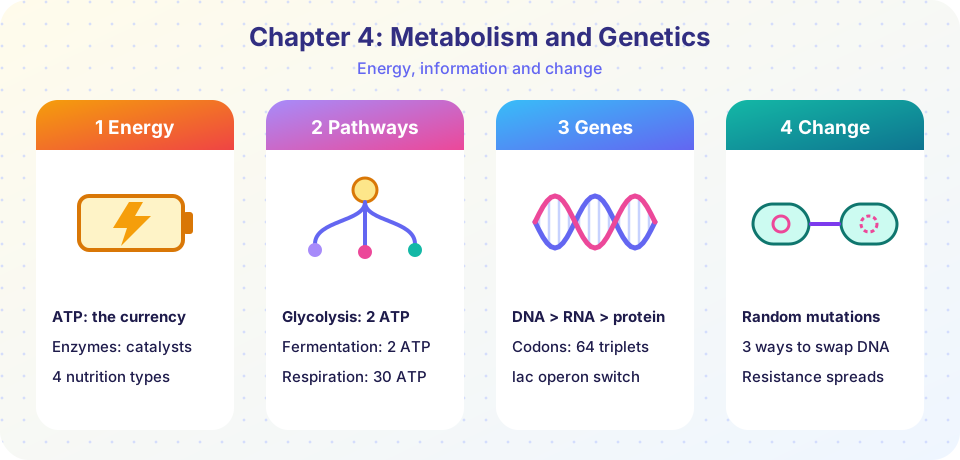
This chapter had two halves that turn out to be one story. In the first half you learned how a microbe earns its energy: enzymes speed up the reactions, ATP carries the energy, and the choice between fermentation, aerobic respiration and anaerobic respiration decides how much a cell gets and what waste it leaves behind. In the second half you saw how a cell stores and uses information: DNA is copied, genes are transcribed and translated, operons switch genes on when they are needed, and mutation and gene transfer constantly reshuffle the information. Together they explain why microbes are so adaptable, and why they can be both a threat and a tool.
What you will learn
- The key facts and formulas of Chapter 4 in one place.
- How metabolism and genetics connect in the lac operon and in antibiotic resistance.
The chapter at a glance
| Lesson | Big idea | Facts and formulas |
|---|---|---|
| Energy, enzymes and nutrition | Cells use enzymes and ATP; microbes are photo- or chemo-, auto- or heterotrophs | v = Vmax[S]/(Km + [S]); competitive inhibitors raise Km, noncompetitive lower Vmax |
| Fermentation and respiration | Where the electrons go decides the ATP yield | glycolysis net 2 ATP; fermentation 2 ATP; aerobic respiration about 30 to 32 ATP; ΔG = −nFΔE |
| DNA and gene expression | DNA to RNA to protein, with regulation | oriC and DNA pol III; RNA polymerase and sigma factor; 64 codons; lac operon needs lactose and low glucose |
| Mutation and gene transfer | Variation arises at random and spreads sideways | silent, missense, nonsense, frameshift; transformation, transduction, conjugation; Luria-Delbrück |
Connections
Follow E. coli in a bowl of milk. It has to decide which sugar to use. If glucose is present, low cAMP keeps the lac operon quiet (Lesson 4.3). When the glucose runs out, allolactose releases the repressor, and β-galactosidase splits lactose into glucose and galactose, which are fed into glycolysis. With oxygen the cell respires and makes about 30 ATP per sugar; in a sealed jar it ferments and makes 2 (Lesson 4.2). A plasmid with a resistance gene can move into the cell by conjugation (Lesson 4.4), and if an antibiotic is then added, the cells that carry the plasmid survive. One short story, four lessons.
Worked mini-problems
Problem 1. An enzyme has Vmax = 80 and Km = 4 mM. What is the rate at [S] = 12 mM? Solution: v = 80 × 12 / (4 + 12) = 60.
Problem 2. A glucose molecule is fully respired (modern yields 2.5 and 1.5 ATP per NADH and FADH₂). How many ATP? Solution: 4 direct + 10 × 2.5 + 2 × 1.5 = 32.
Problem 3. The coding strand ATG CCC GGA TAG is translated. What is the peptide? Solution: ATG is Met, CCC is Pro, GGA is Gly and TAG is a stop, so the peptide is Met-Pro-Gly.
Problem 4. A culture of 10⁸ cells has a mutation rate to drug resistance of 10⁻⁸ per cell division. About how many resistant mutants arise as the culture doubles once? Solution: 10⁸ divisions × 10⁻⁸ = about 1 new resistant mutant. Over many generations of growth the numbers add up fast.
Study checklist
You should be able to describe how each of the four nutritional types gets energy and carbon, draw the three fates of pyruvate, explain why fermentation makes so little ATP, name the three stages of aerobic respiration, translate a short DNA sequence, explain how the lac operon responds to lactose and glucose, classify a mutation as silent, missense, nonsense or frameshift, and match transformation, transduction and conjugation with their carriers.
Try it: key numbers
The practice generator below makes a new numerical problem each time you press the button.
Review quiz
Quick check · 10 questions
of 10 answered You scored / 10 · perfect!
-
1. Which statement about enzymes is correct?
Enzymes lower the activation energy and are recycled. -
2. A bacterium that gets energy from oxidizing ammonia and carbon from CO₂ is a...
An inorganic chemical gives the energy and CO₂ gives the carbon. -
3. What is the net ATP yield of glycolysis plus fermentation for one glucose?
Fermentation adds no ATP beyond the 2 net from glycolysis. -
4. In bacteria, ATP synthase and the electron transport chain are found in the...
Bacteria have no mitochondria, so the plasma membrane does the job. -
5. Which electron acceptor releases the most energy from NADH?
Oxygen has the highest reduction potential. -
6. A coding strand reads ATG AAA TAA. How many amino acids does the protein have?
ATG (Met) and AAA (Lys) are amino acids; TAA is a stop codon. -
7. With both glucose and lactose present, the lac operon is...
Low cAMP keeps CAP from activating transcription even though lactose releases the repressor. -
8. A mutation changes one codon to a stop codon. This is...
A nonsense mutation creates a premature stop. -
9. Which mechanism of gene transfer uses a bacteriophage?
In transduction a phage carries DNA from one cell to another. -
10. Why does an antibiotic increase the proportion of resistant bacteria?
Antibiotics select for resistance that already exists; they do not create it.
Summary
- Enzymes and ATP drive metabolism; nutritional types describe each microbe's energy and carbon sources.
- Fermentation gives 2 ATP per glucose; respiration gives about 30 to 32.
- DNA is copied, transcribed and translated; operons such as lac are controlled by repressors and activators.
- Mutation creates variation at random; transformation, transduction and conjugation spread genes sideways, and selection by antibiotics spreads resistance.
Track your progress
Create a free account to tick off lessons and pick up where you left off on any device.
of Microbiology lessons completed