


















Lesson 13 of 45 · Bacterial Structure and Growth
Shapes, Appendages and Endospores
Learn the shapes and arrangements of bacteria, how flagella and pili work, what capsules do, the internal structures of the cell, and how endospores survive extremes.
Pick up a bacterial culture and look at it through a microscope and you will see only a few basic shapes: dots, sticks and corkscrews. But shape is not decoration. A sphere has the least surface area for its volume; a rod gets food in faster while still being easy to divide; a corkscrew can bore through thick mucus. On top of the basic shape, many bacteria carry extras: propellers for swimming, hairs for grabbing, slime coats for hiding, and, in a few cases, a survival capsule that can outlast boiling water.
This lesson covers all of it: the shapes, the appendages on the outside, the structures on the inside, and the endospore. Look for the question that each structure answers: how do I move, how do I stick, how do I hide, how do I survive?
What you will learn
- The names of the main bacterial shapes and arrangements.
- How flagella, pili and capsules work and what they are for.
- The internal parts of a bacterium, including inclusions.
- How endospores form and why they survive heat, drying and chemicals.
Key terms
Coccus, bacillus, spirillum: a spherical, a rod-shaped, and a spiral bacterium.
Flagellum (plural flagella): a long protein filament, rotated by a motor in the membrane, that propels the cell.
Pilus (plural pili): a thin protein fiber used for attachment, twitching movement or DNA transfer.
Capsule: an organized layer of slime outside the cell wall.
Endospore: a tough, dormant cell made inside a bacterium of the genera Bacillus and Clostridium (and a few others).
Shapes and arrangements
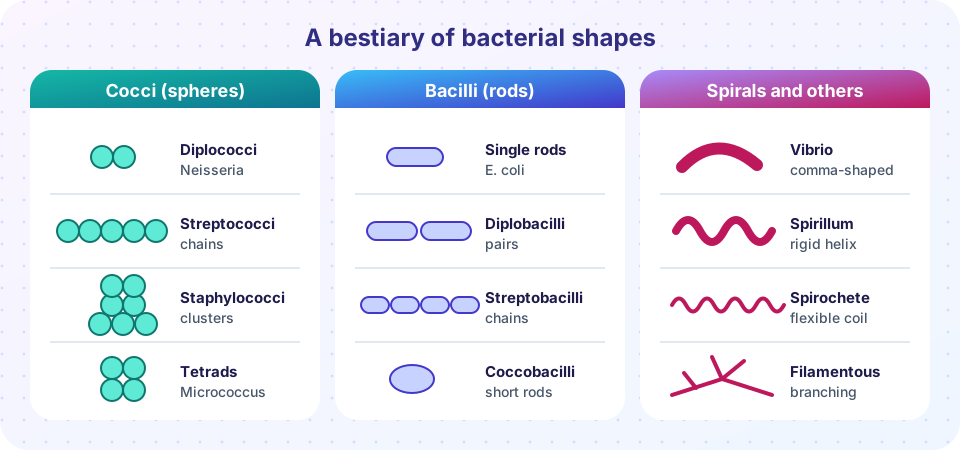
The three main shapes are cocci (spheres), bacilli (rods) and spiral forms. Spirals come as vibrios (comma-shaped curves), spirilla (rigid helices) and spirochetes (flexible, thin coils). A few bacteria are filamentous, forming long branching threads, and some change shape with conditions (pleomorphic).
Arrangement depends on the plane of division and whether the daughter cells separate:
- Cocci dividing in one plane and staying together form chains (streptococci, from Greek streptos, twisted) or pairs (diplococci).
- Dividing in several planes gives irregular grape-like clusters (staphylococci) or cubes of eight (sarcinae).
- Rods can form pairs or chains (streptobacilli), but never clusters in several planes because they divide across their short axis.
Scientists use shape and arrangement together with the Gram stain as a first description: "Gram-positive cocci in clusters" points to Staphylococcus; "Gram-negative rods" suggests, among others, Escherichia or Pseudomonas.
Why small is useful
A cell takes in nutrients through its surface but has to feed its whole volume. For a sphere of radius r, surface area is 4πr² and volume is 4πr³/3, so the ratio is 3/r. Smaller cells have a much higher surface-to-volume ratio, so food reaches the middle quickly. This limits how large a simple cell can get, and it is one reason bacteria grow and divide so fast.
Press Run (or Ctrl + Enter) to see the result here.
Program input · what you'd type while the program runs
Type the answers before you press Run, one per line. Each time the program reads a line (with input()), it gets the next line from this box.
Moving: flagella
Many bacteria swim. A bacterial flagellum is nothing like the whip-like flagellum of a eukaryotic cell. It is a rigid helical propeller with three parts:
- A long filament made of the protein flagellin.
- A hook, a flexible joint.
- A basal body, a set of rings embedded in the envelope that acts as a rotary motor, powered by the flow of protons (or sodium ions) into the cell down their concentration gradient, not by ATP.
The motor rotates the filament at hundreds of revolutions per second in some species, and a swimming cell can cover many body lengths each second. The arrangement of flagella is a useful descriptor: monotrichous (one), lophotrichous (a tuft), amphitrichous (one at each end) and peritrichous (all around the cell). Spirochetes keep their flagella inside the envelope, between the cell wall and an outer sheath, and the whole cell corkscrews.
Cells do not swim randomly. In chemotaxis they sense gradients of nutrients or toxins. An E. coli alternates runs (counterclockwise flagellar rotation, flagella bundled, swimming straight) with tumbles (clockwise rotation, bundle flies apart, cell reorients randomly). When the cell is heading up an attractant gradient it tumbles less often, which makes a random walk biased toward food. The simulation below shows the principle: no cell can "see" the food, but a simple rule biases the walk.
Sticking and hiding: pili and capsules
Pili (also called fimbriae when they are short and numerous) are hair-like protein fibers. Attachment pili let bacteria stick to host cells or surfaces; this is the first step toward infection or biofilm formation. Type IV pili can extend and retract, pulling the cell along a surface in "twitching" motility. Sex pili (conjugation pili) connect one bacterium to another so that a plasmid can pass between them (Chapter 4).
The glycocalyx is a coat of sticky polysaccharide (or sometimes protein) around the wall. If it is firmly attached and well organized it is called a capsule; if it is loose and diffuse it is a slime layer. Capsules help cells avoid being engulfed by white blood cells. In the 1920s, Frederick Griffith found that Streptococcus pneumoniae with a capsule killed mice, while strains without one did not, an observation that led to the discovery that DNA carries genetic information. Capsules also help cells survive drying and anchor them in biofilms.
The inside of the cell
- Nucleoid: the tangled chromosome, usually one circular DNA molecule roughly a thousand times longer than the cell, supercoiled and folded to fit.
- Plasmids: small, circular, extra DNA that replicate independently and often carry genes for antibiotic resistance, toxins or the ability to break down unusual compounds.
- Ribosomes: 70S ribosomes, made of a 30S and a 50S subunit, that translate genes into proteins. Many antibiotics (tetracyclines, aminoglycosides, macrolides) bind these subunits and so stop bacterial protein synthesis without touching our 80S ribosomes.
- Inclusions: storage granules of glycogen, polyhydroxybutyrate (a bioplastic-like carbon reserve), polyphosphate and sulfur. Some bacteria make gas vesicles for buoyancy or magnetosomes, chains of magnetic crystals that act as a compass.
- Cytoskeleton: bacteria have protein filaments related to those of eukaryotes (such as FtsZ, related to tubulin, which forms the ring that divides the cell).
Endospores: the survival capsule
When nutrients run out, some Gram-positive bacteria (Bacillus, Clostridium and relatives) can build an endospore. This is not reproduction; one cell makes one spore. The process, sporulation, takes several hours:
- The chromosome is copied and one copy is walled off near one end by an asymmetric septum.
- The mother cell engulfs this forespore.
- Layers are laid down around it: a thick cortex of peptidoglycan and a protein coat. The core fills with calcium dipicolinate and loses most of its water. Small acid-soluble proteins coat and protect the DNA.
- The mother cell breaks open and releases the mature spore.
Endospores can survive boiling, drying, radiation and many disinfectants for years, and when nutrients return they germinate into normal cells. That has consequences: spores of Clostridium botulinum survive ordinary cooking, so home canning needs pressure cookers that exceed 100 °C (about 121 °C); Bacillus anthracis spores persist in soil; and Clostridioides difficile spores spread in hospitals because alcohol hand gels do not kill them. Laboratory sterilization therefore uses an autoclave at 121 °C, and the endospore stain from Stains, Culture Media and Aseptic Technique reveals them.
Common misconceptions
"Bacteria swim with whip-like flagella like sperm." Bacterial flagella rotate like propellers and use a proton or ion gradient, not ATP, to turn.
"An endospore is a bacterial seed that makes new cells." One vegetative cell forms one spore and one spore germinates into one cell; the spore is for survival, not reproduction.
"Capsules are the same as cell walls." The capsule is an extra layer outside the wall that many bacteria lack.
Check your understanding
Quick check · 5 questions
of 5 answered You scored / 5 · perfect!
-
1. Gram-positive cocci arranged in grape-like clusters are most likely...
Dividing in several planes gives clusters (staphylococci); division in one plane gives chains (streptococci). -
2. What powers the bacterial flagellar motor?
The basal body acts as a rotary motor driven by ion flow, not by ATP. -
3. In chemotaxis, an E. coli moving up an attractant gradient...
Fewer tumbles mean longer runs in the favorable direction. -
4. Which feature protects bacteria such as Streptococcus pneumoniae from engulfment by white blood cells?
The capsule makes the cell harder to engulf. Griffith's mouse experiments showed this. -
5. Why do endospores need an autoclave at 121 °C to be killed?
Spores survive boiling because of their low water content, thick layers and DNA-protecting proteins.
Summary
- Main shapes: cocci, bacilli and spirals; arrangements (pairs, chains, clusters, tetrads) reflect planes of division.
- Small size gives a high surface-to-volume ratio (3/r for a sphere), which speeds nutrient uptake.
- Flagella are ion-driven rotary propellers; chemotaxis biases a run-and-tumble walk. Pili attach cells or transfer DNA; capsules hide cells from phagocytes.
- Internal parts: nucleoid, plasmids, 70S ribosomes and inclusions.
- Endospores are dormant, extremely resistant forms made by Bacillus and Clostridium.
Track your progress
Create a free account to tick off lessons and pick up where you left off on any device.
of Microbiology lessons completed