


















Lesson 43 of 45 · Projects and Practice
Microbiology glossary: chapters 5 to 8
Definitions of about forty key terms from virology, mycology, parasitology, infection, immunity, antimicrobials and applied microbiology, with a flashcard tool.
Use this page like a dictionary: look up a term while you read, or test yourself with the flashcard tool at the end. The terms are grouped by chapter, in the order they appear in the course. Each definition is short, so follow the link in the right-hand column to the lesson for the full explanation.
Viruses
| Term | Meaning | Lesson |
|---|---|---|
| Virion | a complete, infectious virus particle | Overview |
| Capsid | the protein shell around a viral genome | Structure |
| Envelope | a host-derived lipid membrane around some virions, carrying spikes | Structure |
| Baltimore classification | seven groups of viruses by the route from genome to mRNA | Structure |
| Reverse transcriptase | an enzyme that copies RNA into DNA, carried by retroviruses | Structure |
| Viroid | a short, naked circular RNA that infects plants | Structure |
| Prion | an infectious misfolded protein with no nucleic acid | Structure |
| Lytic cycle | replication that ends with the host cell bursting | Replication |
| Lysogeny, prophage | integration of phage DNA into the host chromosome; the integrated genome | Replication |
| Induction | the switch of a prophage to the lytic cycle | Replication |
| PFU, plaque | plaque-forming unit; a clear zone made by one infectious particle | Replication |
| MOI | multiplicity of infection, the ratio of virions to cells | Replication |
Fungi and parasites
| Term | Meaning | Lesson |
|---|---|---|
| Hypha, mycelium | a fungal thread; a mass of hyphae | Fungi |
| Yeast | a single-celled fungus that buds | Fungi |
| Dimorphic fungus | one that is a mold in the environment and a yeast in the body | Fungi |
| Ergosterol | the main sterol of fungal membranes | Fungi |
| Mycosis | a fungal disease | Fungi |
| Protozoan | a single-celled, animal-like eukaryote | Parasites |
| Helminth | a parasitic worm: nematode, cestode or trematode | Parasites |
| Vector | an organism, often an insect, that carries a pathogen between hosts | Parasites |
| Definitive host | the host with adult or sexual stages of a parasite | Parasites |
| Hypnozoite | a dormant liver stage of Plasmodium vivax and ovale | Parasites |
Disease and immunity
| Term | Meaning | Lesson |
|---|---|---|
| Pathogen | a microbe that can cause disease | Overview |
| Reservoir | where a pathogen normally lives and multiplies | Overview |
| Virulence | the degree of harm a pathogen causes | Pathogenesis |
| Adhesin | a surface molecule that lets a microbe attach to host cells | Pathogenesis |
| Exotoxin, endotoxin | a secreted protein toxin; the lipid A of Gram-negative cell walls | Pathogenesis |
| R₀ | basic reproduction number: new cases per case in a susceptible population | Pathogenesis |
| Innate immunity | fast, general defenses: barriers, phagocytes, inflammation | Immunity |
| Antibody | a Y-shaped protein from plasma cells that binds one antigen | Immunity |
| Memory cell | a long-lived B or T cell that remembers an antigen | Immunity |
| Herd immunity | indirect protection when enough people are immune | Immunity |
| MIC | the lowest drug concentration that stops visible growth | Antimicrobials |
| Selective toxicity | harming the microbe but not the host | Antimicrobials |
| Plasmid | a small circular DNA that can carry resistance genes | Antimicrobials |
Applied and environmental microbiology
| Term | Meaning | Lesson |
|---|---|---|
| Fermentation | making ATP without oxygen by recycling NADH | Food and industry |
| Starter culture | selected microbes added to begin a fermentation | Food and industry |
| Pasteurization | gentle heating that kills most harmful microbes | Food and industry |
| Bioreactor | a controlled tank for growing microbes | Food and industry |
| Recombinant DNA | DNA joined from different sources, such as a human gene in a bacterium | Food and industry |
| Nitrogen fixation | N₂ converted to ammonia by nitrogenase | Environmental |
| Nitrification | ammonium oxidized to nitrite, then nitrate | Environmental |
| Denitrification | nitrate reduced to N₂ without oxygen | Environmental |
| Activated sludge | aerated flocs of microbes that clean wastewater | Environmental |
| BOD | biochemical oxygen demand | Environmental |
| Bioremediation | using organisms to degrade pollutants | Environmental |
| Microbiome | the community of microbes in a habitat such as the gut | Environmental |
Pairs of terms to keep apart
Many errors in exams come from confusing two terms that sound alike. These pairs are worth learning side by side.
| Pair | The difference |
|---|---|
| Virulence and contagiousness | virulence is how severe the disease is; contagiousness is how easily it spreads |
| Antigen and antibody | an antigen is the molecule that is recognized; an antibody is the protein that recognizes it |
| Exotoxin and endotoxin | an exotoxin is a secreted protein; endotoxin is lipid A in the outer membrane of Gram-negative bacteria |
| Lytic and lysogenic | lytic ends with a burst; lysogenic keeps the phage genome as a prophage |
| Nitrification and nitrogen fixation | fixation turns N₂ into ammonia; nitrification oxidizes ammonium to nitrate |
| Nitrification and denitrification | nitrification needs oxygen and makes nitrate; denitrification happens without oxygen and removes it |
| Bactericidal and bacteriostatic | killing versus stopping growth |
| Colonization and infection | the microbe lives peacefully on the host versus invades and multiplies in tissue |
| Intermediate and definitive host | larval or asexual stages versus adult or sexual stages |
| Pasteurization and sterilization | kills most harmful microbes versus kills all of them |
| Incidence and prevalence | new cases in a period versus all existing cases at a time |
Common misconceptions
"Memorizing the glossary is the same as understanding the subject." Definitions help, but exam questions and real problems ask you to use the terms. Test yourself by explaining each one to a friend with an example.
"Similar words mean the same thing." Virulence and contagiousness, antibody and antigen, nitrification and nitrogen fixation are different ideas. Check pairs that you tend to mix up.
Try it
The first demonstration is a flashcard drill in the console. It shows a term and then the answer. Add your own cards.
Press Run (or Ctrl + Enter) to see the console output here.
No output.
The second demonstration is a search box for the terms. Type part of a word to filter the list.
Check your understanding
Quick check · 4 questions
of 4 answered You scored / 4 · perfect!
-
1. Which term describes a dormant liver stage of the malaria parasite?
Hypnozoites remain in the liver in P. vivax and P. ovale and can cause relapses. -
2. Which pair is correctly defined?
The MIC is read from a dilution series; virulence is severity, and BOD is oxygen demand. -
3. Which process turns N2 gas into ammonia?
Nitrogenase in certain bacteria and archaea reduces N2 to ammonia. -
4. A prion is best described as:
Prions are misfolded proteins that spread by converting normal protein.
Summary
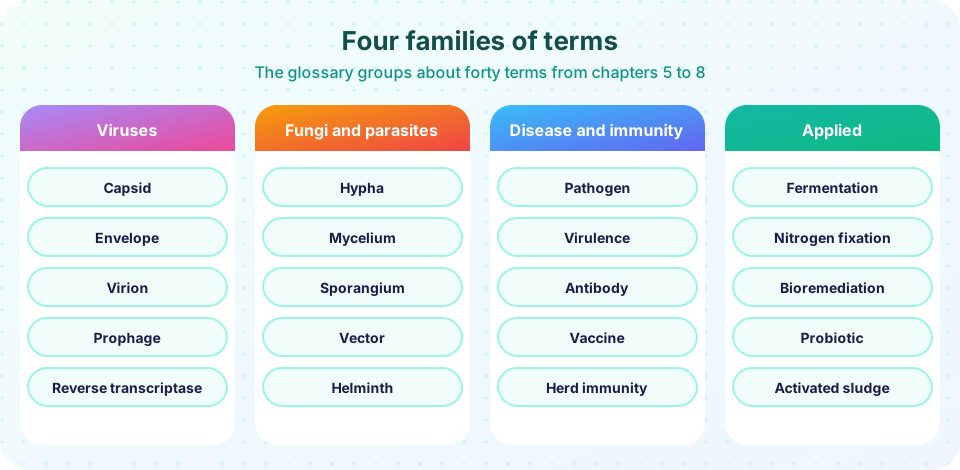
- The glossary groups terms by chapter: viruses, fungi and parasites, disease and immunity, and applied microbiology.
- Pairs that are easy to confuse (virulence and contagiousness, antibody and antigen, nitrification and fixation) deserve extra checking.
- Use the flashcards and the search box to revise, and follow the links for full explanations.
Next: Microbiology cheat sheet
Track your progress
Create a free account to tick off lessons and pick up where you left off on any device.
of Microbiology lessons completed