


















Lesson 36 of 45 · Applied and Environmental Microbiology
Chapter 8 overview: Applied and environmental microbiology
See how humans use microbes for food, medicines, industry and a healthy planet, and preview the nitrogen cycle, wastewater treatment and bioremediation.
After three chapters about microbes as invaders, it is time to look at the other side. Humans have worked with microbes for thousands of years, long before anyone knew they existed. Every loaf of leavened bread, every wheel of cheese and every glass of wine is the product of microbial work. In the last century we learned to direct that work on purpose: to make antibiotics, enzymes and hormones in giant tanks, to clean water and oil spills, and to engineer bacteria and yeast that make molecules no factory could easily produce.
Microbes are also the unseen engineers of the whole planet. Bacteria and archaea keep the nitrogen, carbon and sulfur cycles turning, which makes soils fertile and air breathable. In this chapter you will see how both stories connect: the same basic metabolism that makes a yogurt also removes nitrogen from sewage.
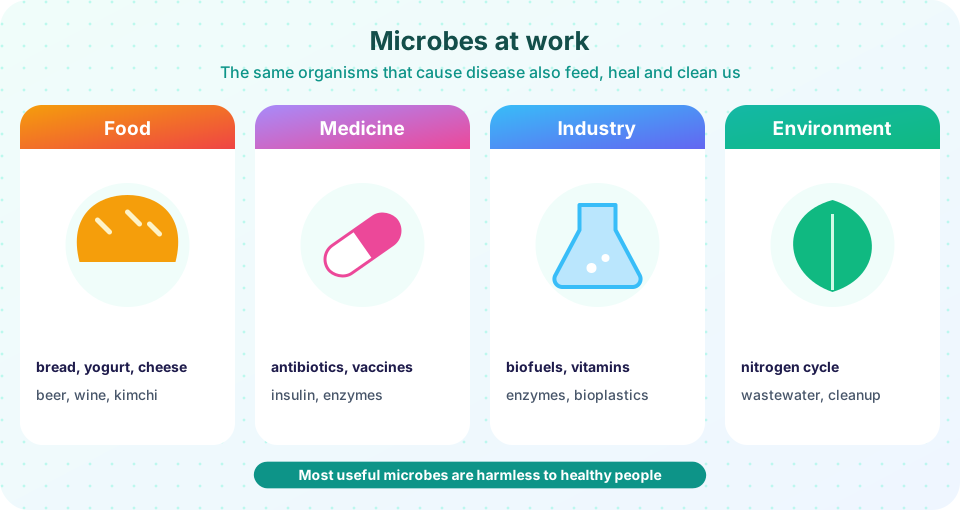
What you will learn
- The main areas where microbes are used: food, medicine, industry and the environment
- Why microbes make such useful tools: fast growth, flexible metabolism, easy to engineer
- How the chapter is organized and what each lesson covers
- How big microbial populations are in different places
Key terms
Biotechnology: the use of living organisms, or parts of them, to make products or solve problems.
Fermentation: in industry, any large-scale microbial process; in biochemistry, ATP production without oxygen.
Bioreactor (fermenter): a tank in which microbes are grown under controlled conditions.
Bioremediation: the use of organisms to break down pollutants.
Biogeochemical cycle: the flow of an element, such as nitrogen or carbon, through living and non-living parts of Earth.
Why microbes make good tools
Microbes have several features that suit industrial and environmental work. They grow quickly: E. coli can double in about 20 minutes in the lab, and yeast in about 90 minutes, so a culture goes from a few cells to billions in a day. They are small, so a huge surface for exchanging substances fits in a small tank. They are metabolically diverse: between them they can use sugars, oils, methane, hydrogen, sulfur, oil, plastics and even toxic compounds as sources of energy. Many are easy to modify genetically, so that they make a human protein such as insulin. And they can be grown cheaply from simple, renewable raw materials, from sugar cane to waste streams.
The numbers are remarkable. Typical figures, which vary widely from site to site, are about a million bacterial cells per milliliter of seawater or fresh water, a hundred million to a billion per gram of fertile soil, and around a hundred billion per gram of gut content. We live on a microbial planet, and the microbes are not only a threat.
A tour of the chapter
- Food and industrial microbiology explains fermentation of bread, beer and yogurt, how food is preserved and kept safe, and how bioreactors make antibiotics, enzymes, vaccines and recombinant medicines such as insulin.
- Environmental microbes looks at the nitrogen cycle, wastewater treatment, bioremediation of oil, and the microbiome of the human body.
- Chapter review brings all of these together in one picture and a ten-question quiz.
Microbes in the kitchen
Microbes in the factory
Microbes in the soil
Microbes as cleaners
The same biology, different uses
A theme of this chapter is that one metabolic ability can be put to many uses. Yeast converts sugar to ethanol and carbon dioxide: put it in dough and you get bread, put it in grape juice and you get wine, put it in a sugar cane mash and you get fuel ethanol. Lactic acid bacteria convert sugar to lactic acid: in milk this is yogurt, in cabbage it is sauerkraut, and in silage it is livestock feed that keeps over winter. Methane-producing archaea in the absence of oxygen turn organic waste into biogas, whether they are in a rice paddy, a cow's rumen or a municipal digester. Nitrifying bacteria oxidize ammonium in the soil and in a wastewater plant alike. Once you understand the biology, the applications follow.
Common misconceptions
"Fermented foods are spoiled foods." Fermentation is a controlled process with chosen microbes, and it often makes food safer and longer-lasting, because acid and alcohol keep other microbes out. Spoilage is uncontrolled growth of unwanted microbes.
"Genetically engineered microbes are rare and exotic." Most insulin used in medicine today is made in engineered bacteria or yeast, and many food enzymes come from engineered microbes.
"Microbes in the environment are mostly pathogens." Nearly all environmental microbes are harmless to humans, and they carry out the processes that keep ecosystems running.
Try it
The first demonstration is a lookup quiz for matching a product to the microbe and the kind of process. Run it, then add your own entries.
Press Run (or Ctrl + Enter) to see the console output here.
No output.
The second demonstration charts the typical cell densities mentioned above. They are order-of-magnitude figures, rounded, and real values vary a lot with place and season.
Press Run (or Ctrl + Enter) to see the result here.
Program input · what you'd type while the program runs
Type the answers before you press Run, one per line. Each time the program reads a line (with input()), it gets the next line from this box.
Check your understanding
Quick check · 5 questions
of 5 answered You scored / 5 · perfect!
-
1. Which feature makes microbes well suited to industrial production?
Fast growth, high surface-to-volume ratio and metabolic flexibility make microbes efficient producers. -
2. What does yeast produce when it ferments sugar?
Alcoholic fermentation gives ethanol and CO2. -
3. What is bioremediation?
Bioremediation relies on microbes (and sometimes plants) to degrade contaminants. -
4. Roughly how many bacterial cells are in a gram of fertile soil?
Soil is among the most densely populated microbial habitats, with around 10^8 to 10^9 cells per gram. -
5. Which microbes produce biogas from organic waste?
Methanogens make methane in the absence of oxygen.
Summary
- Humans use microbes in food, medicine, industry and environmental cleanup; they are also essential to nature's cycles.
- Microbes are useful because they grow fast, are small, metabolically diverse and easy to engineer.
- One metabolic ability, such as fermentation, can serve many uses.
- Typical densities range from about a million cells per mL in water to about a hundred billion per gram in the gut.
- The chapter covers food and industrial microbiology, environmental microbes, and a review.
Track your progress
Create a free account to tick off lessons and pick up where you left off on any device.
of Microbiology lessons completed