


















Lesson 39 of 45 · Applied and Environmental Microbiology
Chapter 8 review: Applied and environmental microbiology
Review fermentation, food safety, industrial products, the nitrogen cycle, wastewater and bioremediation with a one-picture summary and a ten-question quiz.
This chapter showed microbes in the roles they play every day: feeding us, making our medicines, keeping the nutrient cycles turning and cleaning up after us. The unifying idea is that microbial metabolism is enormously varied, and that humans have learned to direct it. A fermenter, a wastewater plant and a sourdough starter work on the same principle: give the right microbes the right conditions, and they do the chemistry.
Use the picture to see the six jobs at a glance, then try two quick exercises. One calculates how much a heat treatment cuts the number of microbes. The other is a set of flashcards. Finish with the quiz, which mixes all three lessons of the chapter.
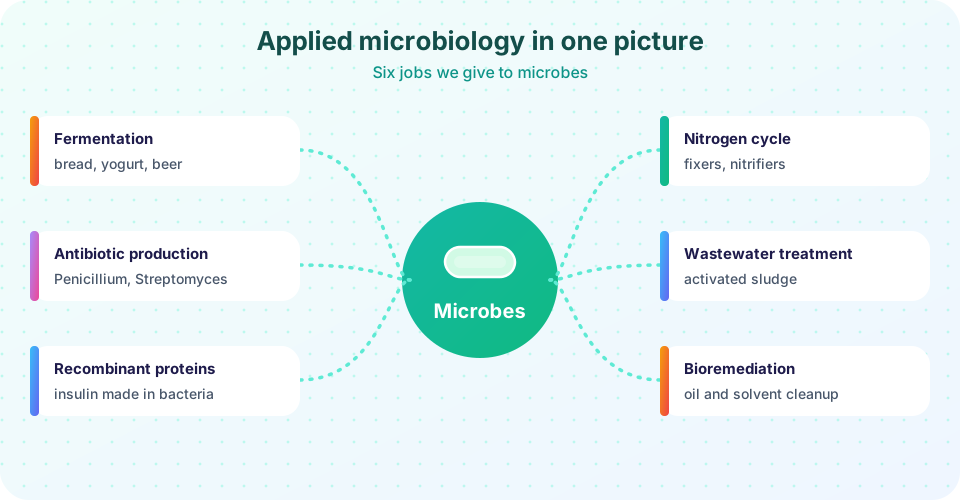
The chapter at a glance
| Topic | Key points | Lesson |
|---|---|---|
| Fermentation | glycolysis, NADH recycled; yeast makes ethanol and CO₂, lactic acid bacteria make lactate | Food and industry |
| Food safety | pasteurization, canning (121 °C for C. botulinum spores), refrigeration, hygiene | Food and industry |
| Industrial products | antibiotics (secondary metabolites), enzymes, citric acid, biofuels, recombinant insulin | Food and industry |
| Nitrogen cycle | fixation, nitrification (two steps), denitrification, ammonification | Environmental microbes |
| Wastewater | activated sludge removes BOD; aerobic and anoxic zones remove nitrogen | Environmental microbes |
| Bioremediation | biostimulation, bioaugmentation, hydrocarbon degraders | Environmental microbes |
| Microbiome | gut community, colonization resistance, probiotics, FMT for C. difficile | Environmental microbes |
Following one drop of wastewater
Here is a story that connects three lessons. Imagine a drop of household wastewater containing urine, food waste and a little yogurt. Urine carries nitrogen as urea, and food waste carries proteins. Soon after leaving the house, decomposers in the sewer turn urea and proteins into ammonium (ammonification). In the treatment plant, the drop enters an aerated tank full of activated sludge. Heterotrophic bacteria use the dissolved organic matter as food and oxygen to respire, which lowers the BOD. In the same tank, Nitrosomonas turns ammonium into nitrite and Nitrobacter and relatives turn nitrite into nitrate.
Next the water moves to an oxygen-free zone, where denitrifying bacteria such as Pseudomonas use nitrate in place of oxygen and release N₂ gas. The nitrogen has been taken out of the water and returned to the air, so it will not feed algae downstream. The settled sludge goes to an anaerobic digester, where mixed communities end in methanogenic archaea and produce biogas that can run the plant. Meanwhile the lactic acid bacteria of the yogurt, the yeast of the bread crumbs and every other microbe in the drop also take part, though on a much smaller scale.
The lesson is that applied microbiology is one set of principles used in many settings: energy-yielding reactions, oxygen or alternative electron acceptors, and the cycling of elements. The tank, the fermenter and the field differ in scale, not in kind.
Try it
The first demonstration is about heat treatment. When microbes are heated, their numbers fall by a constant factor in each time step. The D-value is the time at a given temperature that kills 90 percent of the cells, meaning one logarithmic (tenfold) reduction. The D-value below is a made-up number for a hypothetical microbe, chosen to show the calculation.
Press Run (or Ctrl + Enter) to see the result here.
Program input · what you'd type while the program runs
Type the answers before you press Run, one per line. Each time the program reads a line (with input()), it gets the next line from this box.
The second demonstration shuffles flashcards for the nitrogen cycle. Run it more than once to get a different order.
Press Run (or Ctrl + Enter) to see the console output here.
No output.
Check your understanding
Quick check · 10 questions
of 10 answered You scored / 10 · perfect!
-
1. Which pair of microbes performs the two steps of nitrification?
Nitrosomonas oxidizes ammonium to nitrite, and Nitrobacter oxidizes nitrite to nitrate. -
2. What is the net ATP yield of glycolysis per glucose?
Glycolysis gives a net of 2 ATP and 2 NADH per glucose. -
3. Why does an activated sludge tank need aeration?
Aerobic bacteria need oxygen to oxidize organic matter and form flocs. -
4. Heating a food to 72 °C for 15 seconds is an example of:
This high-temperature short-time treatment pasteurizes milk. -
5. A culture with a D-value of 3 minutes is heated for 12 minutes. How large is the log reduction?
12 / 3 = 4 decimal reductions, so numbers fall by a factor of 10,000. -
6. Which process turns nitrate back into N2?
Denitrifying bacteria use nitrate in place of oxygen and release N2. -
7. Which is a secondary metabolite typically made in a fed-batch fermenter?
Antibiotics are secondary metabolites produced when growth slows. -
8. What is bioaugmentation?
Biostimulation adds nutrients; bioaugmentation adds microbes. -
9. Which organisms make methane in wetlands, landfills and the rumen?
Methanogens are archaea that produce methane in the absence of oxygen. -
10. Why is the Taq polymerase important in the laboratory?
It comes from the heat-loving bacterium Thermus aquaticus and survives the repeated heating of PCR.
Summary
- Fermentation, enzymes, antibiotics and recombinant proteins show how microbial metabolism is put to work.
- Heat, acid, drying, refrigeration and hygiene control microbes in food; D-values quantify heat killing.
- The nitrogen cycle, carbon cycle and wastewater treatment depend on microbial communities.
- Bioremediation uses natural degraders, sometimes helped by nutrients or added strains.
- The human microbiome is a community that protects, digests and trains.
Next: Chapter 9: Practice set
Track your progress
Create a free account to tick off lessons and pick up where you left off on any device.
of Microbiology lessons completed