


















Lesson 19 of 45 · Metabolism and Genetics of Microbes
Fermentation and Respiration
Follow glucose through glycolysis, fermentation and aerobic or anaerobic respiration, calculate ATP yields, and see how microbes use different electron acceptors.
A loaf of bread rises because yeast cells make carbon dioxide. A glass of yogurt is sour because bacteria make lactic acid. A swamp smells of rotten eggs because other bacteria breathe sulfate instead of oxygen. All three are variations on one theme: a cell takes electrons from food and has to dump them somewhere. What it dumps them on decides how much energy it gets, what waste it leaves behind, and what role it plays in food, disease and the planet's chemistry.
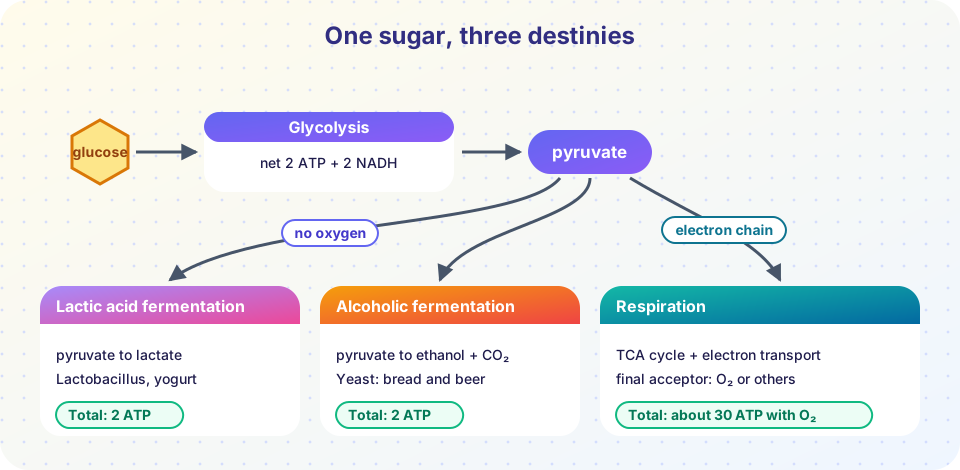
This lesson follows the sugar glucose from the first step shared by nearly all life, glycolysis, to its three fates: fermentation, aerobic respiration and anaerobic respiration. At the end you will be able to count the ATP from each route and explain why a microbe in a sealed jar behaves differently from one with air.
What you will learn
- The steps and the net yield of glycolysis.
- Why cells ferment and how the main fermentation types differ.
- How the TCA cycle and the electron transport chain make ATP in respiration.
- How anaerobic respiration uses acceptors other than oxygen.
- How to calculate ATP yield and the energy released by different electron acceptors.
Key terms
Glycolysis: the pathway that splits glucose (6 carbons) into two pyruvate (3 carbons each), yielding a little ATP and NADH.
Fermentation: breaking down food without an external electron acceptor; pyruvate or its products accept the electrons.
Respiration: ATP production using an electron transport chain and a final external electron acceptor.
Proton motive force (PMF): the energy stored as a proton gradient across a membrane.
Terminal electron acceptor: the molecule that finally receives electrons at the end of the chain (O₂ in aerobic respiration).
Glycolysis: the common start
Glycolysis happens in the cytoplasm and needs no oxygen. In the first half the cell spends 2 ATP to attach phosphates to the sugar and split it into two three-carbon pieces. In the second half each piece is converted to pyruvate, producing 4 ATP and 2 NADH in total. The net result for one glucose is:
glucose + 2 NAD⁺ + 2 ADP + 2 Pi → 2 pyruvate + 2 NADH + 2 ATP + 2 H₂O + 2 H⁺
That ATP is made by substrate-level phosphorylation. Many bacteria use this pathway (the Embden-Meyerhof-Parnas pathway); some, including Pseudomonas, use the Entner-Doudoroff pathway instead, which yields only 1 ATP but needs fewer enzymes.
The problem is the NADH. The cell has only a small pool of NAD⁺. If all of it is converted to NADH, glycolysis stops. The cell must regenerate NAD⁺ by handing the electrons on, and how it does that is what separates fermentation from respiration.
Fermentation: regenerate NAD⁺ and stop
In fermentation, an organic molecule derived from pyruvate accepts the electrons from NADH, turning it back to NAD⁺. There is no electron transport chain and no net ATP beyond the 2 from glycolysis. Fermentation is inefficient, but it is fast, needs no oxygen and works where oxygen is absent.
| Type | End products | Organisms | Uses and tests |
|---|---|---|---|
| Lactic acid (homolactic) | lactate | Lactobacillus, Streptococcus | yogurt, cheese, sauerkraut; the acid lowers pH and preserves food |
| Lactic acid (heterolactic) | lactate, ethanol, CO₂ | Leuconostoc | sourdough, kimchi |
| Alcoholic | ethanol + CO₂ | yeast (Saccharomyces) | bread, beer, wine |
| Mixed acid | lactate, acetate, succinate, formate, ethanol (+ gas) | E. coli and relatives | acid production detected with methyl red |
| Butanediol | butanediol, ethanol, CO₂ | Enterobacter | Voges-Proskauer test |
| Propionic acid | propionate, acetate, CO₂ | Propionibacterium | the CO₂ makes the holes in Swiss cheese |
Muscle cells also make lactate when oxygen is scarce during intense exercise. Fermentation tests are used in the laboratory: a color indicator shows acid, and a small inverted tube (a Durham tube) traps gas, which helps separate species.
Aerobic respiration
Cells with an electron transport chain can extract far more energy. Respiration has three stages:
- Glycolysis (as above): 2 ATP, 2 NADH.
- Pyruvate oxidation and the TCA (Krebs) cycle. Each pyruvate loses a carbon as CO₂ and becomes acetyl-CoA (making NADH). Acetyl-CoA enters the cycle, a ring of reactions that fully oxidizes it to CO₂. For one glucose (2 turns), the cycle yields 6 NADH, 2 FADH₂ and 2 ATP (or GTP). In bacteria these steps take place in the cytoplasm; in eukaryotes, in the mitochondrial matrix.
- Electron transport and oxidative phosphorylation. NADH and FADH₂ deliver electrons to a chain of carriers in the plasma membrane of bacteria (the inner mitochondrial membrane in eukaryotes). As electrons pass down the chain, protons are pumped out of the cell, building a proton motive force. Protons flow back in through ATP synthase, a rotary enzyme, and ATP is made. At the end of the chain, the electrons are handed to oxygen, which turns into water.
Counting the ATP
Per glucose we get 10 NADH and 2 FADH₂ in total, plus 4 ATP directly (2 from glycolysis, 2 from the TCA cycle). Modern measurements suggest that each NADH drives about 2.5 ATP and each FADH₂ about 1.5. Older textbooks used 3 and 2, which gave the familiar 36 to 38 ATP. The total is therefore about 30 to 32 ATP, depending on the organism and on how many protons it needs to make one ATP.
Press Run (or Ctrl + Enter) to see the result here.
Program input · what you'd type while the program runs
Type the answers before you press Run, one per line. Each time the program reads a line (with input()), it gets the next line from this box.
Anaerobic respiration: breathing something else
Oxygen is not the only possible electron acceptor. Many bacteria and archaea carry out anaerobic respiration, using the same kind of electron transport chain but with a different final acceptor:
- Nitrate (NO₃⁻), reduced to nitrite and eventually to nitrogen gas (N₂) by denitrifying bacteria such as Pseudomonas and Paracoccus. This removes nitrogen from soil.
- Sulfate (SO₄²⁻), reduced to hydrogen sulfide (H₂S) by Desulfovibrio. It gives the rotten-egg smell of marsh mud, and the black iron sulfide stains in it.
- Carbon dioxide, reduced to methane by methanogens (archaea).
- Iron (Fe³⁺) and fumarate, used by Geobacter and E. coli respectively.
The energy available depends on the difference in reduction potential between the electron donor and the acceptor. The free-energy change is ΔG°' = −n × F × ΔE°', where n is the number of electrons moved, F = 96.485 kJ/(V·mol) and ΔE°' is the potential difference in volts. Oxygen is a strong electron acceptor (E°' = +0.82 V), nitrate is next, and sulfate and CO₂ are weak, so organisms respiring on them make less ATP per electron. That is one reason aerobic microbes grow faster than anaerobes.
Press Run (or Ctrl + Enter) to see the result here.
Program input · what you'd type while the program runs
Type the answers before you press Run, one per line. Each time the program reads a line (with input()), it gets the next line from this box.
Photosynthesis in brief
Phototrophs use light to move electrons. In oxygenic photosynthesis (cyanobacteria, algae, plants), light energizes electrons in two photosystems; water is the electron donor and O₂ is released; the products are ATP and NADPH, which then drive the Calvin cycle to turn CO₂ into sugar. Anoxygenic photosynthesis (purple and green bacteria) uses one photosystem and donors such as H₂S or H₂, so no oxygen is made, and sulfur granules may appear instead.
Try it: yeast with and without air
Yeast can ferment or respire, depending on whether oxygen is available. The widget below applies the textbook yields (2 ATP for fermentation, about 30 ATP for respiration) to show how much sugar a culture needs for the same energy.
Common misconceptions
"Fermentation needs no oxygen, so it is respiration without oxygen." Anaerobic respiration uses an electron transport chain with another acceptor. Fermentation uses no chain at all.
"Respiration is breathing." In biology it is the chemical process of ATP production; breathing is just how many animals deliver O₂.
"Bacteria need oxygen to respire." Many respire on nitrate, sulfate, iron or CO₂.
"All 38 ATP always form." The yield is an estimate of about 30 to 32 and varies with conditions.
Check your understanding
Quick check · 6 questions
of 6 answered You scored / 6 · perfect!
-
1. What is the net ATP gain from glycolysis of one glucose?
Glycolysis uses 2 ATP and produces 4, so the net is 2 (plus 2 NADH). -
2. Why do cells ferment?
Fermentation oxidizes NADH back to NAD⁺ by passing electrons to an organic molecule. -
3. Which organism makes the holes in Swiss cheese?
Propionic acid fermentation produces CO₂ bubbles. -
4. In bacteria the electron transport chain is located in the...
Bacteria have no mitochondria, so the plasma membrane carries the chain and ATP synthase. -
5. Which final acceptor gives the most energy per electron pair from NADH?
Oxygen has the highest reduction potential (+0.82 V), so ΔG is most negative. -
6. Which bacteria convert nitrate to nitrogen gas?
Denitrifiers use nitrate as an electron acceptor and release N₂.
Summary
- Glycolysis nets 2 ATP and 2 NADH per glucose; the NADH must be reoxidized.
- Fermentation regenerates NAD⁺ with organic products (lactate, ethanol and others) and makes only 2 ATP in total.
- Respiration uses the TCA cycle and an electron transport chain, giving about 30 to 32 ATP per glucose with oxygen.
- Anaerobic respiration uses nitrate, sulfate, CO₂ or iron; the energy depends on
ΔG = −nFΔE.
Track your progress
Create a free account to tick off lessons and pick up where you left off on any device.
of Microbiology lessons completed