


















Lesson 44 of 45 · Projects and Practice
Microbiology cheat sheet: chapters 5 to 8
A one-page recap of viruses, fungi and parasites, infection and immunity, antibiotics, fermentation and the nitrogen cycle, with the key formulas and a calculator.
This page is the revision sheet for chapters 5 to 8. Look at the poster to see the whole picture, scan the key facts and formulas, and run the calculator to check your arithmetic. Everything here is explained in full in the lessons, which are linked in each table.
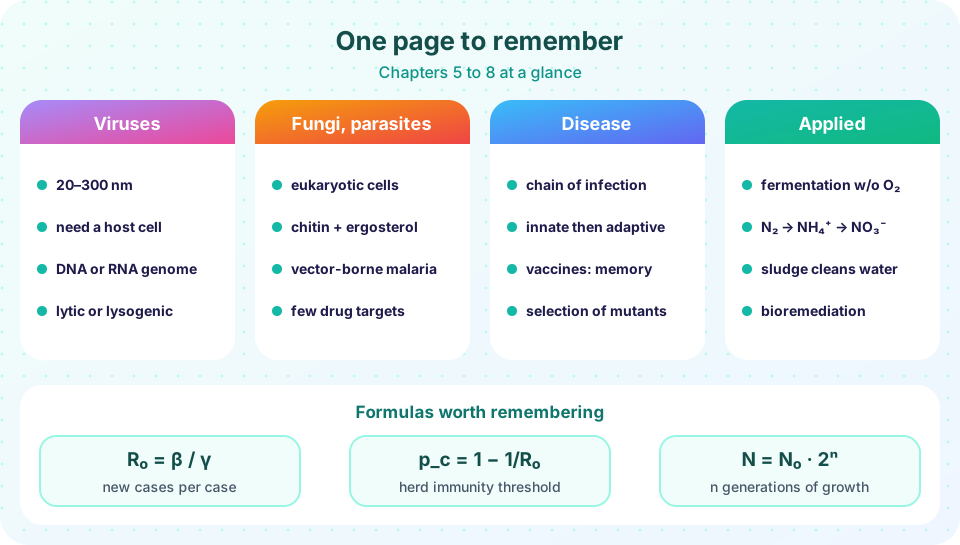
Key facts by chapter
| Topic | Remember |
|---|---|
| Virus | genome (DNA or RNA) in a capsid, sometimes an envelope; no metabolism; 20 to 300 nm typical; obligate intracellular parasite |
| Baltimore | I dsDNA, II ssDNA, III dsRNA, IV (+)ssRNA, V (−)ssRNA, VI ssRNA-RT (HIV), VII dsDNA-RT (hepatitis B); all make mRNA |
| Phage cycles | lytic: attach, inject, make parts, assemble, burst; lysogenic: prophage integrated, induced by DNA damage |
| Fungi | eukaryotes, chitin wall, ergosterol; yeasts bud, molds make hyphae and spores; drugs: polyenes, azoles, echinocandins |
| Protozoa | single-celled eukaryotes: amoebae, flagellates, apicomplexans; Plasmodium needs a human and an Anopheles mosquito |
| Helminths | nematodes, cestodes, trematodes; eggs and larvae; albendazole, ivermectin, praziquantel |
| Chain of infection | agent, reservoir, portal of exit, transmission, portal of entry, susceptible host |
| Virulence | adhesins, capsule, enzymes, exotoxins (proteins), endotoxin (lipid A of Gram-negatives) |
| Immunity | barriers and innate first; B cells make antibodies, T cells help and kill; memory makes the second response faster |
| Antibiotics | wall (beta-lactams), 30S/50S ribosome, folate, DNA gyrase, RNA polymerase, membrane; resistance by selection |
| Fermentation | glycolysis (+2 ATP), yeast: ethanol + CO₂, lactic acid bacteria: lactate |
| Nitrogen cycle | fixation → ammonification → nitrification (two steps) → denitrification |
| Wastewater | activated sludge removes BOD; aerobic then anoxic zones remove nitrogen |
How the chapters connect
The four chapters tell one story. Viruses, fungi and parasites are the actors: each has a structure, a life cycle and a set of weak points. Disease is what happens when an actor meets a host: the chain of infection decides whether it arrives, virulence factors decide how much damage it does, and the immune system and drugs decide who wins. Applied microbiology turns the story around, and uses the same metabolism and the same genes for food, medicine and the cleaning of the planet. When a new organism appears in your reading, ask four questions: what is it, how does it spread, how does the host respond, and how can we use or stop it?
Key formulas
| Quantity | Formula | Example |
|---|---|---|
| Phage titer | plaques / (dilution × volume in mL) | 84 / (10⁻⁷ × 0.1) = 8.4 × 10⁹ PFU/mL |
| Capsid subunits | 60 × T | T = 4: 240 |
| Fraction of cells with no virion | e^(−MOI) | MOI 1: 37% |
| Burst size | (final titer − initial titer) / infected cells | |
| Growth by doubling | N = N₀ × 2ⁿ | 6 doublings: 64-fold |
| Log reduction | time / D | 7.5 min / 1.5 min = 5 logs |
| Herd immunity threshold | 1 − 1/R₀ | R₀ = 5: 80% |
| Coverage needed | threshold / vaccine effectiveness | 0.8 / 0.9 = 89% |
| Early doubling time (SIR) | ln 2 / (γ (R₀ − 1)) | R₀ = 3, 5 days: 1.7 days |
| BOD | L₀ (1 − e^(−kt)) | |
| Ethanol from sugar | sugar × 0.511 × efficiency | 220 g/L × 0.511 × 0.92 = 103 g/L |
Ten things people forget
- Antibiotics do nothing against viruses.
- Enveloped viruses are easy to inactivate with soap and alcohol; naked viruses are tougher.
- Positive-sense RNA is already mRNA; negative-sense RNA needs the virion's polymerase.
- A prophage can carry toxin genes (diphtheria, cholera, Shiga).
- Fungi are closer to animals than to plants, which is why antifungals are hard to design.
- Malaria fever comes from synchronized red cell bursts; P. vivax can relapse from the liver.
- Virulence is severity; contagiousness is ease of spread.
- A second exposure is faster because of memory B and T cells.
- Resistance mutations exist before the drug is applied; the drug selects them.
- Nitrification needs oxygen; denitrification happens without it.
Try it
The first demonstration is a small calculator for the main formulas. Change the numbers at the top to check your own problems.
Press Run (or Ctrl + Enter) to see the result here.
Program input · what you'd type while the program runs
Type the answers before you press Run, one per line. Each time the program reads a line (with input()), it gets the next line from this box.
The second demonstration is a random question generator for self-testing. Run it again for new questions.
Press Run (or Ctrl + Enter) to see the console output here.
No output.
Check your understanding
Quick check · 4 questions
of 4 answered You scored / 4 · perfect!
-
1. Which formula gives the herd immunity threshold?
The fraction that must be immune is 1 - 1/R0. -
2. Which pair of terms is matched correctly?
Endotoxin is lipid A; exotoxins are secreted proteins. -
3. A culture with D = 2 min is heated for 8 min. How many log reductions?
8 / 2 = 4 decimal reductions. -
4. Which is the correct order of the nitrogen cycle pathway for waste ammonium in a treatment plant?
Aerobic nitrification makes nitrate, and anoxic denitrification then removes it as N2.
Summary
- The poster and tables hold the main facts for chapters 5 to 8.
- Eleven formulas cover titers, growth, killing, herd immunity, outbreaks, BOD and ethanol yield.
- The ten commonly forgotten points are good last-minute checks.
- Use the calculator and self-test to revise actively.
Next: Where to go next
Track your progress
Create a free account to tick off lessons and pick up where you left off on any device.
of Microbiology lessons completed