


















Lesson 2 of 45 · Getting Started
A Short History of Microbiology
Follow the discoveries that built microbiology: first lenses, the end of spontaneous generation, germ theory, Koch's postulates, antibiotics and genomes.
For most of human history nobody knew that microbes existed, yet people used them every day. They brewed beer, baked bread and made cheese without any idea why those processes worked, and they watched epidemics sweep through towns without knowing what carried them. Microbiology became a science only when three things came together: lenses good enough to see single cells, experiments clever enough to test where life comes from, and a willingness to believe that something invisible could kill a person.
The history is also a lesson in how science works. Ideas that seem obvious today were fiercely argued, and each answer came from a carefully designed experiment, not from a flash of insight. Knowing the story makes the later chapters easier to remember, because many techniques you will meet (sterile broth, pure cultures, vaccines, antibiotics) were invented to settle a specific argument.
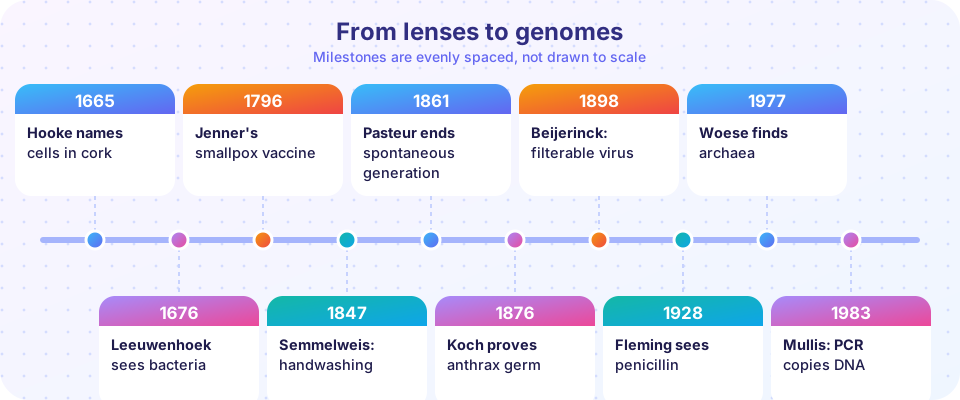
What you will learn
- How the first microscopes revealed the microbial world.
- Why the spontaneous generation debate ended, and which experiments ended it.
- How Pasteur, Lister, Semmelweis and Koch established the germ theory of disease.
- What Koch's postulates are, and where they fall short.
- How viruses, antibiotics, DNA and archaea entered the story.
Key terms
Spontaneous generation: the old belief that living things can arise from non-living matter, such as maggots from meat.
Germ theory: the idea that specific microorganisms cause specific diseases.
Pure culture: a population of cells descended from a single cell, with no other species present.
Aseptic technique: working so that unwanted microbes are kept out of a culture and the worker is protected.
Vaccination: deliberate exposure to a harmless form of a pathogen to produce immunity.
Seeing the invisible: Hooke and Leeuwenhoek
In 1665 the English scientist Robert Hooke published Micrographia, a book of detailed drawings made with a compound microscope. He examined a thin slice of cork and saw rows of tiny boxes, which he called "cells" after the small rooms of a monastery. The same book shows the fruiting bodies of a mold, so Hooke was among the first to draw a microbe, although he did not know what it was.
A few years later a Dutch cloth merchant named Antonie van Leeuwenhoek took a different route. He ground tiny, nearly spherical single lenses and mounted each in a metal plate, producing microscopes that, in his best instruments, magnified roughly 200 to 270 times with remarkable clarity. Between 1673 and the 1720s he sent letters to the Royal Society in London describing what he saw: swimming "animalcules" in rainwater and pepper infusions, and, in 1683, tiny moving rods and spirals scraped from his own teeth. Those were bacteria. Leeuwenhoek had no formal training, kept his lens-making methods secret, and still opened the field.
Does life arise from nothing?
People once believed that maggots arose from rotting meat and mice from dirty grain. In 1668 the Italian physician Francesco Redi tested the idea on flies. He put meat in several jars: some open, some sealed, some covered with gauze. Maggots appeared only where flies could land. That settled the question for large animals, but when microbes were discovered, the old idea returned: surely the cloudy growth in a flask of broth arose by itself?
The argument ran for two centuries. John Needham heated broth and saw it turn cloudy; Lazzaro Spallanzani showed that broth sealed and boiled for longer stayed clear, but critics replied that heat or sealing spoiled the "vital force" in the air. The matter was settled by Louis Pasteur in the early 1860s. He filled flasks with nutrient broth and drew the necks out into long, S-shaped curves, open to the air but with a bend. After boiling, the broth stayed clear for months: dust and microbes settled in the bend and could not reach the liquid. When he tilted a flask so the broth touched the bend, or snapped off the neck, microbes grew within days. The air was not the problem. The particles in it were.
Pasteur's flasks are a model of experimental design: the same broth, the same air, and a single changed variable (the shape of the neck). The simulation below mimics the logic with made-up probabilities, so you can see why even good controls can show a rare contamination.
Press Run (or Ctrl + Enter) to see the result here.
Program input · what you'd type while the program runs
Type the answers before you press Run, one per line. Each time the program reads a line (with input()), it gets the next line from this box.
Germs cause disease
If microbes were everywhere, perhaps some of them caused illness. Several people reached this idea from different directions.
- Edward Jenner (1796) noticed that milkmaids who caught cowpox seemed protected from smallpox. He inoculated a boy with cowpox material and later showed he resisted smallpox. The word vaccine comes from the Latin vacca, cow. Smallpox was declared eradicated by the World Health Organization in 1980.
- Ignaz Semmelweis (1847), working in a Vienna maternity hospital, saw far more deaths from childbed fever on the ward where doctors came straight from autopsies. When he required hand washing with a chlorinated lime solution, deaths fell sharply. His colleagues largely rejected the explanation.
- Joseph Lister (1860s) applied carbolic acid (phenol) to wounds, instruments and the air of the operating room, after reading Pasteur's work. Post-operative infections declined, and antisepsis became standard.
- Louis Pasteur also showed that fermentation of wine and beer is performed by living yeasts, and that other microbes spoil them. Heating liquid gently to kill the spoilers became known as pasteurization.
The decisive proof came from the German physician Robert Koch. In 1876 he showed that Bacillus anthracis, a rod-shaped bacterium he could see in the blood of sick animals, caused anthrax. In 1882 he identified the cause of tuberculosis, Mycobacterium tuberculosis. To do this he needed pure cultures, so his laboratory developed solid media (gelatin at first, then agar, a seaweed extract that Fanny Hesse, the wife of a colleague, is credited with suggesting). His assistant Julius Petri invented the flat glass dish that still carries his name, in 1887.
Koch's postulates
From this work came a set of criteria, formulated in the 1880s, for proving that a particular microbe causes a particular disease:
- The microbe must be found in every case of the disease and not in healthy hosts.
- It must be isolated and grown in pure culture.
- The pure culture must cause the same disease when put into a healthy, susceptible host.
- The same microbe must be recovered again from the experimentally infected host.
Koch's postulates are powerful but not universal. Some microbes cannot be grown in pure culture (viruses, for example, need living cells), some pathogens cause disease only in certain hosts, and some healthy people carry a pathogen without symptoms, which breaks the first postulate. Modern microbiologists use the postulates as a guide and add molecular evidence such as DNA sequences.
Viruses, antibiotics and molecules
In 1892 Dmitri Ivanovsky showed that sap from diseased tobacco plants stayed infectious after passing through a filter fine enough to hold back bacteria. Martinus Beijerinck repeated the work in 1898 and concluded the agent was something new, a "contagious living fluid". We call such agents viruses. Wendell Stanley crystallized tobacco mosaic virus in 1935, and electron microscopes in the 1930s finally let people see virus particles.
In 1928 Alexander Fleming noticed that a Penicillium mold contaminating a plate had cleared the Staphylococcus colonies around it. A team at Oxford led by Howard Florey and Ernst Chain, with Norman Heatley, purified penicillin and tested it in the early 1940s. The antibiotic era began, and Chapter 3 will show why penicillin targets the bacterial cell wall.
The second half of the twentieth century brought molecular answers. Frederick Griffith (1928) and then Oswald Avery, Colin MacLeod and Maclyn McCarty (1944) showed bacteria could pass on heritable traits, and that the carrier was DNA. Carl Woese and George Fox compared ribosomal RNA sequences in 1977 and found a third domain of life, the archaea. Kary Mullis devised the polymerase chain reaction in 1983, and in 1995 Haemophilus influenzae became the first free-living organism with a fully sequenced genome.
Common misconceptions
"Leeuwenhoek invented the microscope." Compound microscopes existed before him. His achievement was the quality of his single lenses and his careful, curious observations.
"Pasteur discovered that germs cause disease on his own." The germ theory was built by many people, including Semmelweis, Lister and especially Koch, whose methods provided the proof.
"Fleming gave us a medicine." Fleming discovered the effect; Florey, Chain and Heatley turned penicillin into a usable drug years later.
Check your understanding
Quick check · 5 questions
of 5 answered You scored / 5 · perfect!
-
1. What did Pasteur's swan-neck flasks show?
Broth stayed sterile while particles were trapped in the bend, and grew microbes when the broth touched the bend. Life came from existing microbes, not from the broth or air itself. -
2. Which scientist is credited with developing methods for pure cultures on solid media and proving that specific bacteria cause specific diseases?
Koch isolated the anthrax and tuberculosis bacteria with solid media and formulated the postulates. -
3. Which of Koch's postulates cannot be met for a virus that only grows in living cells?
Viruses cannot be grown in lifeless medium, so pure culture on agar is impossible; they need cell cultures or living hosts. -
4. Why did Ivanovsky's filter experiment matter?
An agent small enough to pass through a bacteria-proof filter and still cause disease pointed to something smaller than any known bacterium: a virus. -
5. Which discovery in 1977 added a new domain of life?
Woese and Fox used ribosomal RNA sequences to show archaea are as distinct from bacteria as bacteria are from eukaryotes.
Summary
- Hooke drew cells and molds in 1665; Leeuwenhoek's lenses revealed bacteria in the 1670s and 1680s.
- Redi and Pasteur disproved spontaneous generation with controlled experiments.
- Semmelweis, Lister, Jenner and Koch built the germ theory, vaccination and antisepsis; Koch's postulates link a microbe to a disease.
- Viruses (1892 and 1898), penicillin (1928), DNA as genetic material (1944), archaea (1977) and PCR (1983) extended the field.
Track your progress
Create a free account to tick off lessons and pick up where you left off on any device.
of Microbiology lessons completed