


















Lesson 20 of 45 · Metabolism and Genetics of Microbes
DNA, Gene Expression and Regulation
Learn how bacteria copy DNA, transcribe genes into RNA and translate them into proteins, and how operons like the lac operon switch genes on and off.
The same four-letter code, written in DNA, runs every living cell on Earth. For a bacterium the genome is a single loop a few million letters long, and everything it can do (digest lactose, build a flagellum, resist an antibiotic) is written there. To make use of the code, the cell must do three things reliably: copy the whole genome before dividing, read individual genes when their products are needed, and control which genes are read at any moment.
Bacteria do all three faster and in simpler ways than eukaryotes, which is why they became the model systems for molecular biology. Much of what you know about genes was first worked out in E. coli. In this lesson you will follow information from DNA to RNA to protein, and then see how a bacterium decides which genes to use with the best-known example, the lac operon.
What you will learn
- How the bacterial chromosome is organized and replicated.
- How transcription and translation work, and why they are coupled in bacteria.
- How to translate a DNA sequence into a protein with the genetic code.
- How operons, repressors and catabolite repression regulate genes.
- Which antibiotics target replication, transcription and translation.
Key terms
Codon: a group of three bases in mRNA that codes for one amino acid or a stop signal.
Promoter: the DNA sequence where RNA polymerase binds to begin transcription.
Operon: a group of genes under the control of one promoter and transcribed together.
Repressor: a protein that binds DNA and blocks transcription.
Inducer: a small molecule that switches on a gene, usually by inactivating its repressor.
The bacterial genome and DNA replication
A bacterium usually has one circular chromosome. That of E. coli K-12 is about 4.6 million base pairs long, holds roughly 4,300 genes, and is a thousand times longer than the cell itself, so it is folded and supercoiled with the help of enzymes such as DNA gyrase, a target of the quinolone antibiotics. Genes are packed tightly, with little non-coding DNA between them.
DNA is a double helix: two antiparallel strands joined by base pairs (A with T, G with C). Replication is semiconservative: each new double helix has one old strand and one new one.
- Initiation. The protein DnaA binds the origin of replication (oriC) and opens the helix. Helicase unwinds it in both directions, creating two replication forks.
- Priming. Primase makes short RNA primers.
- Elongation. DNA polymerase III adds nucleotides to the 3′ end of a primer, always in the 5′→3′ direction, at roughly 1,000 nucleotides per second. On the leading strand copying is continuous. On the lagging strand it is done in pieces called Okazaki fragments, which DNA ligase joins later.
- Proofreading and termination. DNA polymerase checks its work, so that roughly one error remains per billion or ten billion bases copied. The forks meet in the Ter region, and the two circles separate.
The speed gives a simple estimate for the time needed to copy the chromosome: 4.6 × 10⁶ bp / (2 forks × 1,000 bp/s) ≈ 2,300 s, about 38 minutes. As noted in the previous chapter, fast-growing cells start new rounds before the old ones end.
Press Run (or Ctrl + Enter) to see the result here.
Program input · what you'd type while the program runs
Type the answers before you press Run, one per line. Each time the program reads a line (with input()), it gets the next line from this box.
Transcription: DNA to RNA
To use a gene, the cell copies it into messenger RNA (mRNA). In bacteria one enzyme, RNA polymerase, does the work. A subunit called sigma factor guides it to a promoter (typically with conserved sequences about 10 and 35 bases upstream of the start). The polymerase unwinds the DNA, reads the template strand in the 3′→5′ direction, and builds an RNA strand 5′→3′ using U instead of T. When it reaches a terminator (often a hairpin loop in the RNA, sometimes with help from a protein called Rho), it releases the transcript. The antibiotic rifampin blocks bacterial RNA polymerase.
Many bacterial genes with related functions sit together and are transcribed as one long polycistronic mRNA, which gives them the same on-off control: an operon.
Translation: RNA to protein
Bacteria have no nucleus, so ribosomes can begin translating an mRNA while it is still being made. The two processes are coupled, which gives bacteria a very fast response to a signal.
A 70S ribosome (30S + 50S subunits) recognizes a Shine-Dalgarno sequence just before the start codon and begins at AUG, which codes for a modified methionine (formylmethionine) in bacteria. Then, one codon at a time, a tRNA whose anticodon pairs with the codon brings its amino acid, and the ribosome joins the amino acids by peptide bonds, at roughly 15 to 20 per second in E. coli. Three codons (UAA, UAG, UGA) are stop signals that end translation.
The genetic code has 64 codons for 20 amino acids and stop, so most amino acids have several codons ("degenerate" code), and the code is nearly universal across life. Many antibiotics bind the bacterial ribosome: streptomycin and tetracycline bind the 30S subunit, while chloramphenicol and erythromycin bind the 50S subunit. They are selective because bacterial and human ribosomes differ.
Regulation: switching genes on and off
A cell that makes every protein all the time would waste energy. Bacteria control gene expression, mostly at the level of transcription. François Jacob and Jacques Monod worked out the first model in the 1950s and 1960s (Nobel Prize, 1965).
The lac operon (inducible)
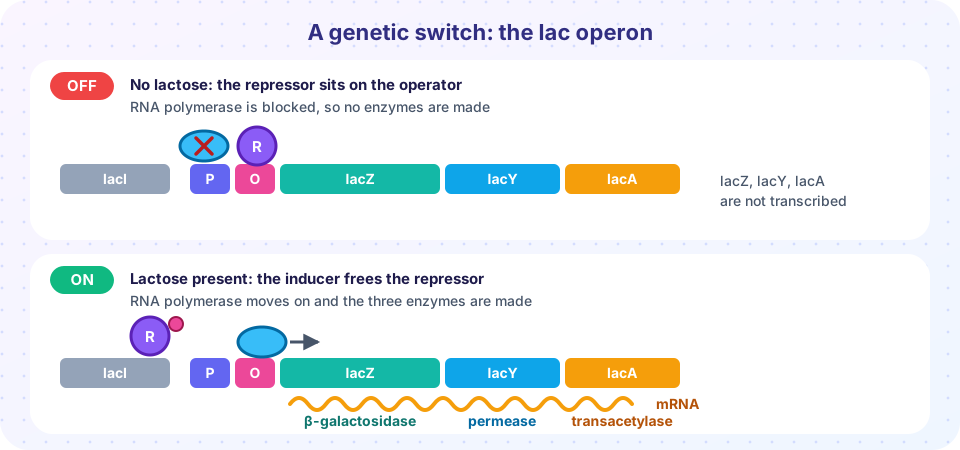
E. coli can use lactose, but only after making the enzymes to digest it. Three genes are in a row: lacZ (β-galactosidase, which splits lactose), lacY (permease, which brings lactose into the cell) and lacA (transacetylase). A separate gene, lacI, makes the repressor.
- No lactose: the repressor binds the operator next to the promoter and blocks RNA polymerase. A few molecules of each enzyme are still made at a trickle.
- Lactose present: a small amount is converted to allolactose, the inducer. It binds the repressor and changes its shape, so the repressor lets go. RNA polymerase now transcribes all three genes.
Catabolite repression
Glucose is a better food than lactose, so a second layer of control makes the cell prefer it. When glucose is plentiful, the level of the small molecule cyclic AMP is low. The activator protein CAP needs cAMP to bind DNA near the promoter and help RNA polymerase. With glucose around, there is little cAMP, so even when lactose is present the operon stays weakly expressed. Only when lactose is present and glucose is gone does the operon switch fully on. This is the molecular basis of the diauxic growth you met in the growth-curve lesson.
Repressible operons and other controls
The trp operon, which makes tryptophan, works in reverse: it is on by default, and tryptophan itself acts as a co-repressor that turns it off when there is enough. Bacteria also use two-component systems (a membrane sensor that passes a phosphate to a response regulator that switches genes), riboswitches (RNA that senses a small molecule and changes shape), and global regulators that switch dozens of genes in response to stress.
Common misconceptions
"Lactose turns on the operon directly." The real inducer is allolactose, an isomer made from lactose, and it acts by releasing the repressor.
"Bacterial genes have introns." They almost never do, so mRNA needs no splicing and translation can start on a growing transcript.
"Genes are on or off like a light switch." Many are graded: expression rises and falls with conditions, as the glucose effect shows.
"Antibiotics that target ribosomes harm our ribosomes equally." Bacterial 70S and human 80S ribosomes differ in structure, which is the basis of selective toxicity (though mitochondrial ribosomes resemble bacterial ones, which explains certain side effects).
Check your understanding
Quick check · 5 questions
of 5 answered You scored / 5 · perfect!
-
1. Which enzyme adds nucleotides during DNA replication in E. coli?
DNA polymerase III is the main replicative enzyme; helicase unwinds, primase makes primers. -
2. The DNA coding strand reads ATG GCT TAA. What is the amino acid sequence of the protein?
ATG is Met, GCT is Ala and TAA is a stop codon. -
3. How does the lac repressor stop transcription when lactose is absent?
The repressor sits on the operator, so RNA polymerase cannot pass. -
4. Why is the lac operon only weakly expressed when both glucose and lactose are present?
Catabolite repression: low cAMP means the CAP activator is inactive. -
5. Why can translation start before transcription is finished in bacteria?
Without a nuclear envelope, ribosomes can bind the growing mRNA at once.
Summary
- The E. coli chromosome is a circle of about 4.6 million base pairs; replication from oriC takes roughly 40 minutes at about 1,000 nt/s per fork.
- Transcription (RNA polymerase and sigma factor) and translation (70S ribosome, tRNA, codons) are coupled in bacteria.
- The genetic code uses 64 codons for 20 amino acids and stop signals.
- Operons are regulated by repressors and activators: lac is induced by allolactose and subject to catabolite repression.
- Quinolones, rifampin and the ribosome-binding antibiotics target replication, transcription and translation.
Track your progress
Create a free account to tick off lessons and pick up where you left off on any device.
of Microbiology lessons completed