


















Lesson 31 of 45 · Microbes and Disease
Chapter 7 overview: Microbes and disease
Understand how a few microbes cause disease: the chain of infection, pathogens and hosts, immune defenses, antimicrobial drugs and how outbreaks are stopped.
Almost all microbes are harmless to people, and many are essential to our health. Yet a small minority are pathogens, microbes that can cause disease. Why do these few cause illness, and how do they get from one person to another? And how do our bodies, and our medicines, fight back? Those are the questions of this chapter.
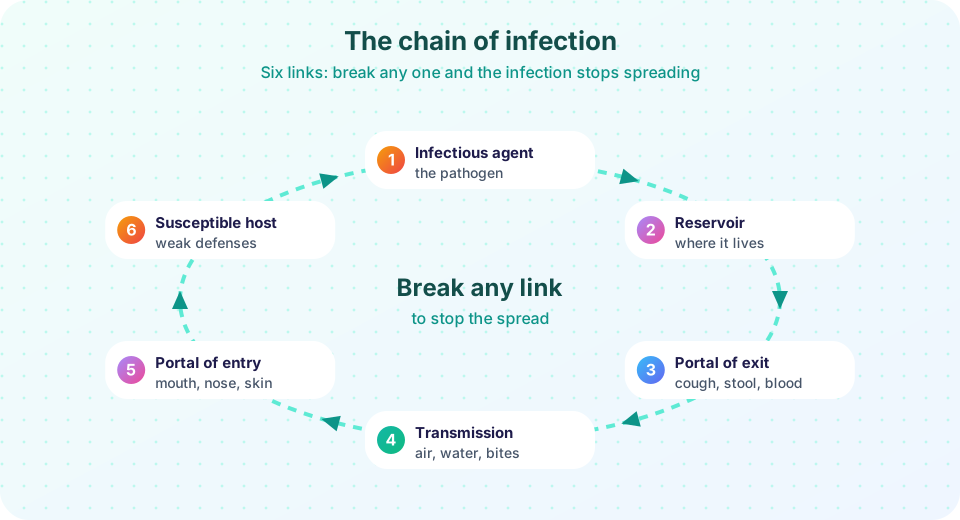
The key idea is that infection is not a one-sided attack but a relationship between a microbe and a host, with many steps. Disease only happens when each step succeeds. This is good news, because it means that each step is also a chance to stop it. A public health worker thinks in terms of links in a chain, and breaking any single link stops the spread.
Educational information. This course explains how microbes and the immune system work. It is not medical advice and cannot diagnose or treat any condition. If you are ill or worried about an infection, speak to a doctor or another qualified health professional.
What you will learn
- The six links of the chain of infection and examples of interventions for each
- The difference between colonization, infection and disease
- How the chapter's lessons fit together: pathogenesis, immunity and vaccines, antimicrobials
- Why most microbes are not pathogens, and why context matters
Key terms
Pathogen: a microbe that can cause disease.
Infection: the entry and multiplication of a microbe in a host.
Disease: damage or dysfunction that results from an infection.
Reservoir: the place where a pathogen normally lives and multiplies, such as a person, an animal or soil.
Transmission: the passing of a pathogen from one host to another.
The chain of infection
Each link in the chain asks a simple question about a pathogen.
- Infectious agent. What is the microbe: a bacterium, virus, fungus or parasite? How many are needed to cause infection, and how well do they survive outside the body?
- Reservoir. Where does it live between infections? Humans (measles, influenza), animals (rabies, Lyme disease), soil (tetanus) or water (cholera).
- Portal of exit. How does it leave the reservoir: through coughs and sneezes, stool, blood, skin lesions or a mosquito's blood meal?
- Mode of transmission. How does it travel: direct contact, droplets and aerosols, contaminated food or water, objects, or vectors such as mosquitoes and ticks?
- Portal of entry. How does it enter the new host: inhalation, ingestion, broken skin, a bite or the mucous membranes?
- Susceptible host. Is the new host able to resist it? Age, nutrition, existing illness, medicines and vaccination all matter.
Hand washing breaks the transmission link for many gut and respiratory infections. Clean water and sewage treatment break the transmission of cholera and typhoid. Bed nets break the link between mosquito and human. A vaccine makes the host no longer susceptible. A mask changes the portal of exit and entry. Antibiotics remove the agent from an infected person. Each tool targets a different link.
Colonization, infection and disease
It helps to separate three words that people often confuse. Colonization means a microbe lives on or in a host without invading or harming it. Your skin and gut carry trillions of microbes, mostly harmless or helpful; this is your microbiota. Infection means that a microbe has invaded tissues and multiplies there. Disease means that the infection has caused signs and symptoms. Many infections never cause disease, and a person with no symptoms may still pass the microbe on.
The same species can fall into any of these categories depending on the circumstances. Escherichia coli in your intestine is a harmless member of the microbiota. The same species in the bladder can cause a urinary tract infection, and certain strains, such as O157:H7, carry toxin genes that cause bloody diarrhea. Opportunistic pathogens are microbes that usually do no harm but cause disease when defenses are weak, for example Candida in a patient on chemotherapy.
A tour of the chapter
- Infection and pathogenesis explains how microbes cause damage: virulence factors, toxins, the stages of disease, Koch's postulates and the ways outbreaks spread.
- Immune defenses and vaccines covers the innate and adaptive immune systems, antibodies, memory and how vaccines work.
- Antimicrobials and resistance explains how antibiotics work, how bacteria resist them and what we can do about it.
- Chapter review puts the defenses and public health tools together.
Chain of infection
Break one link, stop the spread
How microbes cause harm
How we defend
How medicine helps
A short history of ideas
Before the 1800s, many people believed that disease came from bad air or imbalance. In 1847 Ignaz Semmelweis showed in a Vienna hospital that when doctors washed their hands with a chlorine solution, deaths of new mothers from puerperal fever fell sharply, even though the germ theory was not yet accepted. In 1854 John Snow traced a cholera outbreak in London to a water pump on Broad Street, which is considered a founding event of epidemiology. Louis Pasteur showed that microbes cause fermentation and disease, and Robert Koch proved in the 1870s and 1880s that specific bacteria cause anthrax, tuberculosis and cholera. Joseph Lister used antiseptics in surgery. The result was a revolution: sanitation, vaccines and, from the 1940s, antibiotics changed life expectancy more than almost any other advance.
Common misconceptions
"Germs are always bad." The vast majority of microbes are harmless or helpful, and a healthy microbiota protects you from pathogens.
"If I am not sick, I cannot spread it." Many infections, such as some influenza and COVID-19 infections, can be passed on by people with mild or no symptoms, before symptoms start, or by carriers.
"A stronger immune system always means a better defense." The immune system needs balance. Overreaction causes allergies, autoimmune disease and tissue damage in some infections.
Try it
The first demonstration is an interactive chain of infection. Click a link to "break" it and read which public health tool does that, and what would still be possible.
The second demonstration shows why a small change in a link can matter: if each contact carries a risk of infection, then the chance of getting infected over many contacts grows quickly, and halving the risk per contact makes a large difference. The risks are illustrative numbers.
Press Run (or Ctrl + Enter) to see the result here.
Program input · what you'd type while the program runs
Type the answers before you press Run, one per line. Each time the program reads a line (with input()), it gets the next line from this box.
Check your understanding
Quick check · 5 questions
of 5 answered You scored / 5 · perfect!
-
1. Which of these is a link in the chain of infection?
The six links are agent, reservoir, portal of exit, transmission, portal of entry and susceptible host. -
2. Which intervention breaks the transmission link for cholera?
Cholera spreads through water contaminated with feces, so clean water cuts the chain. -
3. What is an opportunistic pathogen?
Opportunists such as Candida usually do no harm to healthy people. -
4. What is the difference between colonization and infection?
Infection means invasion and multiplication in tissue; colonization is the peaceful presence. -
5. What did John Snow's study of the Broad Street pump show?
Snow mapped cases around a pump and showed water carried the disease.
Summary
- A pathogen reaches a new host through a chain of six links; breaking any link stops spread.
- Colonization, infection and disease are different; the same species can be harmless or harmful depending on context.
- Most microbes are harmless or beneficial; opportunists cause disease when defenses are weak.
- Historic work by Semmelweis, Snow, Pasteur, Koch and Lister built modern infection control.
- The chapter covers pathogenesis, immunity and vaccines, and antimicrobials.
Track your progress
Create a free account to tick off lessons and pick up where you left off on any device.
of Microbiology lessons completed