


















Lesson 10 of 45 · The Microbial World
Chapter 2 Review: The Microbial World
Review the three domains, bacterial and archaeal diversity, extremophiles, protists, biofilms and quorum sensing with a recap table and a ten-question quiz.
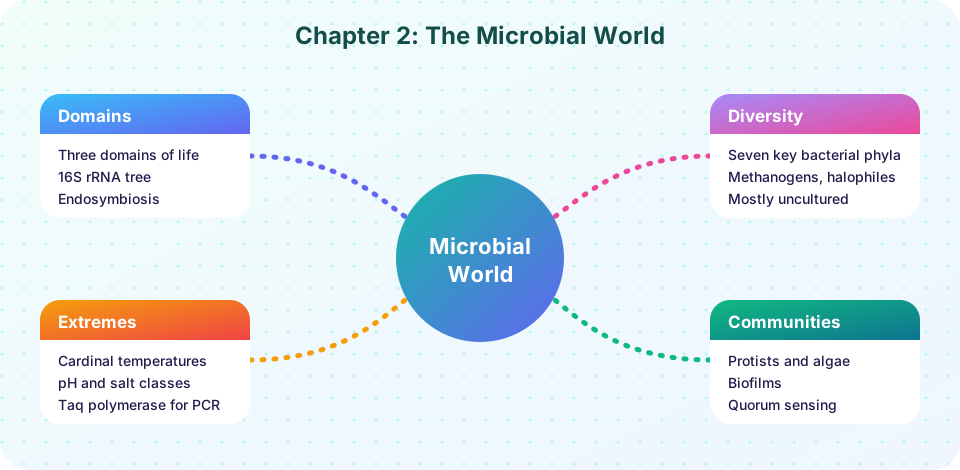
This chapter drew the map of the microbial world. You saw that cellular life has three domains, that archaea are not odd bacteria but a separate branch closer to us, that prokaryotes occupy habitats from boiling springs to salt lakes, and that microbes live not as loners but in communities that talk to each other. Use this page to check that the map is in your head, not just on the page.
What you will learn
- Which key facts from Chapter 2 to know without notes.
- How the four lessons fit together.
The chapter at a glance
| Lesson | Big idea | Facts to remember |
|---|---|---|
| Three Domains | rRNA sequences reveal three domains of cellular life | binomial names are italic, genus capitalized; Archaea are closer to Eukarya; mitochondria and chloroplasts came from engulfed bacteria |
| Bacteria and Archaea | Prokaryotes occupy every habitat | Cyanobacteria made oxygen; methanogens make CH₄; thermophiles 45 to 80 °C, hyperthermophiles above 80 °C; most microbes are uncultured |
| Protists and Communities | Microbes cooperate | Protists: amoebae, flagellates, ciliates, apicomplexans, algae; biofilm in four stages; quorum sensing needs a signal threshold |
Putting it together
Think of a hot spring. A thermophile such as Thermus aquaticus grows in the water, and its heat-stable polymerase became a tool for PCR. Beside it a mat of cyanobacteria photosynthesizes at the cooler edge. In the same pool, a biofilm of several species holds on to the rocks, sharing nutrients. Archaea and bacteria sit side by side with similar shapes, which is why microscopes could not tell them apart until the rRNA comparison revealed the third domain. Every idea of this chapter appears in that one place.
Common exam traps
- "Bacteria" versus "prokaryotes." All bacteria are prokaryotes, but so are archaea. If a question asks about prokaryotes, it includes both domains.
- Words that mislead. Methanobacterium and Halobacterium have "bacter" in their names but they are archaea. Check the domain, not the spelling.
- Which pair is closer? Archaea and eukaryotes share a more recent ancestor than archaea and bacteria. A drawing that puts archaea next to bacteria because they look alike is wrong.
- Extremophile versus extreme habitat. A thermophile is defined by its optimum temperature (45 to 80 °C), not by the fact that it was found in a hot place; many organisms tolerate heat without preferring it.
- Biofilm versus colony. A colony on agar descends from one cell; a biofilm is usually a mixture of cells, often of several species, held in a matrix.
Study checklist
You should be able to: write a scientific name correctly; list the three domains and one feature that separates each; give two pieces of evidence for endosymbiosis; classify an organism as a psychrophile, mesophile, thermophile or hyperthermophile from its optimum; name two kinds of protist and one thing each does; describe the four stages of a biofilm; and explain quorum sensing in one sentence. If you can, you are ready for Chapter 3.
Check temperature classes
Test your classification skills with this tool. Enter an optimum growth temperature and read the class.
Review quiz
Quick check · 10 questions
of 10 answered You scored / 10 · perfect!
-
1. Who is credited with discovering the three-domain structure of life by comparing rRNA?
Woese and Fox compared 16S rRNA sequences in 1977. Whittaker proposed five kingdoms, Margulis championed endosymbiosis and Linnaeus introduced binomial names. -
2. Which pair of organisms are both eukaryotes?
Paramecium is a ciliate protist and yeast is a fungus; both have a nucleus. -
3. Which of these is evidence that mitochondria came from bacteria?
Their DNA and ribosomes resemble bacterial ones. -
4. An organism grows optimally at 90 °C. It is...
Above 80 °C is hyperthermophile territory. -
5. Which microbes produce methane from H₂ and CO₂?
Methanogens are archaea that make CH₄ by 4 H₂ + CO₂ → CH₄ + 2 H₂O. -
6. The slime matrix of a biofilm is called...
EPS stands for extracellular polymeric substances. -
7. Quorum sensing allows cells to...
Signal molecules reach a threshold when many cells are present. -
8. Which statement about archaea is correct?
Ether-linked isoprenoid lipids are a hallmark of archaea. They have no nucleus and no peptidoglycan. -
9. The great plate count anomaly says that...
Plate counts capture only a small fraction of the cells seen under the microscope. -
10. Why are viruses drawn outside the tree of life?
Viruses have no ribosomes, so the tree built on rRNA does not include them.
Summary
- The tree of life has three domains; archaea are closer to eukaryotes than to bacteria.
- Prokaryotes occupy habitats from hot springs to salt lakes, and most have not been cultured.
- Protists, biofilms and quorum sensing show that microbes live as communities.
Track your progress
Create a free account to tick off lessons and pick up where you left off on any device.
of Microbiology lessons completed