


















Lesson 33 of 45 · Microbes and Disease
Immune defenses and vaccines
How the body defends itself: barriers, phagocytes, inflammation and fever, B and T cells, antibodies and memory, and how different vaccines train immunity.
Every minute of every day your body is exposed to microbes. You breathe them in, swallow them and touch them, and yet you are rarely ill. The reason is a layered defense system that works mostly without your noticing. The first layers are fast and general. They hold off almost anything, immediately. If a microbe gets past them, a second system with a slow start, high precision and a long memory takes over.
Vaccines are the great practical application of this second system. By showing your immune system a harmless version of a pathogen in advance, they give it a head start. In this lesson you will meet the cells and molecules of both systems and see how they combine into the pattern of immune response and memory that makes vaccination work.
What you will learn
- The first line of defense: barriers and the microbiota
- How innate immunity works: phagocytes, pattern recognition, complement, inflammation, fever and interferons
- How B cells, T cells and antibodies create specific, remembered immunity
- Why a second exposure triggers a faster, stronger response
- How the main types of vaccine work, and what herd immunity means
Key terms
Antigen: a molecule that the immune system can recognize, such as a protein on a microbe.
Antibody: a Y-shaped protein made by B cells that binds a specific antigen.
Phagocyte: a cell that engulfs and destroys microbes, such as a neutrophil or macrophage.
Memory cell: a long-lived B or T cell that remembers an antigen.
Vaccine: a preparation that trains the immune system to recognize a pathogen without causing the disease.
First line: barriers and microbiota
Healthy skin is a tough, dry barrier of dead cells with an acidic surface. Mucous membranes in the nose, airways and gut trap microbes in sticky mucus, and cilia sweep them out. Tears and saliva contain lysozyme, an enzyme that digests bacterial cell walls. Stomach acid kills many swallowed microbes. The trillions of microbes that normally live on the skin and in the gut also defend you, by crowding out pathogens and competing for food, a protective effect called colonization resistance. This is why antibiotics, which disturb the microbiota, can open the door to infections such as Clostridioides difficile.
Innate immunity
If a microbe crosses a barrier, innate immunity responds within minutes to hours. It does not need prior exposure and reacts in the same way every time.
- Recognition. Cells carry pattern recognition receptors, including Toll-like receptors, that detect molecular patterns found on microbes but not on our own cells: the lipopolysaccharide of Gram-negative bacteria, flagellin, bacterial and viral nucleic acids.
- Phagocytes. Neutrophils arrive first in huge numbers, and macrophages engulf microbes into a vesicle, the phagosome, where enzymes and reactive oxygen species destroy them. Dendritic cells capture antigens and carry them to the lymph nodes to start the adaptive response.
- Complement is a group of blood proteins that, once activated, coat microbes so that phagocytes can find them (opsonization), attract immune cells and punch holes in some bacterial membranes.
- Inflammation is the local response to damage or infection: widened blood vessels bring more blood and immune cells (redness and heat), fluid leaks out (swelling), and signals stimulate nerves (pain). It is useful in the short term and harmful when chronic.
- Fever is a rise in the body's temperature set point, triggered by signals from immune cells. Many microbes grow worse at higher temperatures and some immune responses work faster.
- Interferons are signal proteins released by virus-infected cells. They warn neighbors to produce proteins that block viral replication.
- Natural killer (NK) cells destroy cells that are infected with a virus or have become cancerous.
Adaptive immunity
Adaptive immunity is slower, taking days at first, but it is specific and has memory. It rests on lymphocytes, which have randomly generated receptors, so that the body has billions of different ones, each recognizing a different antigen. When a lymphocyte meets its antigen it is activated and multiplies into a large clone: this is clonal selection.
B cells make antibodies. An activated B cell becomes a plasma cell, a factory that secretes thousands of antibody molecules per second. Antibodies work in several ways: they neutralize by blocking a virus or toxin from binding; they opsonize by coating microbes for phagocytes; they activate complement; and they clump microbes together. The classes differ in role: IgM is the first to appear, IgG is the main antibody in blood and crosses the placenta to protect a newborn, IgA guards mucous membranes and is present in breast milk, and IgE is involved in parasite defense and allergy.
T cells come in two main types. Helper T cells (CD4) release signals that coordinate the response and help B cells. Cytotoxic T cells (CD8) find and kill infected cells. T cells only recognize antigens shown to them on special display molecules, the MHC molecules, on the surface of cells: MHC class I on almost all cells (for killer T cells) and MHC class II on antigen-presenting cells such as dendritic cells and macrophages (for helper T cells).
Memory
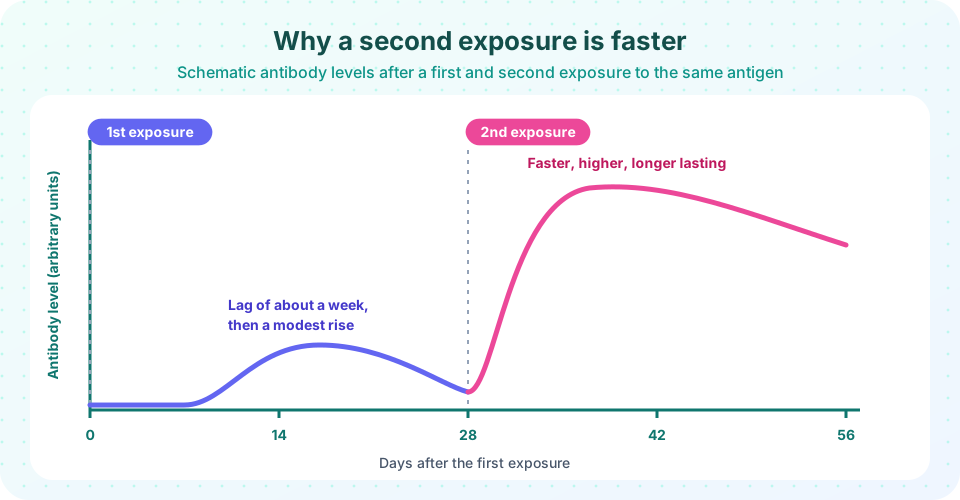
After an infection most of the effector cells die, but a few memory B and T cells persist for years or decades. On a second exposure they react much faster: in the graph at the top of the page, the first response has a lag of about a week and modest antibody levels, mostly IgM and then IgG. The second response begins within a few days, reaches a much higher level, is dominated by IgG, and lasts longer. Memory is the reason you rarely catch measles twice, and the reason vaccines work.
Vaccines
A vaccine presents antigens, without the risk of full disease, so that memory forms. Edward Jenner showed in 1796 that cowpox infection protected against smallpox, and the word "vaccine" comes from the Latin for cow. The main types are:
| Type | How it works | Examples |
|---|---|---|
| Live attenuated | a weakened pathogen that replicates a little | measles, mumps and rubella (MMR), varicella, oral polio |
| Inactivated | killed whole pathogen | inactivated polio, hepatitis A, rabies |
| Subunit and conjugate | only a piece of the pathogen, sometimes linked to a carrier protein | hepatitis B, HPV, Hib, pneumococcal conjugate |
| Toxoid | inactivated toxin | tetanus, diphtheria |
| mRNA and viral vector | cells make the antigen from instructions | COVID-19 vaccines |
Live vaccines usually give strong, long-lasting immunity with fewer doses but are not suitable for people with severely weakened immunity. Inactivated and subunit vaccines are safer in that respect but often need adjuvants, substances that boost the response, and repeat booster doses. Vaccines are tested for safety and effectiveness in trials and monitored after use. Like any medicine, they can cause side effects, which are usually mild. Smallpox was eradicated in 1980 after a global vaccination campaign, and polio has been nearly eliminated.
Passive immunity is the transfer of ready-made antibodies: mother's IgG across the placenta, IgA in breast milk, or injected immune globulin and antivenom. It works at once but fades in weeks to months because no memory forms.
Herd immunity
When enough people in a community are immune, an infection cannot spread widely, which protects those who cannot be vaccinated, such as newborns and people with some medical conditions. The herd immunity threshold is the fraction of the population that must be immune: 1 − 1/R₀. Measles, with R₀ of about 12 to 18, needs roughly 92 to 95 percent immunity, which is why high vaccination coverage matters. A vaccine that is not fully effective needs a higher coverage: coverage = threshold / effectiveness.
Common misconceptions
"Vaccines contain the disease." Vaccines contain killed or weakened organisms, pieces of them or instructions to make a piece. They cannot cause the full disease in healthy people, apart from rare cases with some live vaccines.
"Natural infection is always better than vaccination." Natural infection can give strong immunity, but at the price of the disease and its risks.
"Fever is always harmful." Fever is part of the defense. Treatment decisions should come from a health professional, especially in babies and in severe or lasting fever.
Try it
The first demonstration is a model of the antibody response after a first and a second exposure on a logarithmic scale. It reproduces the qualitative pattern of the picture, with invented numbers.
Press Run (or Ctrl + Enter) to see the result here.
Program input · what you'd type while the program runs
Type the answers before you press Run, one per line. Each time the program reads a line (with input()), it gets the next line from this box.
The second demonstration is a herd immunity calculator. Choose an R0 and a vaccine effectiveness and read the coverage needed.
Check your understanding
Quick check · 6 questions
of 6 answered You scored / 6 · perfect!
-
1. Which cells are the first phagocytes to arrive at a site of bacterial infection?
Neutrophils are the most numerous early phagocytes, arriving within hours. -
2. What do plasma cells do?
Plasma cells are antibody factories derived from B cells. -
3. Why is the secondary response faster than the primary?
Memory B and T cells persist and react within a few days. -
4. Which type of vaccine uses an inactivated toxin?
Tetanus and diphtheria vaccines contain toxoids. -
5. R0 is 5. What is the herd immunity threshold?
1 - 1/5 = 0.8, so 80% must be immune. -
6. Which antibody class crosses the placenta and protects a newborn?
IgG is transferred across the placenta.
Summary
- Barriers, secretions and the microbiota form the first defense; innate immunity (phagocytes, complement, inflammation, fever, interferons, NK cells) reacts within hours.
- Adaptive immunity uses B cells (antibodies) and T cells (helper and cytotoxic); it is slow, specific and has memory.
- A second exposure triggers a faster, higher, longer-lasting response.
- Vaccines are live attenuated, inactivated, subunit or conjugate, toxoid, or mRNA and vector types; passive immunity gives short-term protection.
- Herd immunity threshold = 1 − 1/R₀, and needs higher coverage when vaccine effectiveness is below 100%.
Track your progress
Create a free account to tick off lessons and pick up where you left off on any device.
of Microbiology lessons completed