


















Lesson 38 of 45 · Applied and Environmental Microbiology
Environmental microbes
See how microbes drive the nitrogen and carbon cycles, clean wastewater with activated sludge, break down oil pollution, and live in healthy partnership with the human body.
The air is about 78 percent nitrogen gas, and yet nitrogen is one of the scarcest nutrients for living things. The reason is that the two atoms in N₂ are held by a triple bond so strong that almost no organism can break it. Plants and animals need nitrogen in a "fixed" form, in amino acids, proteins and DNA, and for almost all of Earth's history only a few kinds of bacteria and archaea could supply it. Every protein in your body contains nitrogen that was once processed by a microbe.
That is the main theme of environmental microbiology: microbes are not just in the environment, they are the machinery of it. They recycle the elements, cleanse water, detoxify pollution and, in our own bodies, form a community that shapes our health. This lesson follows four examples: the nitrogen cycle, wastewater treatment, bioremediation and the human microbiome.
What you will learn
- The steps of the nitrogen cycle and the microbes that run each one
- The role of microbes in the carbon cycle, including methane
- How activated sludge cleans wastewater, and what BOD measures
- How bioremediation degrades oil and other pollutants
- What the human microbiome is, and why it matters for health
Key terms
Nitrogen fixation: converting N₂ gas into ammonia or ammonium.
Nitrification: the oxidation of ammonium to nitrite and then nitrate.
Denitrification: the reduction of nitrate to N₂ gas under low-oxygen conditions.
BOD: biochemical oxygen demand, the oxygen microbes use to break down the organic matter in water.
Microbiome: the community of microbes (and their genes) living in a habitat, such as the human gut.
The nitrogen cycle
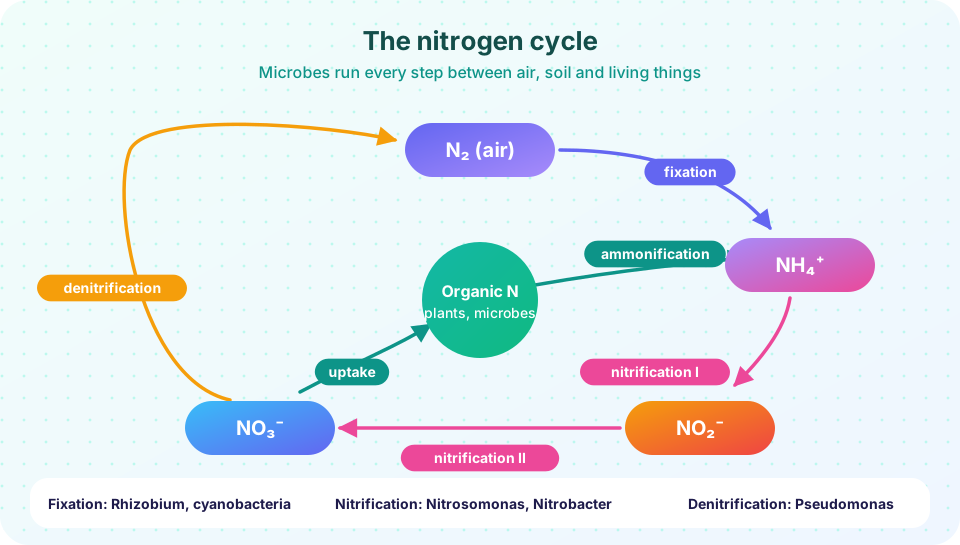
Follow the picture from the top, with each step carried out by microbes.
- Nitrogen fixation. The enzyme nitrogenase, found only in certain bacteria and archaea, reduces N₂ to ammonia (NH₃, present mostly as ammonium, NH₄⁺). It needs a lot of energy (about 16 ATP per N₂) and is poisoned by oxygen, so fixers have ways to protect it. Some live free in soil (Azotobacter), some in water (cyanobacteria, which use special cells called heterocysts), and some in a partnership with plants. Rhizobium and related bacteria form root nodules on legumes such as beans, peas and clover, where the plant supplies sugars and a low-oxygen environment and the bacteria supply ammonium. This is why farmers rotate crops with legumes. Industry now fixes more nitrogen through the Haber–Bosch process for fertilizer.
- Assimilation and ammonification. Plants and microbes take up ammonium and nitrate and build them into organic nitrogen. When organisms die or excrete waste, decomposers break proteins and nucleic acids down and release ammonium again: ammonification (or mineralization).
- Nitrification. In well-aerated soil and water, ammonia-oxidizing bacteria such as Nitrosomonas convert ammonium into nitrite (NO₂⁻), and nitrite-oxidizing bacteria such as Nitrobacter and Nitrospira convert nitrite into nitrate (NO₃⁻). These microbes are chemoautotrophs: they gain energy from the oxidation and fix carbon dioxide as their carbon source. Nitrate is the form most readily taken up by crops, but it is also very soluble and washes away.
- Denitrification. When oxygen is lacking, as in waterlogged soil, sediments or the anoxic zones of a treatment plant, bacteria such as Pseudomonas and Paracoccus use nitrate in place of oxygen for respiration, reducing it step by step to nitrite, nitric oxide, nitrous oxide and finally N₂, which returns to the air and closes the cycle. Nitrous oxide is a powerful greenhouse gas, so how much of it escapes matters for climate.
Human activities have greatly increased the flow of fixed nitrogen. Fertilizer runoff carries nitrate and ammonium into rivers and coastal waters, where it feeds algal blooms. When the algae die and decompose, microbes use up the oxygen in the water, creating "dead zones".
The carbon cycle
Microbes also dominate the carbon cycle. Cyanobacteria and algae in the oceans capture carbon dioxide by photosynthesis, and the ancient cyanobacteria first filled the atmosphere with oxygen roughly 2.4 billion years ago. Decomposers, mostly bacteria and fungi, return carbon to the air as CO₂ by respiration. Without oxygen, in wetlands, rice paddies, landfills and the stomachs of cattle, methanogenic archaea produce methane, a greenhouse gas about 80 times more powerful than carbon dioxide over twenty years. Methanotrophs are bacteria that eat methane, and they reduce the amount that reaches the air. Soil fungi and bacteria hold a very large store of carbon in the soil as organic matter.
Wastewater treatment
Sewage is rich in organic matter, nitrogen, phosphorus and pathogens. A modern treatment plant works in stages.
- Primary treatment removes grit and lets solids settle as sludge.
- Secondary (biological) treatment is where microbes do the work. In the activated sludge process, the water flows into an aerated tank filled with a dense, flocculating mix of bacteria, protozoa and fungi. The bacteria consume the dissolved organic matter and turn it into new cells, carbon dioxide and water. The flocs then settle out in a clarifier, and some are returned to the tank ("activated") while the excess is removed. Protozoa such as ciliates graze on free-swimming bacteria and help clarify the water.
- Tertiary treatment removes nutrients and pathogens. Nitrogen is removed by alternating aerobic (nitrification) and anoxic (denitrification) zones; phosphorus by special bacteria or chemicals; and disinfection by chlorine, ultraviolet light or ozone.
- Anaerobic digestion of the sludge by mixed communities, ending with methanogenic archaea, yields biogas, mainly methane and carbon dioxide, which can power the plant.
The pollution load of wastewater is measured by the biochemical oxygen demand (BOD), the oxygen that microbes consume while degrading the organic matter at 20 °C. The standard test, BOD₅, measures the oxygen used in five days. Untreated municipal sewage typically has a BOD₅ of a couple of hundred milligrams per liter, while treated effluent is commonly required to be down to about 30 mg/L or less. Water that is rich in organic matter would drain the oxygen in a river and kill the fish, so removing BOD protects rivers.
Drinking-water quality is checked with indicator organisms. Because testing for every pathogen is impractical, laboratories test for coliform bacteria and E. coli, which come from feces; their presence signals a risk that pathogens may be present, too.
Bioremediation
Bioremediation uses organisms to degrade or immobilize pollutants. Many bacteria and fungi can use hydrocarbons, solvents and pesticides as food. After the Deepwater Horizon oil spill in the Gulf of Mexico in 2010, naturally occurring hydrocarbon-degrading bacteria bloomed in the water and helped break down a large part of the dispersed oil. After the Exxon Valdez spill of 1989, fertilizer was added to some beaches to speed up native oil-eating bacteria, an approach called biostimulation. Bioaugmentation adds selected microbes to a site. Treatment can be done in place (in situ) or by moving contaminated soil into a treated heap or tank. Limits are common: the pollutant has to be available to the microbes, and nutrients, oxygen and temperature have to be suitable. Some contaminants, such as heavy metals, cannot be degraded, only changed in form or captured, for example by plants (phytoremediation) or microbes that precipitate them.
The human microbiome
Your body hosts a community of trillions of microbes, mostly bacteria, concentrated in the large intestine. A careful estimate from 2016 put the number of bacterial cells in a typical adult at about the same as the number of human cells, rather than ten times more as was once said. These microbes help digest fibre into short-chain fatty acids that feed the gut lining, make some vitamins, train the immune system and crowd out pathogens (colonization resistance). The composition of the microbiome differs between people and changes with diet, age, medicines and illness.
Disturbances of the microbiome are linked to conditions such as Clostridioides difficile infection after antibiotics, and researchers are studying links to obesity, bowel disease and allergies, although for many conditions the cause and effect are not yet clear. Probiotics are live microbes that may give a benefit when taken in adequate amounts, and the evidence is strong for some uses and weak for others. Fecal microbiota transplantation is an accepted treatment for recurrent C. difficile infection that has not responded to antibiotics. As with any health matter, decisions belong with a healthcare professional.
Common misconceptions
"Plants take nitrogen straight from the air." They cannot. They rely on nitrogen-fixing microbes, on fertilizer, or on nitrate and ammonium released by decomposers.
"Sewage treatment is mostly chemical." The core of secondary treatment is biological: dense microbial communities consume the organic pollution.
"We are ten times more bacterial than human." The old figure came from rough estimates. More careful counts suggest the numbers of human and bacterial cells in the body are of the same order, about one to one.
Try it
The first demonstration is a box model of nitrogen transformations in a treatment tank. For the first ten days (aerobic phase) ammonium is oxidized to nitrite and nitrate; after that the tank is made oxygen-free, so denitrification removes nitrate as N₂. The rate constants are illustrative values.
Press Run (or Ctrl + Enter) to see the result here.
Program input · what you'd type while the program runs
Type the answers before you press Run, one per line. Each time the program reads a line (with input()), it gets the next line from this box.
The second demonstration shows the BOD curve. The oxygen demand follows first-order kinetics: L(t) = L₀ (1 − e^(−kt)). The values are typical textbook magnitudes, used here as a model.
Press Run (or Ctrl + Enter) to see the result here.
Program input · what you'd type while the program runs
Type the answers before you press Run, one per line. Each time the program reads a line (with input()), it gets the next line from this box.
Check your understanding
Quick check · 6 questions
of 6 answered You scored / 6 · perfect!
-
1. Which enzyme fixes nitrogen gas into ammonia?
Nitrogenase, found only in certain bacteria and archaea, reduces N2 to NH3. -
2. What is the correct order of nitrification?
Ammonia oxidizers make nitrite and nitrite oxidizers make nitrate. -
3. In which conditions does denitrification occur?
Denitrifiers respire nitrate when oxygen is scarce. -
4. What does BOD measure?
BOD is the oxygen demand of the organic matter in a water sample. -
5. What is biostimulation?
Biostimulation boosts the microbes already present, as in some Exxon Valdez beach treatments. -
6. What is the best current estimate of the ratio of bacterial to human cells in the body?
A 2016 re-estimate put the ratio at roughly one to one.
Summary
- The nitrogen cycle runs on microbes: fixation, assimilation, ammonification, nitrification and denitrification.
- Methanogens, methanotrophs, cyanobacteria and decomposers drive the carbon cycle.
- Wastewater treatment relies on activated sludge to remove BOD; aerobic and anoxic zones remove nitrogen.
- Bioremediation uses native or added microbes to break down pollutants such as oil.
- The human microbiome helps digestion, immunity and protection; its numbers are of the same order as human cells.
Next: Chapter 8 review
Track your progress
Create a free account to tick off lessons and pick up where you left off on any device.
of Microbiology lessons completed