


















Lesson 11 of 45 · Bacterial Structure and Growth
Chapter 3 Overview: Bacterial Structure and Growth
A map of the bacterial cell and how it grows: envelope, appendages, endospores, binary fission, growth curves and control of growth, with a guide to the chapter.
A bacterium is small, but it is not simple. In a volume about a thousand times smaller than a typical animal cell, it packs a protective shell, a membrane that works like a power station, a complete genome, thousands of ribosomes, and often a motor and a set of grappling hooks. This chapter explains how that machinery is built, how the cell multiplies, and how we encourage or stop its growth.
Why does structure come first? Because almost every practical question about bacteria is a structural question. Why does penicillin kill some bacteria and not others? Why do some survive boiling? How does a harmless gut bacterium become a pathogen in the bloodstream? You can answer each of them by looking at the right part of the cell.
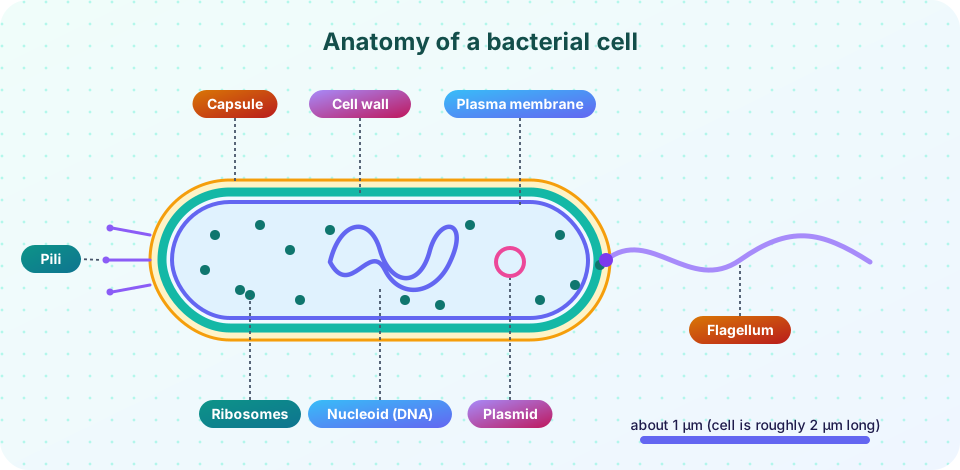
What you will learn
- The standard parts of a bacterial cell and which ones are optional.
- How the chapter's four content lessons fit together.
- The key vocabulary of bacterial structure and growth.
Key terms
Cell envelope: everything around the cytoplasm: the plasma membrane, the cell wall and, in some bacteria, an outer membrane and capsule.
Peptidoglycan: the mesh-like polymer of sugars and short peptides that makes the bacterial cell wall.
Nucleoid: the region of the cytoplasm where the chromosome sits; it has no membrane around it.
Plasmid: a small, circular DNA molecule separate from the chromosome, often carrying extra genes such as antibiotic resistance.
Binary fission: the way bacteria divide: one cell becomes two identical cells.
The cell in four layers
Outside: the envelope
Inside: the working cell
Extras for moving and sticking
Growth
What is in this chapter
- The Bacterial Cell Envelope. Peptidoglycan, the Gram-positive and Gram-negative wall designs, and why they matter for antibiotics.
- Shapes, Appendages and Endospores. Cocci, rods and spirals; flagella, pili, capsules; the internal parts; and the astonishing endospore.
- Bacterial Growth and the Growth Curve. Binary fission, generation time, exponential growth and the four phases.
- Growth Conditions and Control. Oxygen, pH, temperature and osmotic needs, and how sterilization, disinfection and antibiotics stop growth.
- Chapter 3 Review. A summary picture and a ten-question quiz.
Why size and shape matter
Before looking at individual parts, notice how small a bacterial cell is and what that implies. Food and oxygen must reach every part of the cell by simple diffusion, which works well over a micrometer and badly over a millimeter. A bacterium therefore has no need for the transport systems that larger cells use, and it has a very high surface area compared with its volume, which is why it can feed and divide so quickly. The price is that a bacterium is directly exposed to its environment: if the surroundings turn dry, salty, hot or acidic, the cell has almost no buffer. Much of the structure in this chapter (the wall, the capsule, the spore) exists to manage that exposure.
How the lessons use the cell
Each lesson takes one question about the cell and answers it with structures. The envelope lesson asks what holds the cell together and why antibiotics can burst it. The appendages lesson asks how cells move, stick, hide and survive. The growth lessons ask how fast the population grows, what limits it, and how people use that knowledge in laboratories, kitchens and hospitals. Keep the picture of the cell above in mind: every time a new structure appears, locate it on the drawing.
Prokaryote versus eukaryote at a glance
| Feature | Bacterial cell | Typical animal cell |
|---|---|---|
| Size | about 0.5 to 5 µm | about 10 to 100 µm |
| Nucleus | none (nucleoid) | membrane-bound |
| Chromosome | usually one circular | several linear |
| Membrane organelles | none | many (mitochondria, ER, Golgi) |
| Ribosomes | 70S | 80S |
| Cell wall | peptidoglycan (most) | none |
| Division | binary fission | mitosis |
Try it: learn the parts
Check your understanding
Quick check · 3 questions
of 3 answered You scored / 3 · perfect!
-
1. Which structure is present in almost all bacteria?
Every cell has a plasma membrane. Capsules, flagella and endospores are found in only some species. -
2. A plasmid is...
Plasmids carry optional genes, such as antibiotic resistance. -
3. Bacteria divide by...
A bacterium copies its DNA and splits into two cells by binary fission.
Summary
- A bacterial cell has an envelope (membrane, wall, sometimes capsule), a nucleoid, plasmids and ribosomes; flagella, pili and endospores are optional.
- Chapter 3 explains the envelope, the extras, the growth curve and the control of growth.
- Structure answers practical questions about antibiotics, survival and disease.
Track your progress
Create a free account to tick off lessons and pick up where you left off on any device.
of Microbiology lessons completed