


















Lesson 6 of 45 · The Microbial World
Chapter 2 Overview: The Microbial World
A big-picture look at the diversity of microbes: bacteria, archaea, protists and fungi, how scientists classify them, and what the next lessons cover.
If you could sort every living thing on Earth by the number of different kinds, most of the sorting would be done by microbes. The animals you know (all of them, from sponges to blue whales) fill one small twig of the tree of life. The rest of the tree is crowded with single-celled organisms that differ from each other more deeply than a mushroom differs from a mouse. This chapter maps that territory.
You will learn how biologists organize the diversity of life, why they switched from a "plants and animals" view to three domains, what makes archaea different from bacteria, and how microbes live together in communities called biofilms. The next four lessons give the big picture first and then go into detail.
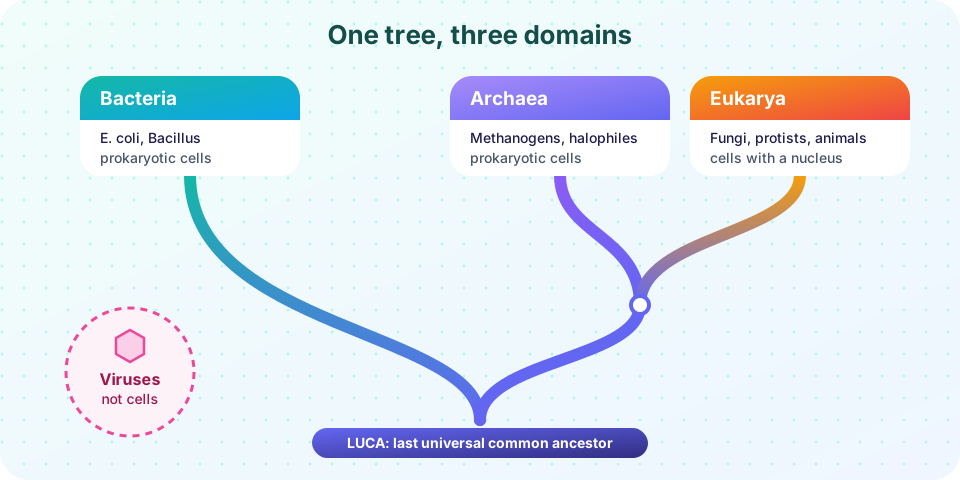
What you will learn
- Why the old kingdoms were replaced by three domains.
- How the main groups of microbes differ in cell structure and lifestyle.
- Where viruses fit (and why they are usually drawn outside the tree).
- What each lesson in this chapter covers.
The big picture
Three domains of cellular life
How we tell them apart
Microbes live in communities
Not in the tree
We study them in Chapter 5
What is in this chapter
- Three Domains and Classification. How organisms are named and grouped, what ribosomal RNA reveals, and how the nucleus-bearing cell arose by endosymbiosis.
- Bacteria and Archaea: Diversity and Extremes. The major groups of prokaryotes, from photosynthetic cyanobacteria to heat-loving archaea, and the idea of habitat and extremophiles.
- Protists, Biofilms and Microbial Communities. Single-celled eukaryotes, and how microbes cooperate, communicate and build slimy cities.
- Chapter 2 Review. A one-page summary and a ten-question quiz.
Why classification matters
Sorting organisms into groups is not just bookkeeping. A good classification predicts. If a laboratory identifies an unknown bacterium as a member of a particular genus, doctors immediately know which antibiotics are likely to work and which are not, food scientists know whether it will survive pasteurization, and ecologists know which nutrient cycle it probably belongs to. The more closely a classification mirrors evolutionary history, the better its predictions.
For many years microbes were classified by what they looked like and what they did: shape, Gram stain, growth on certain media, fermentation tests. Those traits are still useful in a clinic, because they are cheap and quick. Today, though, the backbone of classification is DNA. Sequencing a gene such as the one for 16S ribosomal RNA, or the whole genome, places an organism on the tree in a few hours and reveals relatives that no one could have guessed from the shape under a microscope.
The unseen majority
The tree on this page has a surprise built in: we have grown only a small fraction of the microbes that exist. Scientists now read DNA straight from soil, seawater and the human gut without growing anything (metagenomics), and they keep finding new branches, including whole phyla known only from their genes. As you read the chapter, remember that every table of "groups and examples" is a snapshot of an unfinished map.
Key terms
Domain: the highest rank in modern classification; there are three: Bacteria, Archaea, Eukarya.
Taxonomy: the science of naming and classifying living things.
Phylogeny: the evolutionary relationships among organisms, drawn as a tree.
Prokaryote / eukaryote: a cell without / with a membrane-bound nucleus.
Extremophile: an organism that thrives under conditions humans would find extreme, such as boiling water or saturated salt.
Try it: which domain?
The widget below presents common organisms and asks you to place each in a domain. It is a revision game, nothing more.
Check your understanding
Quick check · 3 questions
of 3 answered You scored / 3 · perfect!
-
1. How many domains of cellular life are recognized?
Bacteria, Archaea and Eukarya. -
2. Which pair of domains is more closely related?
Ribosomal RNA and many other genes show that archaea share a more recent common ancestor with eukaryotes than with bacteria. -
3. Why are viruses usually drawn outside the tree of life?
Viruses lack cell structure and the machinery to make proteins, so they depend on host cells.
Summary
- Life has three domains: Bacteria, Archaea and Eukarya; the first two are prokaryotes.
- Archaea are closer relatives of eukaryotes than of bacteria, although they look like bacteria under a microscope.
- Microbes live in communities and talk to one another chemically.
- Viruses are not cells and sit outside the tree.
Track your progress
Create a free account to tick off lessons and pick up where you left off on any device.
of Microbiology lessons completed