


















Lesson 29 of 45 · Fungi and Parasites
Parasites: protozoa and helminths
Understand protozoan and worm parasites: hosts and vectors, the malaria life cycle in detail, roundworms, tapeworms, flukes and how antiparasitic drugs work.
A parasite is an organism that lives in or on another organism, its host, and takes nutrients at the host's expense. Strictly speaking bacteria and viruses can be parasites too, but in medicine the word "parasitology" refers to protozoa and helminths. They infect a very large part of the world's population, especially in warm regions with limited clean water and sanitation, and they are responsible for some of the oldest recorded diseases.
Parasites are also some of the most elegant organisms in biology, because of their life cycles. A malaria parasite moves between humans and mosquitoes, changing form eight or nine times. A tapeworm needs two or even three different species to complete its life. Learning a life cycle is the main task in this lesson, because every control measure works by breaking a link in it.
What you will learn
- The vocabulary of parasitology: host, vector, definitive and intermediate host
- The major protozoan diseases and how they are spread
- The step-by-step life cycle of Plasmodium, the malaria parasite
- The three groups of parasitic worms and an example of each
- How antiparasitic drugs and prevention work
Key terms
Definitive host: the host in which the parasite reaches maturity or reproduces sexually.
Intermediate host: a host that harbors the larval or asexual stages.
Vector: an organism, usually an insect, that carries a parasite from one host to another.
Cyst: a tough, resting form that survives outside the host.
Zoonosis: an infection that passes from animals to people.
Protozoa
Protozoa are single-celled eukaryotes. They are grouped by how they move and by their general biology. For disease, four groups matter.
- Amoebae move with pseudopods. Entamoeba histolytica causes amoebic dysentery and liver abscess. It spreads through food and water contaminated with its cysts (the fecal–oral route).
- Flagellates swim with whip-like flagella. Giardia duodenalis causes watery diarrhea and is spread by water containing cysts, for example from streams. Trichomonas vaginalis is a sexually transmitted flagellate. Trypanosoma brucei causes African sleeping sickness and is spread by the tsetse fly. Trypanosoma cruzi causes Chagas disease, spread by the feces of triatomine ("kissing") bugs. Leishmania is spread by sandflies.
- Apicomplexans have a special structure at one end of the cell for invading host cells. This group includes Plasmodium (malaria), Toxoplasma gondii (toxoplasmosis; cats are the definitive host, and people are usually infected by cysts in undercooked meat or cat feces) and Cryptosporidium, a chlorine-resistant waterborne cause of diarrhea.
- Ciliates such as Balantidium coli are covered in cilia; very few cause disease.
Many protozoa form cysts that survive drying and disinfectants, which allows them to pass through water treatment. That is why Giardia and Cryptosporidium are among the main concerns in drinking-water safety.
The life cycle of Plasmodium
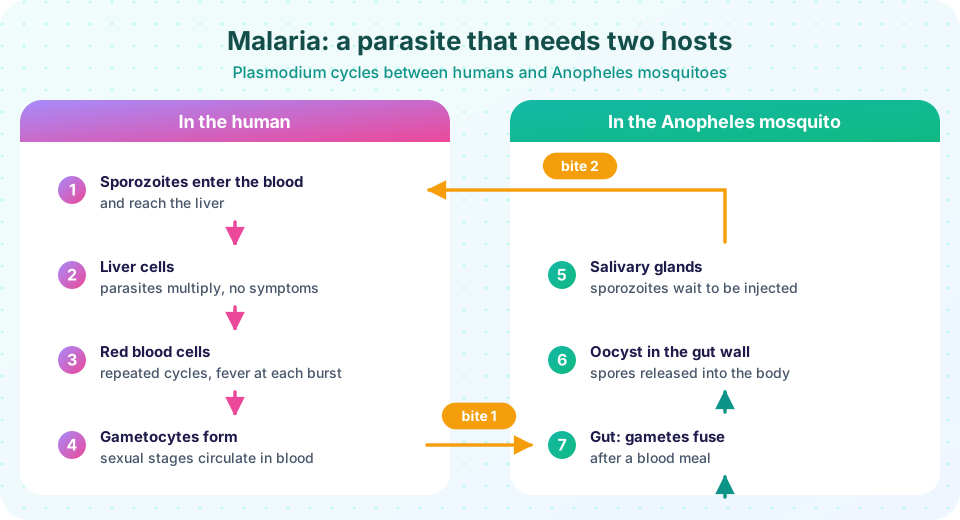
Malaria is caused by five species of Plasmodium in humans: P. falciparum (the most dangerous), P. vivax, P. ovale, P. malariae and P. knowlesi. The vector is the female Anopheles mosquito, which needs a blood meal to develop her eggs. Follow the numbers in the picture above.
- An infected mosquito bites a person and injects sporozoites from her salivary glands. Within minutes they reach the liver.
- Liver stage. Each sporozoite invades a liver cell and divides into thousands of merozoites. This takes roughly a week and causes no symptoms. In P. vivax and P. ovale some parasites remain dormant in the liver as hypnozoites, which can wake months later and cause a relapse.
- Blood stage. Merozoites burst out and invade red blood cells. In each cell the parasite grows through ring, trophozoite and schizont stages, and divides into new merozoites. The cell bursts, releasing them to infect more red cells. The bursts occur at about the same time in many cells, which causes the repeating waves of fever and chills. The cycle takes about 48 hours in P. falciparum, P. vivax and P. ovale, and about 72 hours in P. malariae.
- A few merozoites instead become gametocytes, the sexual forms, which circulate in the blood.
- When a mosquito bites, she takes up gametocytes. In her gut male and female gametes fuse, and the zygote becomes an oocyst in the gut wall.
- The oocyst grows and releases thousands of sporozoites that travel to the salivary glands. The whole mosquito stage takes about ten days or more, depending on temperature, and the mosquito can pass the parasite on when she bites again.
Humans are the host in which the parasite reproduces asexually, while the mosquito is the host for sexual reproduction, which makes the mosquito the definitive host.
Disease and control
Symptoms are fever, chills, headache and anemia, because red blood cells are destroyed. P. falciparum is dangerous because infected red cells stick to the walls of small blood vessels, which can block blood flow to the brain (cerebral malaria) and other organs. Malaria is a leading cause of death in young children in sub-Saharan Africa. An inherited change in hemoglobin, the sickle-cell trait, protects carriers from severe malaria, which is why it is common where malaria is common. People who lack the Duffy blood group protein resist P. vivax, which needs it to enter red cells.
Control has several parts. Insecticide-treated bed nets and indoor spraying reduce bites and kill mosquitoes. Artemisinin-based combination therapy, based on a compound that Tu Youyou isolated from sweet wormwood and which earned her a Nobel Prize in 2015, treats P. falciparum. Earlier drugs such as chloroquine have lost effect where resistance is widespread. A vaccine called RTS,S was recommended by the World Health Organization for children in 2021, followed by a second, R21, in 2023. A malaria diagnosis is made by looking for the parasite in a stained blood smear or by rapid antigen tests.
Helminths
Helminths are multicellular parasitic worms. Their adults live in the intestines or tissues; their eggs or larvae must leave the host to continue the cycle. There are three medically important groups.
| Group | Body | Examples and diseases |
|---|---|---|
| Nematodes (roundworms) | cylindrical, with a complete gut | Ascaris lumbricoides, an intestinal worm up to 35 cm long, infects hundreds of millions of people; hookworms enter through the skin and feed on blood, causing anemia; pinworm (Enterobius) is common in children; filarial worms cause elephantiasis and river blindness |
| Cestodes (tapeworms) | flat, ribbon-like, segmented, no gut | Taenia saginata (beef), Taenia solium (pork), fish tapeworms |
| Trematodes (flukes) | flat, leaf-shaped | Schistosoma blood flukes, with a freshwater snail as intermediate host |
Typical routes of infection are ingestion of eggs (from soil or food contaminated with feces), eating undercooked meat or fish that contains larvae, larvae that penetrate the skin from soil or water, and insect bites. Schistosomiasis shows how an environment feeds a cycle: eggs leave in urine or feces, hatch in fresh water, infect snails, and the snails release cercariae, which swim and penetrate the skin of anyone wading in the water.
Worm infections are diagnosed by finding eggs in stool under the microscope. Drugs include albendazole and mebendazole, which block the worm's tubulin, ivermectin, which paralyzes the worm by affecting its nerve and muscle channels, and praziquantel, which is effective against flukes and tapeworms. Prevention, in the end, depends on sanitation, clean water, shoes, careful cooking and treating infected people in the community.
Common misconceptions
"You get malaria from cold or bad air." The name comes from the Italian "mala aria", but the cause is a parasite carried by mosquitoes. It is not passed directly from person to person in ordinary contact.
"All tapeworms are huge." Some are a few millimeters long. The longest, such as fish tapeworms, can reach several meters.
"Parasites always make you obviously ill." Many infections are quiet for years. A person can carry a worm or a cyst-producing protozoan without symptoms and still spread it.
Try it
The first demonstration is a toy model of how the share of infected red blood cells grows over repeated 48-hour cycles. The multiplication factor is a model input, not a clinical number.
Press Run (or Ctrl + Enter) to see the result here.
Program input · what you'd type while the program runs
Type the answers before you press Run, one per line. Each time the program reads a line (with input()), it gets the next line from this box.
The second demonstration shows why mosquito survival matters so much. A mosquito must live long enough for the parasite to develop, so even a small drop in daily survival cuts transmission sharply.
Press Run (or Ctrl + Enter) to see the result here.
Program input · what you'd type while the program runs
Type the answers before you press Run, one per line. Each time the program reads a line (with input()), it gets the next line from this box.
Check your understanding
Quick check · 6 questions
of 6 answered You scored / 6 · perfect!
-
1. In the malaria life cycle, in which host does sexual reproduction occur?
Gametes fuse in the mosquito gut, so the mosquito is the definitive host. -
2. What causes the repeating fevers of malaria?
The blood stage is synchronized, so merozoites are released in waves. -
3. What are hypnozoites?
They wake months later and restart the blood-stage infection. -
4. Which worm group includes Ascaris and hookworms?
Nematodes are roundworms with a complete gut. -
5. How are schistosome flukes picked up?
Snails release cercariae, which penetrate skin of people wading in the water. -
6. Why do protozoan cysts of Giardia and Cryptosporidium matter for drinking water?
Cysts and oocysts are tough, which makes filtration and other treatment steps essential.
Summary
- Protozoa are single-celled: amoebae, flagellates, apicomplexans and ciliates; many spread through water as cysts.
- Plasmodium alternates between humans (liver and red blood cells) and Anopheles mosquitoes (sexual stage); synchronized red cell bursts cause fever.
- Control uses bed nets, artemisinin combination therapy and vaccines; P. vivax can relapse from hypnozoites.
- Helminths are nematodes, cestodes and trematodes, with life cycles that use eggs, larvae and sometimes intermediate hosts.
- Drugs target tubulin (albendazole), channels (ivermectin) and other parasite-specific features; sanitation and clean water prevent most infections.
Next: Chapter 6 review
Track your progress
Create a free account to tick off lessons and pick up where you left off on any device.
of Microbiology lessons completed