


















Lesson 9 of 45 · The Microbial World
Protists, Biofilms and Microbial Communities
Meet the single-celled eukaryotes called protists, then see how microbes form biofilms and use quorum sensing to act as communities.
So far this chapter has focused on prokaryotes. But a drop of pond water also holds creatures that look like tiny animals, plants and fungi without being any of them: single-celled eukaryotes with a nucleus, organelles and often elaborate shapes. Biologists call them protists. In the sea they are the base of the food web; in the body some of them cause malaria, sleeping sickness and dysentery.
Microbes also rarely live as lone cells. Most spend their lives in crowded communities where cells share food, trade chemical messages and defend each other. This lesson covers the protists and then explains two ideas that explain much of microbial life: the biofilm and quorum sensing.
What you will learn
- What protists are and how they are grouped by movement and nutrition.
- Why algae matter for the oxygen and food supply of the planet.
- How a biofilm forms, and why it is hard to remove.
- What quorum sensing is and how to model it.
- Why the human microbiome is best seen as a community.
Key terms
Protist: a eukaryote that is not an animal, a plant or a fungus; most are single-celled.
Plankton: drifting aquatic organisms; phytoplankton photosynthesize.
Biofilm: a community of microbes attached to a surface and embedded in a slime matrix they produce.
EPS (extracellular polymeric substances): the slime of sugars, proteins and DNA that forms the biofilm matrix.
Quorum sensing: cell-to-cell signaling in which cells release a chemical and respond when its concentration shows that enough neighbors are present.
Protists: a group defined by what it is not
"Protist" is a convenience word. These organisms do not form a single evolutionary branch; they are scattered across the eukaryote tree. Even so, a few groups are useful to know, usually sorted by how they move or feed.
- Amoebae crawl by extending temporary projections called pseudopods ("false feet") and engulf food. Entamoeba histolytica causes amoebic dysentery.
- Flagellates swim with whip-like flagella. Giardia lives in the intestine; Trypanosoma species cause sleeping sickness and Chagas disease.
- Ciliates are covered with beating hairs (cilia) and have two kinds of nucleus. Paramecium is the classic example, swimming at a few body lengths per second.
- Apicomplexans are parasites with a special structure at one end that helps them enter host cells. Plasmodium (malaria) and Toxoplasma belong here.
- Algae photosynthesize with chloroplasts. They include green algae, diatoms (glass-like silica shells) and dinoflagellates, some of which cause toxic red tides.
Protists that cause disease are described in Chapter 6. Here the larger point is ecological: phytoplankton, the drifting photosynthetic cells of the ocean, produce a large share of the planet's oxygen (often given as about half of all photosynthetic production) and feed the food web that supports fish and whales. Diatoms alone are thought to account for a notable fraction of ocean photosynthesis.
Protists also graze on bacteria. A single ciliate can eat many bacteria per hour, so they control bacterial numbers in soil and water, and they are the reason wastewater treatment works.
Biofilms: cities of microbes
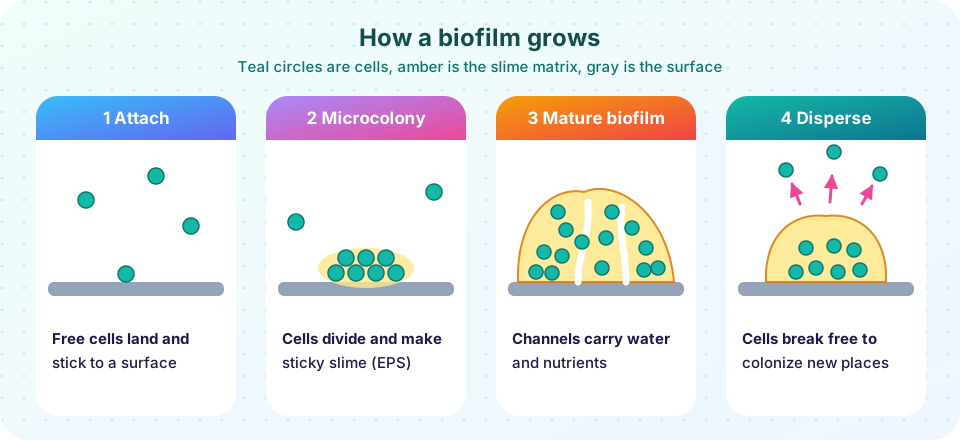
In a stream, on a tooth or inside a pipe, cells that touch a surface can change from free-swimming (planktonic) to attached. The biofilm life cycle has four stages (see the picture):
- Attachment. Free cells land on a surface and stick weakly, using pili and flagella.
- Microcolony. They stick irreversibly, divide, and begin to secrete the EPS matrix.
- Maturation. The community grows into a three-dimensional structure with water channels that carry nutrients in and waste out. Different species may take different roles, and deeper cells may be nearly dormant.
- Dispersal. Cells or clumps break away to settle somewhere new.
Biofilms matter because they are everywhere: dental plaque, the slime on river stones, scum in water pipes, and films on catheters and artificial joints. Cells inside a biofilm are often far more tolerant of antibiotics and disinfectants than the same cells floating free. Reasons include a matrix that slows drugs from reaching the cells, slow growth deep inside the film, and specialized "persister" cells. This is why many chronic infections are hard to clear and why biofilm control is a major research topic in medicine and industry.
Quorum sensing
Cells in a biofilm coordinate their behavior. In quorum sensing, each cell releases small signal molecules (autoinducers). In a sparse population the signal is washed away and stays at a low level. As the population grows, the signal accumulates, and once its concentration passes a threshold the cells switch on a group of genes together.
The textbook example is Aliivibrio fischeri (also called Vibrio fischeri), which lives in the light organ of the Hawaiian bobtail squid. A single cell in the open sea makes no light. In the dense colony of the squid's organ the autoinducer builds up and the bacteria switch on genes for bioluminescence, producing a glow the squid uses to hide its shadow. Many pathogens use quorum sensing to delay the release of toxins until there are enough cells to overwhelm the host. Gram-negative bacteria often use small lipid-based signals (acyl-homoserine lactones); Gram-positive bacteria often use short peptides.
The same logic can be written as a short model: the population grows, signal is made in proportion to cell number and slowly breaks down, and the response gene follows a switch-like curve of signal concentration. This is a model with invented constants, not data from any organism.
Press Run (or Ctrl + Enter) to see the result here.
Program input · what you'd type while the program runs
Type the answers before you press Run, one per line. Each time the program reads a line (with input()), it gets the next line from this box.
The microbiome
Your body hosts a vast microbial community, the microbiome: bacteria, archaea, fungi and viruses on the skin, in the mouth and above all in the large intestine. Careful estimates suggest that an adult carries roughly as many bacterial cells as human cells, with the gut community weighing around a kilogram or less. These microbes help digest fiber, make vitamins such as vitamin K, train the immune system and crowd out pathogens. Their members depend on each other: in anaerobic digestion, fermenting bacteria release hydrogen, which methanogenic archaea consume, a partnership called syntrophy. Disturbance of the community (for example, by broad-spectrum antibiotics) can open the door to opportunists such as Clostridioides difficile.
Common misconceptions
"Protists are tiny animals or plants." They are in their own scattered groups; some behave like animals (eating food) and some like plants (photosynthesizing), and some do both.
"Biofilms are just dirt." They are organized communities with structure, division of labor and chemical communication.
"Quorum sensing means bacteria can count." Cells do not count; the signal concentration rises with population density and cells respond to it.
Check your understanding
Quick check · 5 questions
of 5 answered You scored / 5 · perfect!
-
1. Which protist group moves using cilia?
Ciliates, such as Paramecium, are covered with beating cilia. -
2. In a biofilm, what is EPS?
Extracellular polymeric substances form the matrix that holds the community together. -
3. Why does a single Vibrio fischeri cell in open sea water not glow?
Bioluminescence is switched on when signal accumulates at high cell density. -
4. Which is a typical reason biofilm cells survive antibiotics better than free cells?
The slime slows penetration, and slow or dormant cells are less affected by drugs that target growth. -
5. Phytoplankton are important because they...
They photosynthesize and form the base of marine food webs.
Summary
- Protists are a scattered collection of mostly single-celled eukaryotes: amoebae, flagellates, ciliates, apicomplexans and algae.
- Phytoplankton contribute much of the world's photosynthesis; protozoa graze on bacteria.
- Biofilms form in four stages and protect their cells; they are central to chronic infections and industrial fouling.
- Quorum sensing lets a population change behavior when signal levels show that many cells are present.
- The human microbiome is a community whose members feed and constrain one another.
Track your progress
Create a free account to tick off lessons and pick up where you left off on any device.
of Microbiology lessons completed