


















Lesson 23 of 45 · Viruses
Chapter 5 overview: Viruses
Meet the viruses: particles too small for a light microscope that cannot live on their own. See how big they are, what this chapter covers and why they matter.
Everything you have met so far in this course is a cell. Bacteria are cells, yeasts are cells, and so are you. Viruses are different. A virus is not a cell, has no metabolism of its own and cannot grow or divide by itself. It is a package of genetic material in a protein coat, and it only does anything once it gets inside a living cell and borrows that cell's machinery.
That strange in-between status makes viruses one of the most interesting topics in biology. They cause some of the oldest and most feared diseases, from the common cold to smallpox and influenza. They are also the most abundant biological entities on Earth, they shape ocean ecosystems, they move genes between species, and we now use them as tools for vaccines, gene therapy and fighting resistant bacteria.
What you will learn
- Why virologists call viruses "obligate intracellular parasites" and why they are not classed as living cells
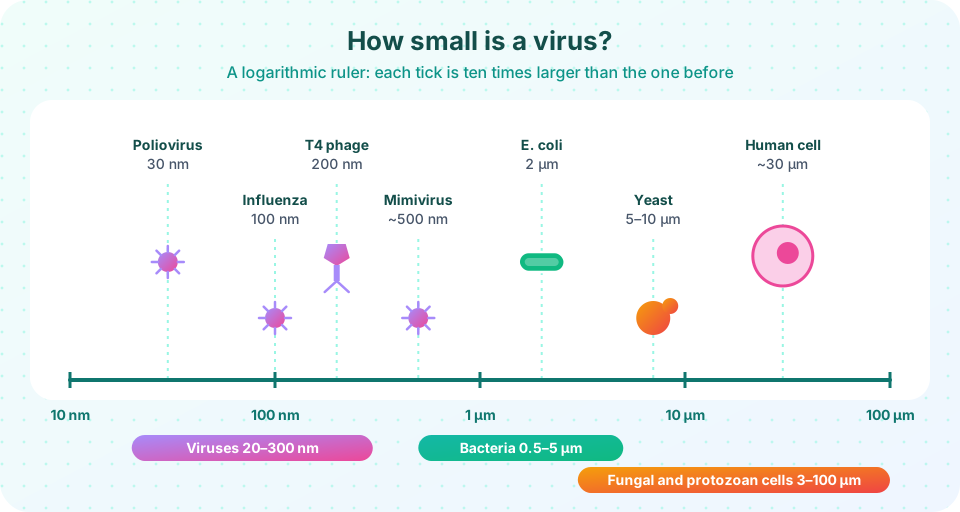
- How small viruses are, and how scientists first proved they existed
- What the lessons in this chapter cover and how they fit together
- Why a virus can matter to an ecosystem as much as to a patient
Key terms
Virus: a non-cellular infectious particle made of a nucleic acid genome inside a protein coat.
Virion: one complete, infectious virus particle outside a host cell.
Host: the living organism, or the cell, that a virus infects.
Obligate intracellular parasite: an agent that can only reproduce inside a host cell.
Bacteriophage (phage): a virus that infects bacteria.
The big picture
A useful way to see a virus is as information with a delivery system. The genome carries instructions, written in DNA or RNA. The coat protects the genome and, in many cases, recognizes the right kind of cell and helps the genome get in. Once inside, the instructions hijack the host's ribosomes, enzymes and energy supply to make new copies of the genome and new coat proteins. The copies assemble into new virions, which leave the cell and start again.
Everything else about viruses follows from this simple cycle. Because they depend on a host, each virus infects only certain species, and usually only certain cell types: a plant virus does not infect you, and a bacteriophage does not infect your cells, although both are all around you. Because they have no metabolism, antibiotics do nothing to them, since antibiotics attack bacterial processes that viruses do not have. And because many of them copy their genomes with error-prone enzymes, they mutate quickly, which is why you need a new flu vaccine most years.
How scientists found something they could not see
Light microscopes cannot see most viruses, so the first evidence was indirect. In 1892 the Russian botanist Dmitri Ivanovsky showed that the sap from diseased tobacco plants stayed infectious after being passed through a filter fine enough to hold back bacteria. In 1898 the Dutch microbiologist Martinus Beijerinck repeated and extended the work and decided the cause was not a bacterium but a new kind of infectious agent that needed living tissue to multiply. In 1915 and 1917 Frederick Twort and Félix d'Hérelle independently found viruses that destroy bacteria, which d'Hérelle named bacteriophages. In 1935 Wendell Stanley crystallized tobacco mosaic virus, a surprise because crystals are usually made of simple chemicals, and the first electron-microscope pictures of viruses followed in the late 1930s.
A tour of the chapter
The chapter has three parts, each building on the last.
- Structure and classification shows what a virion is made of: the four main body plans, the many kinds of genome, how giant viruses break the old size rules, and how the Baltimore system sorts viruses by the way they make messenger RNA. It also introduces two even simpler agents, viroids and prions.
- Replication cycles follows a virus from first contact to release: attachment, entry, copying, assembly and exit. You will compare the lytic and lysogenic cycles of bacteriophages, see how animal viruses differ, and learn how scientists count viruses with plaque assays.
- Chapter review pulls everything into one picture and a ten-question quiz.
What is a virus?
How small?
One basic cycle
Lytic phages end it with a burst
Why they matter
Why viruses matter beyond disease
Viral diseases get the headlines, but disease is only one side of the story. In seawater there are typically millions of virus particles in every milliliter, and the great majority infect bacteria and other microbes. By destroying a fraction of the microbial population every day, these phages release nutrients back into the water and influence how much carbon sinks to the deep ocean. In your own gut, phages help regulate which bacteria thrive. About eight percent of human DNA comes from ancient retrovirus infections that became part of our genome, and one such gene, syncytin, helps form the placenta. And in medicine, viruses are engineered into vaccines, into vectors that deliver genes, and into phage therapies that can attack bacteria that antibiotics no longer kill.
Common misconceptions
"Viruses are tiny bacteria." They are not. Bacteria are cells that eat, grow and divide. Viruses are non-cellular and reproduce only inside a host.
"Antibiotics kill viruses." They do not. Antibiotics target bacterial structures and enzymes. Viral infections are prevented with vaccines and, for some viruses, treated with specific antiviral drugs.
"All viruses are dangerous." Almost all viruses on Earth infect bacteria, archaea, plants, fungi or animals other than humans. Only a small fraction cause human disease.
Try it
The first demonstration is a calculator that shows how much space the size difference represents. Drag the sliders to change the diameter of the virus and of the bacterium, then see how many virus particles would fit inside the bacterium by volume.
The second demonstration plots the sizes of familiar particles on a logarithmic axis, so you can see why viruses need electron microscopes. The numbers are typical rounded values, and real particles vary.
Press Run (or Ctrl + Enter) to see the result here.
Program input · what you'd type while the program runs
Type the answers before you press Run, one per line. Each time the program reads a line (with input()), it gets the next line from this box.
Check your understanding
Quick check · 5 questions
of 5 answered You scored / 5 · perfect!
-
1. Why is a virus called an obligate intracellular parasite?
A virus has no metabolism or ribosomes of its own, so it can only make more virus by using a host cell's machinery. -
2. What did Ivanovsky and Beijerinck show about the cause of tobacco mosaic disease?
The infectious sap stayed infectious after filtration through bacteria-proof filters, and Beijerinck concluded it was a new kind of agent that needed living tissue. -
3. Which statement about antibiotics and viruses is correct?
Antibiotics hit bacterial cell walls, ribosomes and enzymes, none of which a virion contains. -
4. A bacteriophage is a virus that infects what?
Phage means bacteria eater: it is a virus whose host is a bacterial cell. -
5. Roughly how large is a typical virus compared with a typical bacterium?
Most viruses are 20 to 300 nm across, while typical bacteria are 1,000 to several thousand nm long.
Summary
- A virus is a non-cellular particle: a DNA or RNA genome in a protein coat, sometimes inside a lipid envelope.
- Viruses are obligate intracellular parasites. They have no metabolism and reproduce only inside host cells.
- Most are 20 to 300 nm across, so they need an electron microscope. They were first detected by filtration experiments in the 1890s.
- Viruses are the most abundant biological entities, shape ecosystems, and are tools as well as threats.
- This chapter covers structure and classification, replication cycles, and a review.
Track your progress
Create a free account to tick off lessons and pick up where you left off on any device.
of Microbiology lessons completed